
September 4, 2026
Vanlife Without Gas? What Our Camper Electrical System Does All Day
Vanlife ohne Gas? Unsere Camper-Elektrik im Alltag

We have been living off-grid in Humbär for more than a year and a half now. Thanks to our electrical system, we run ordinary household appliances on the road - an induction cooktop and an espresso machine. A fridge with its own freezer and Starlink are part of our everyday life too.
Are you sizing up the electrics for your own van conversion right now? Then maybe you will find a few pointers here from our daily life: what do we actually use? How much solar comes in? And is a 5 kWh battery really enough for a life without gas and without being permanently plugged in?
Cooking in a van without gas - is that possible?
No appetite for a gas inspection, for refilling gas tanks, or for hunting down the right gas adapter? That is why we, too, decided from the very beginning to travel without gas in the van.
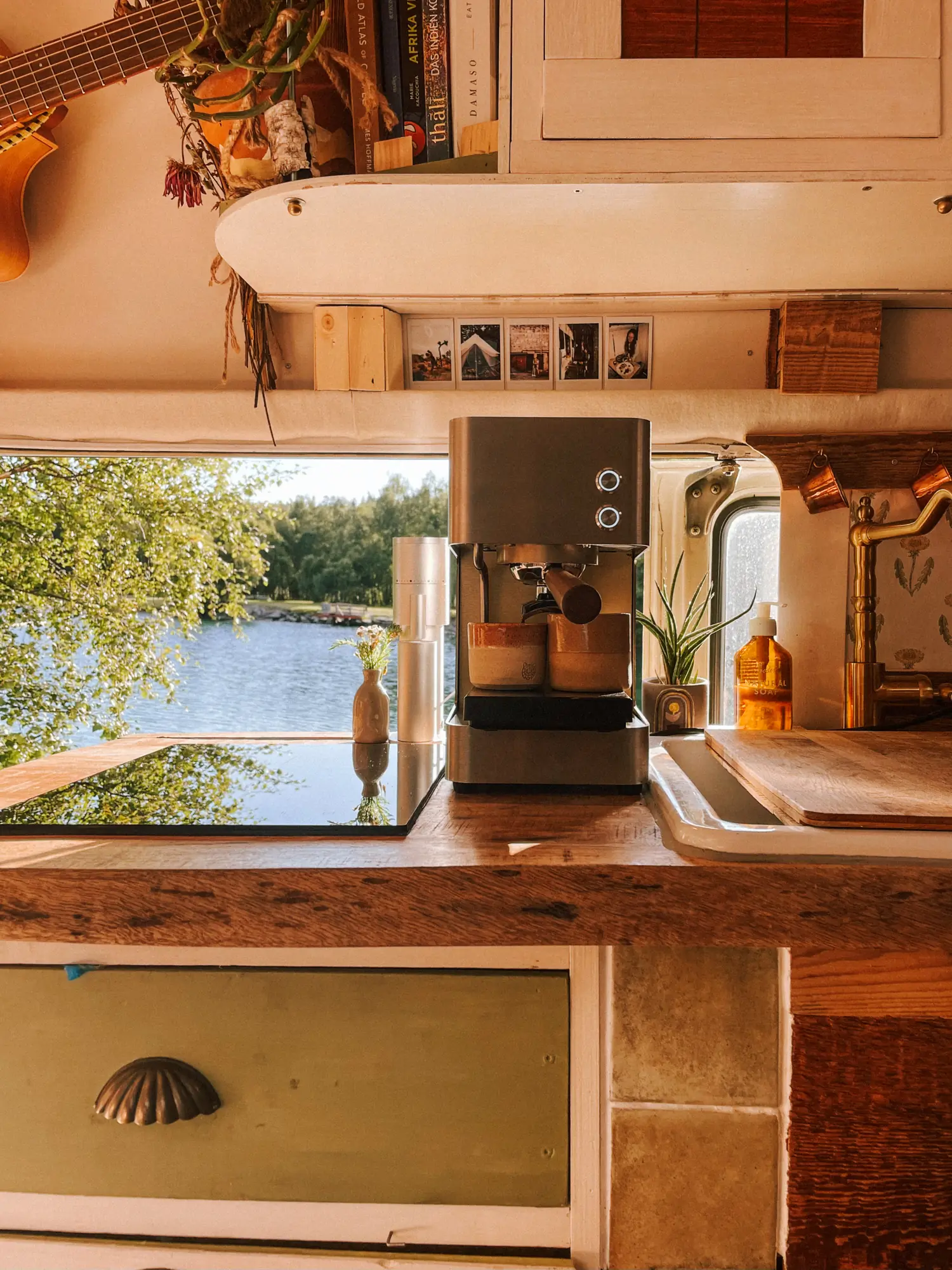
In our van Humbär we cook exclusively with an induction cooktop. We use an ordinary household unit from IKEA, which we built into the countertop. Thanks to induction we can cook quickly and comparatively efficiently.
Our cooktop draws 2000 W on its highest setting. We installed an inverter - the inverter turns 24 V DC battery voltage into 230 V AC outlet voltage - which is rated at 2000 W but can only be run continuously at 1500 W. So that we don't overload the inverter, we cook at the second-highest setting at most. That works surprisingly well for us: water boils quickly, and in normal cooking we don't miss the full power at all.
And the best part: we need no gas bottle, no gas locker and no gas inspection.
Which electrical appliances do we have in the camper?
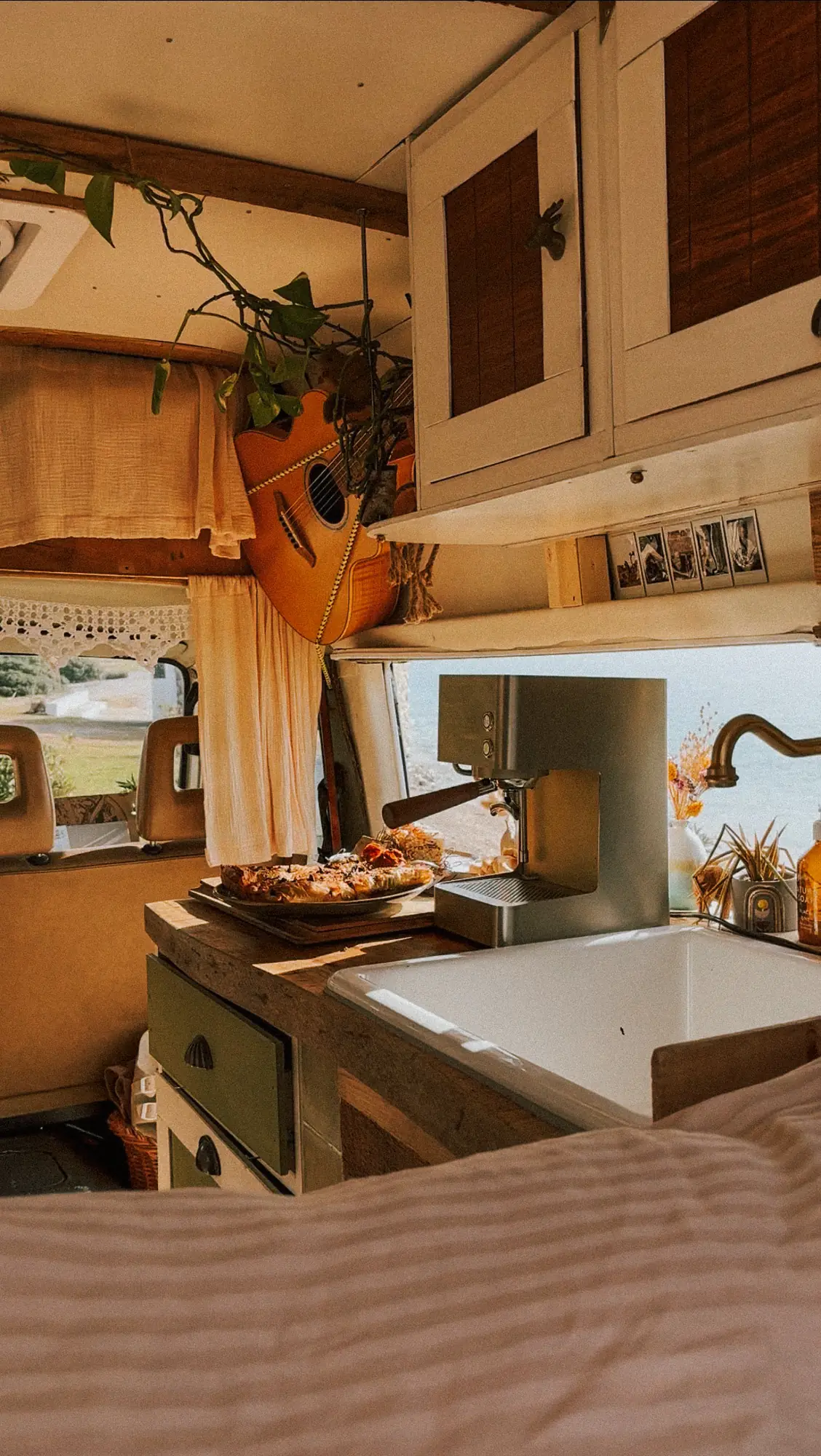
The hungriest appliances live in our van's kitchen: an electric cooktop (up to 2000 W), a coffee machine (up to 1800 W), a kettle (up to 1850 W) and a fridge (up to 70 W while cooling down, more like 20 W in normal operation). On top of that there is even a portable oven (up to 1300 W) and a food processor (up to 250 W).
So really, everything just like at home.
Since we also work from the road, we run Starlink from the outlet as well (around 20 W in normal operation), have a Marshall speaker (max. 35 W) and various chargers for laptop (65 W), phone (15 W), camera, drone, batteries, toothbrush and power bank.
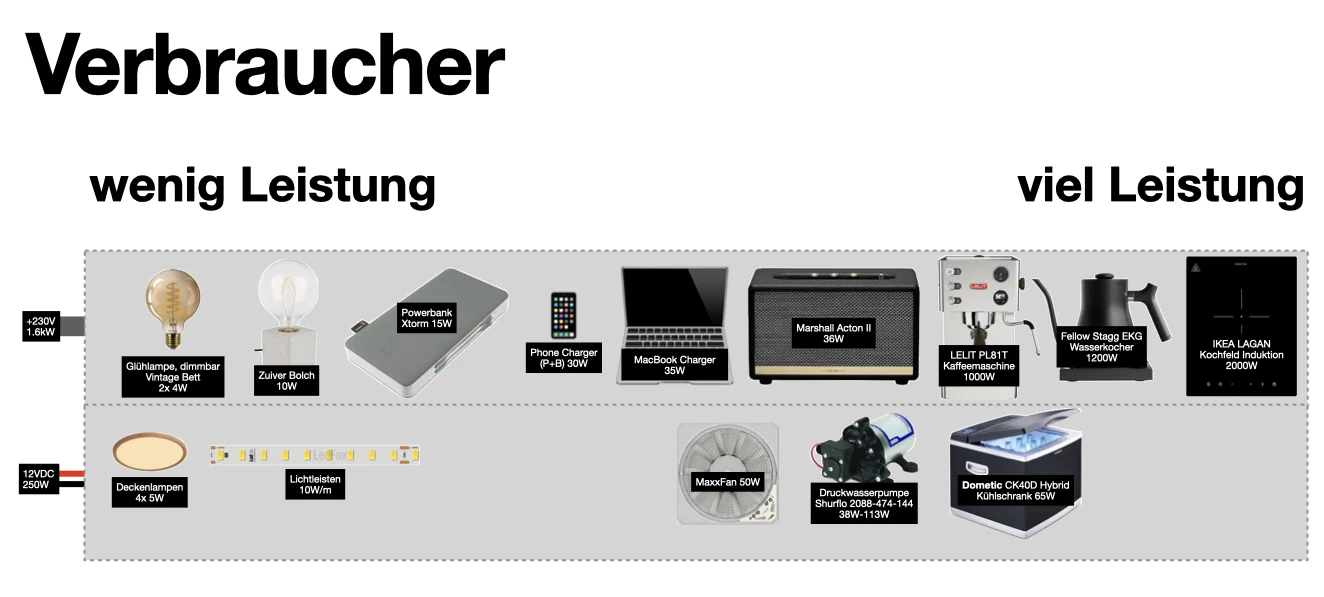
Our consumers, sorted from little to a lot of power - everything on 230 V along the top, the 12 V side underneath
Apart from the fridge, all appliances run on ordinary household 230 V. The fridge is connected to 12 V through a DC/DC converter. The same goes for other camping-specific equipment such as our composting toilet, the roof fan (MaxxFan), the tank gauge, the water pump and all the LED lights in the van.
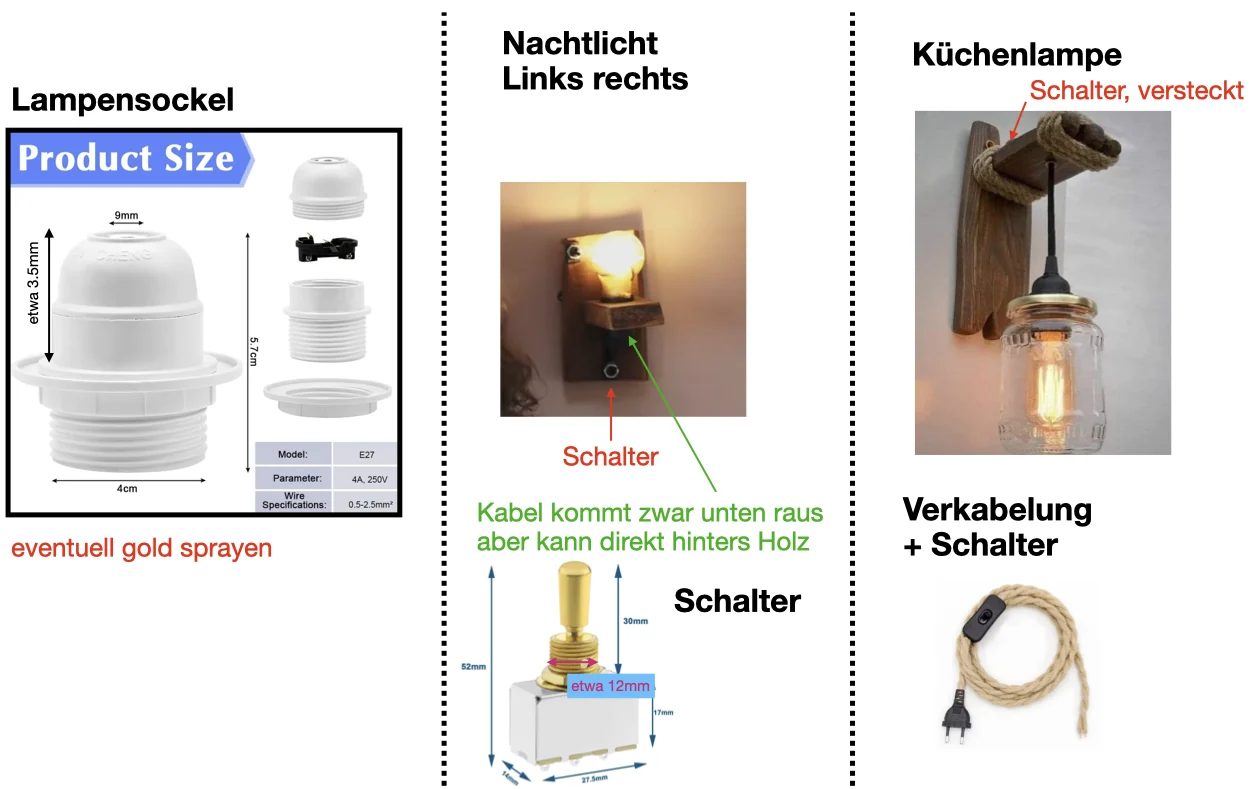
The little lamps started on paper too - hidden switches included
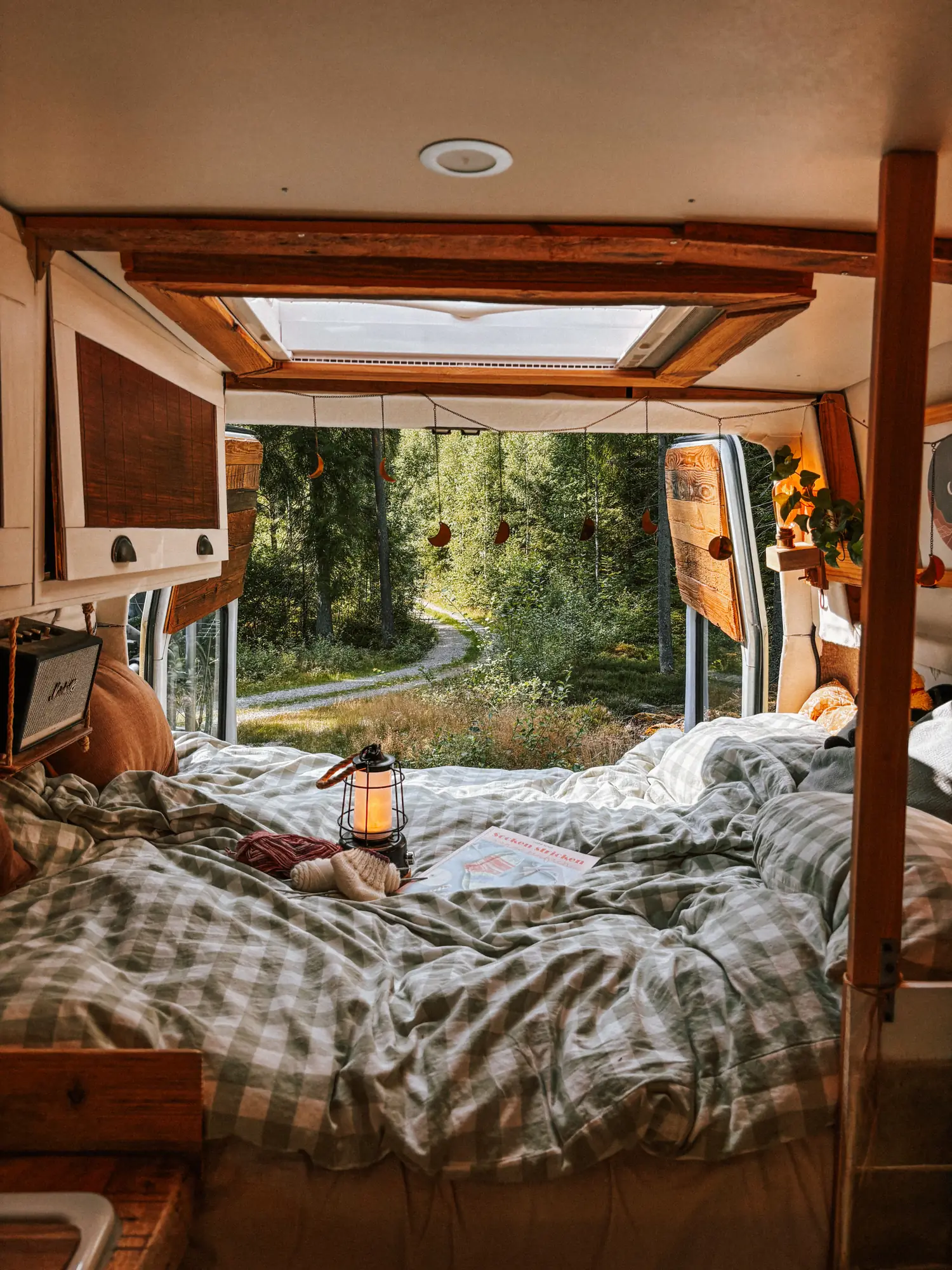
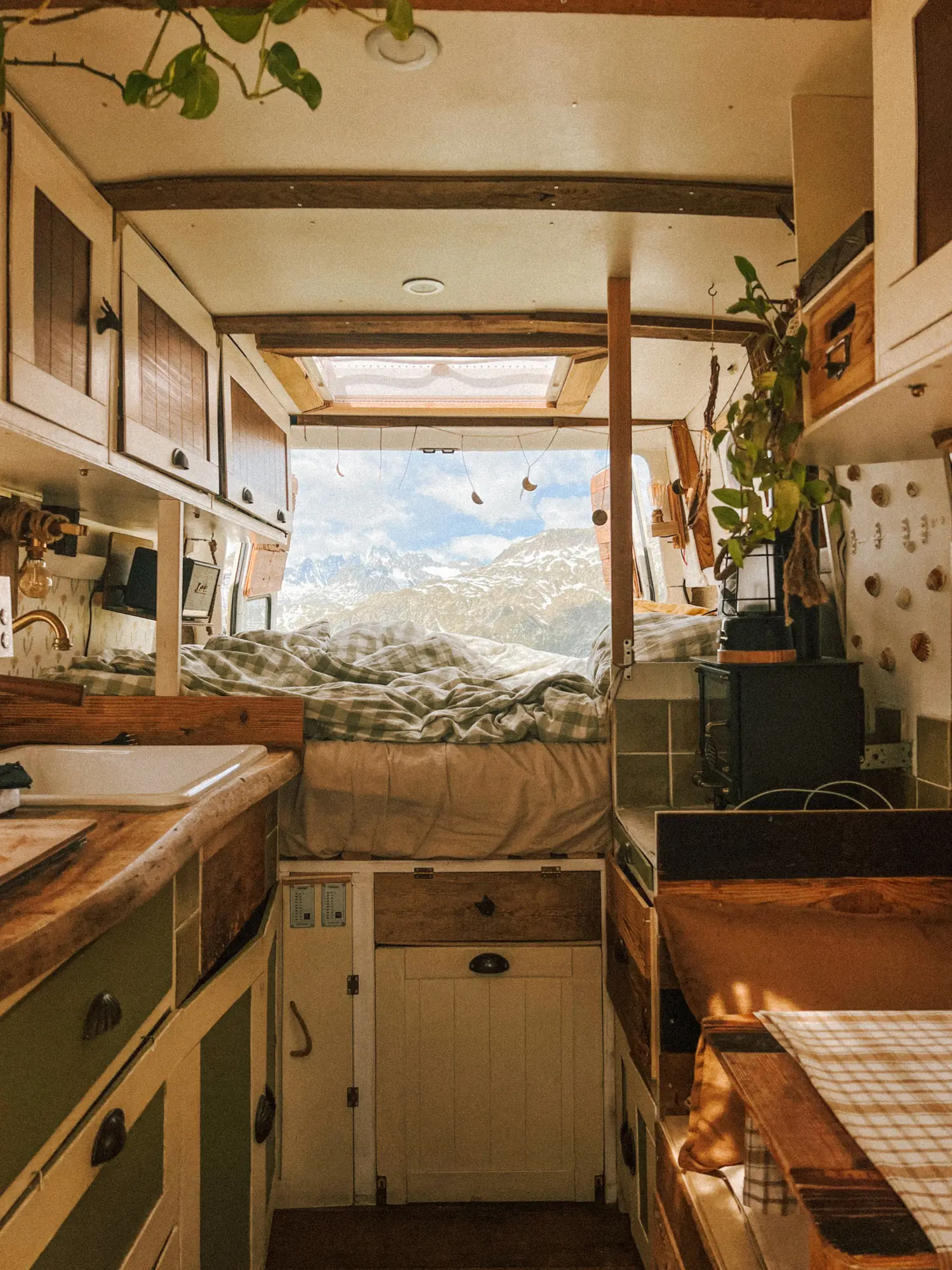
What is interesting here: the maximum power of an appliance doesn't say all that much about our actual daily consumption. A cooktop may draw 2000 W - but if it only runs for 20 minutes, it uses considerably less energy than a small consumer that runs for 24 hours.
That is exactly the difference between power and energy: watts describe how much an appliance pulls in a given moment. Watt-hours describe how much it actually uses over time. And only the latter decides whether our battery still has something left in the evening.
How much electricity does a van need per day?

We usually cook once a day - in the evening, and then quite happily something tasty and elaborate. For that we budget roughly 1 kWh of cooking, with our cooktop running around 30 minutes on medium heat. A lasagne takes more electricity than a couscous salad, that much is obvious.
On particularly abundant days we like to allow ourselves some baking. That adds at least 1-1.5 kWh.
For a matcha latte for two in the morning, a cappuccino for two and some tea, we budget about 200 Wh a day.
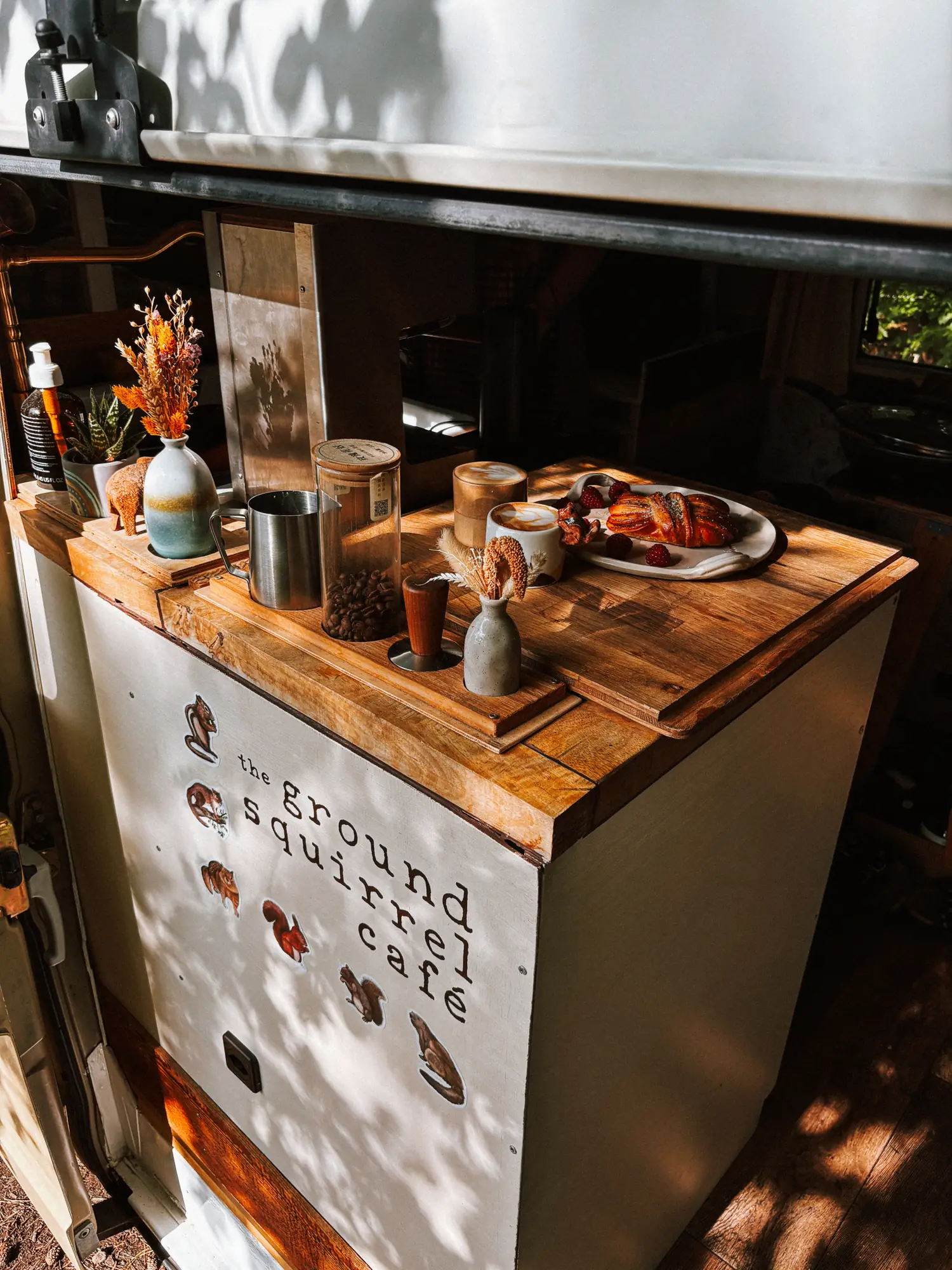

Our fridge has two separate compartments. The freezer runs at -18 °C, the fridge at 6 °C. Holding those temperatures in typical European weather (around 15 °C) uses up to 400 Wh a day.
For Starlink we budget about 250 Wh a day, since we usually switch the internet off in the evening.
Things that barely register: charging laptops, charging phones, and the van electrics for lights, composting toilet and MaxxFan.
Our rough daily consumption
Adding up these big consumers, an ordinary day lands us at around 1.85 kWh:
- Cooking: approx. 1000 Wh
- Coffee, matcha & tea: approx. 200 Wh
- Fridge & freezer: up to 400 Wh
- Starlink: approx. 250 Wh
- Everything else: comparatively little
On a baking day the oven alone can add another 1-1.5 kWh. And on a long working day with a lot of coffee, a lot of internet and a warm shower, that quickly becomes double. An average is only ever an average.
How do you size the electrics for a camper?
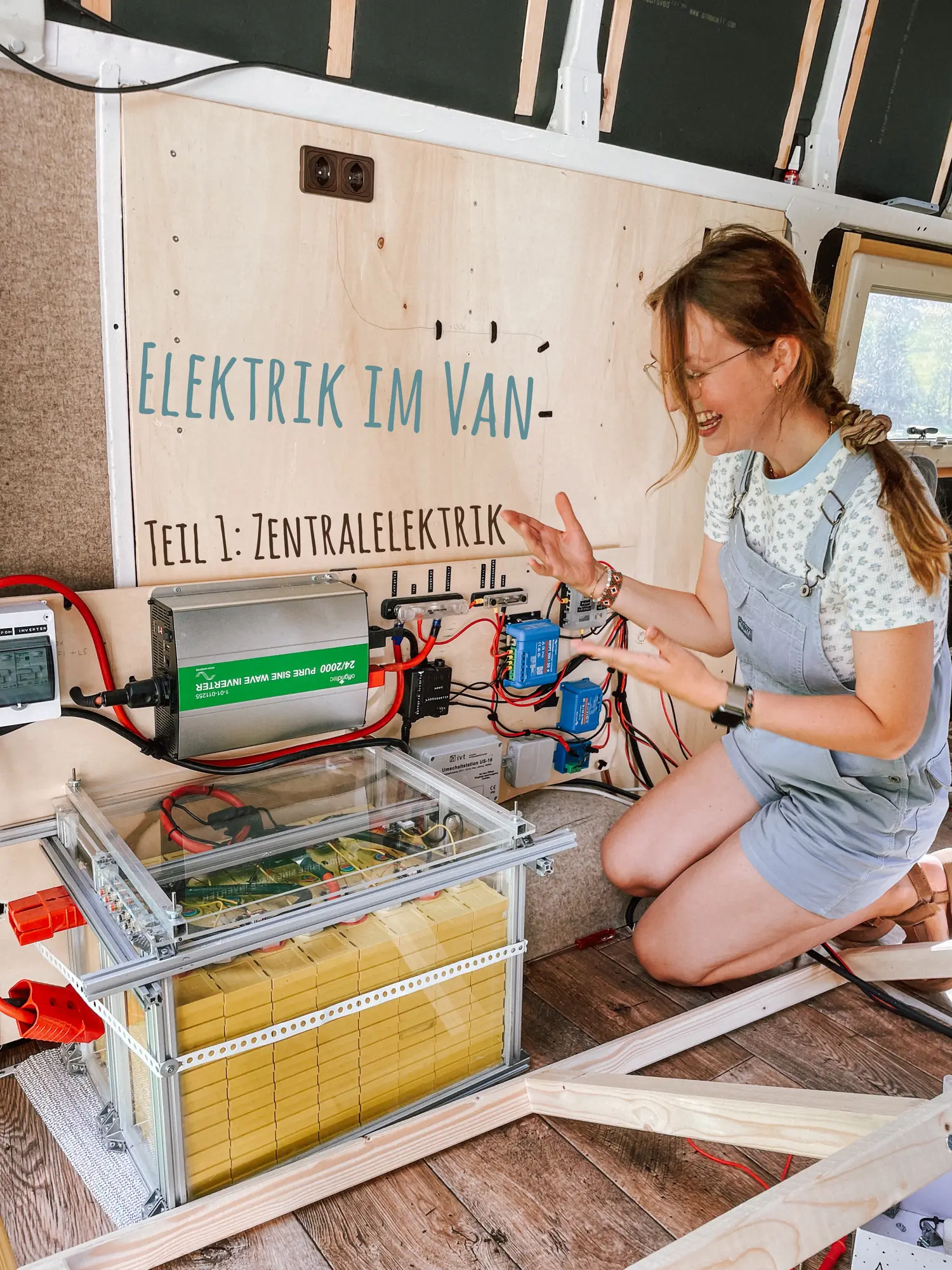
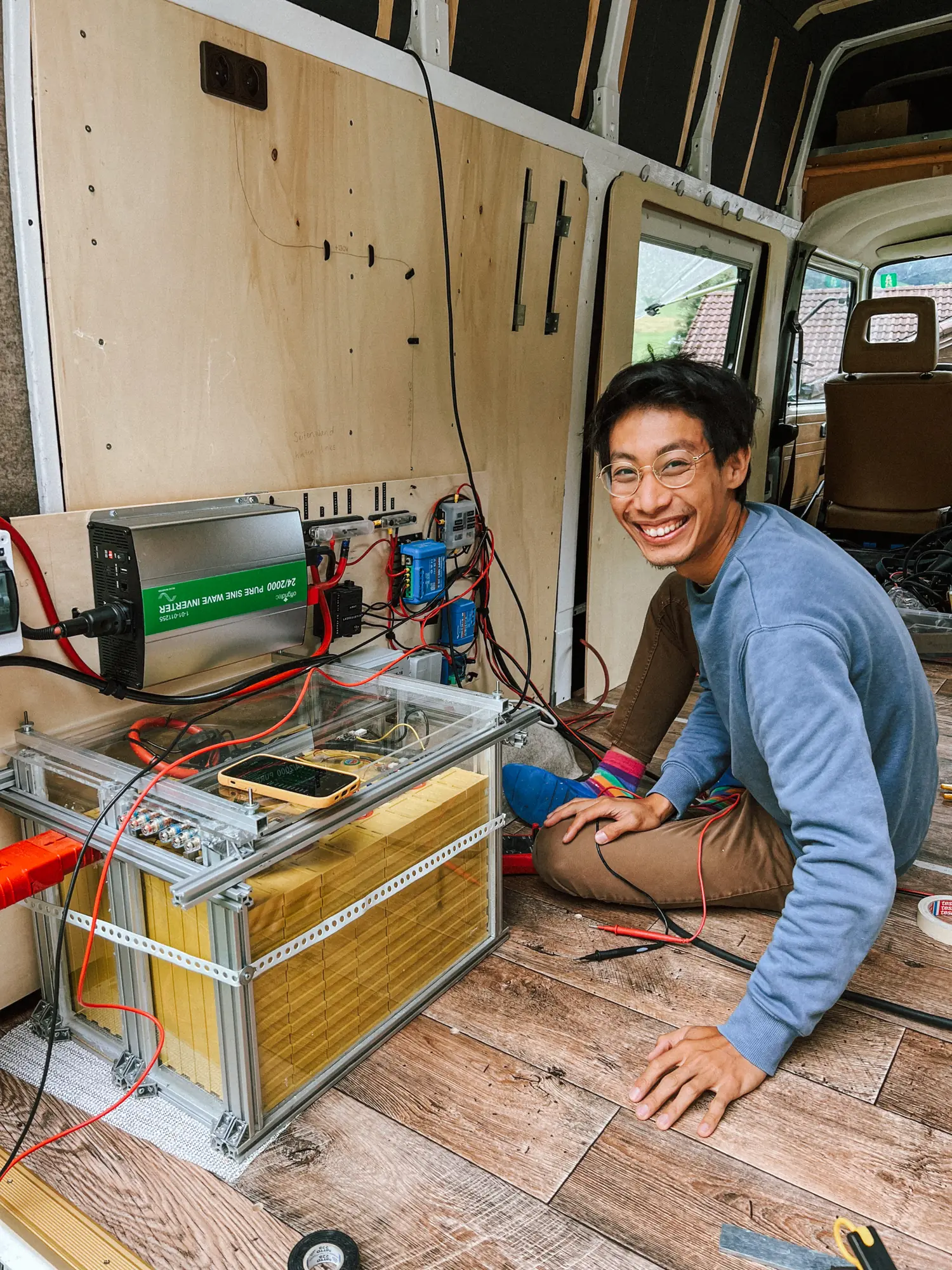
Our sizing is the result of roof area, budget and need. We decided on a LiFePO4 battery from the very start. It is lighter than AGM, and you can genuinely use a large part of its capacity.
Frank assembled our battery from eight individual 200 Ah cells. The cells are wired in series. That gives us a 24 V system with 200 Ah - around 5 kWh of storage.
Nerd talk: yes, exactly - 24 V!
At the same power, roughly half as much current flows at 24 V as at 12 V. The lower the current, the lower the losses in the cables, and the smaller the required cable cross-section can be - given the same permissible heating and the same voltage drop.
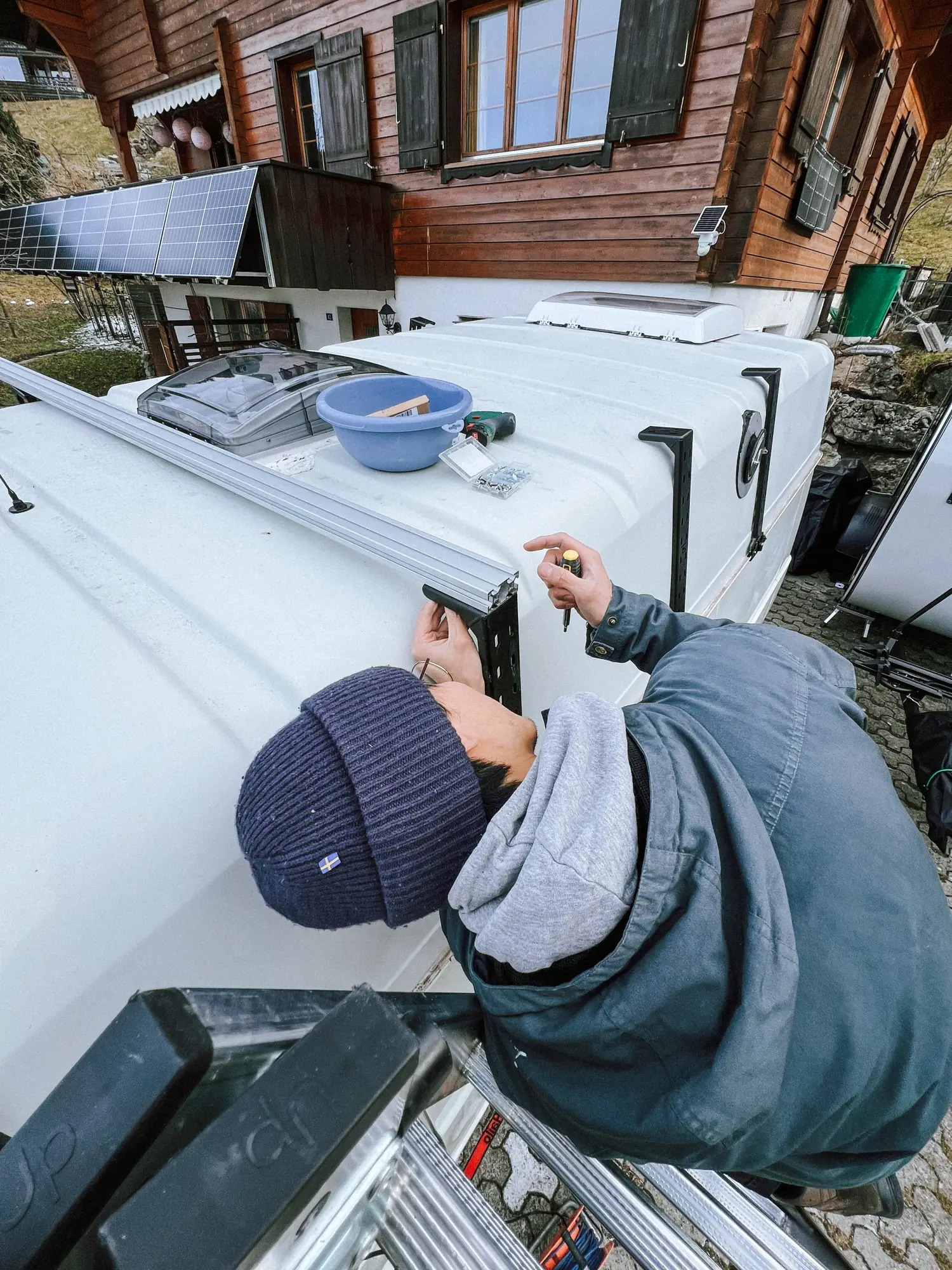
We installed rigid solar panels. For that we measured the roof very precisely, bought a matching roof rack and planned the entire roof accordingly.
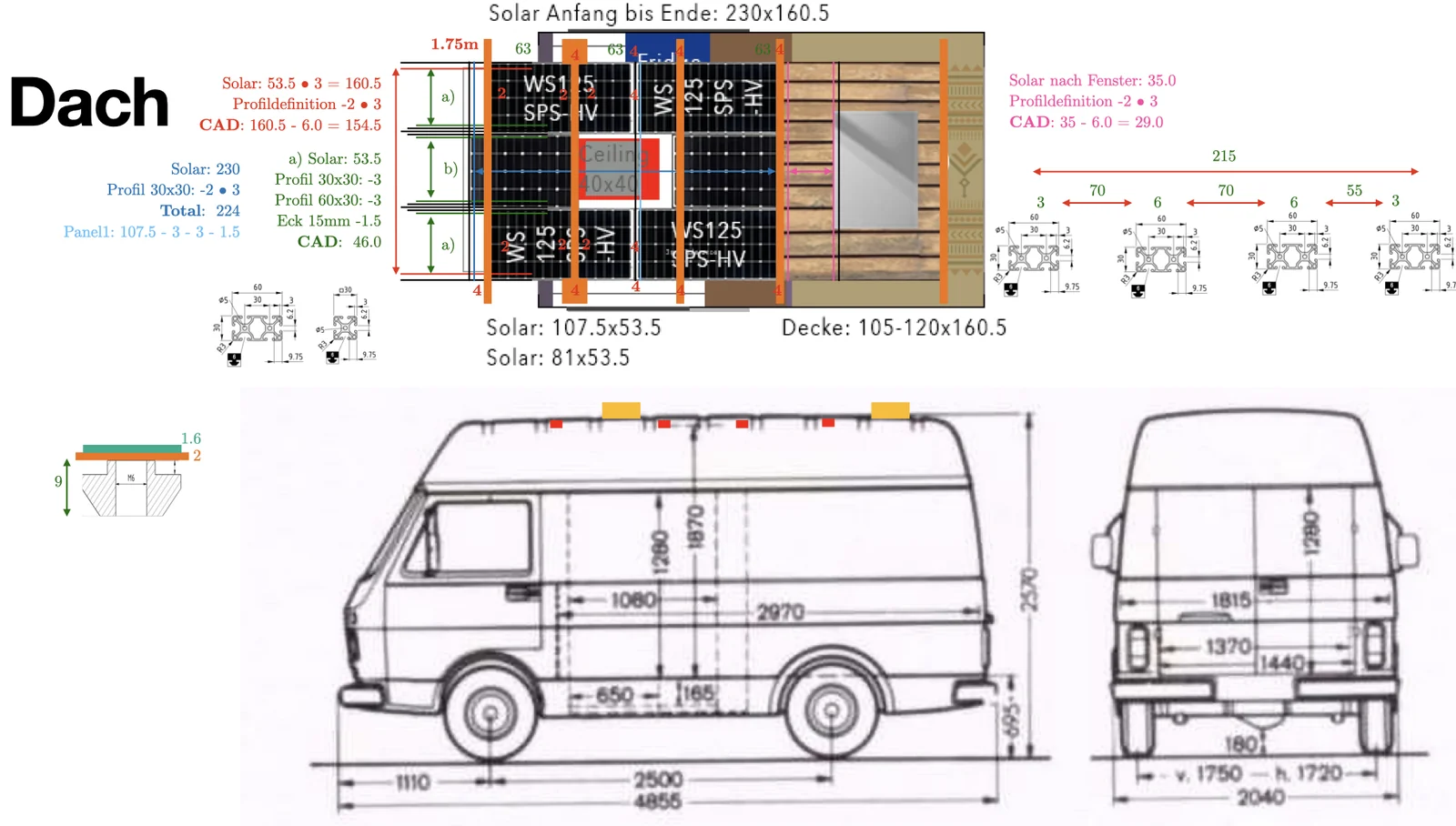
Every centimeter of roof is planned before the first hole is drilled
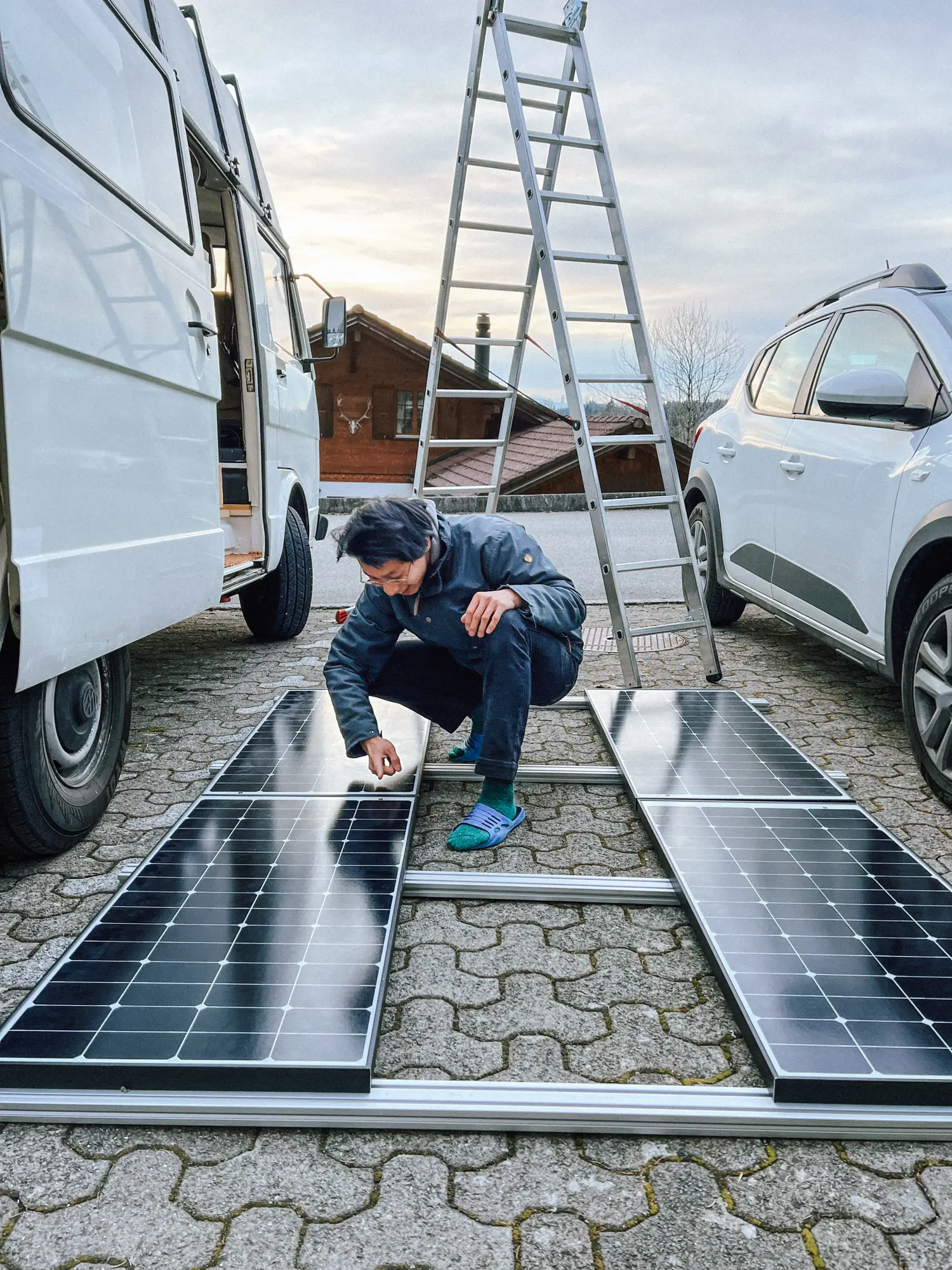
Because we have a roof hatch and a MaxxFan installed, the free, continuous area for solar panels shrinks considerably. We got the best use out of the remaining space with four 125 Wp solar panels from Wattstunde. That gives us a maximum rated output of 500 Wp. The four panels are wired in parallel and bolted firmly to four aluminum profiles on the roof rack.
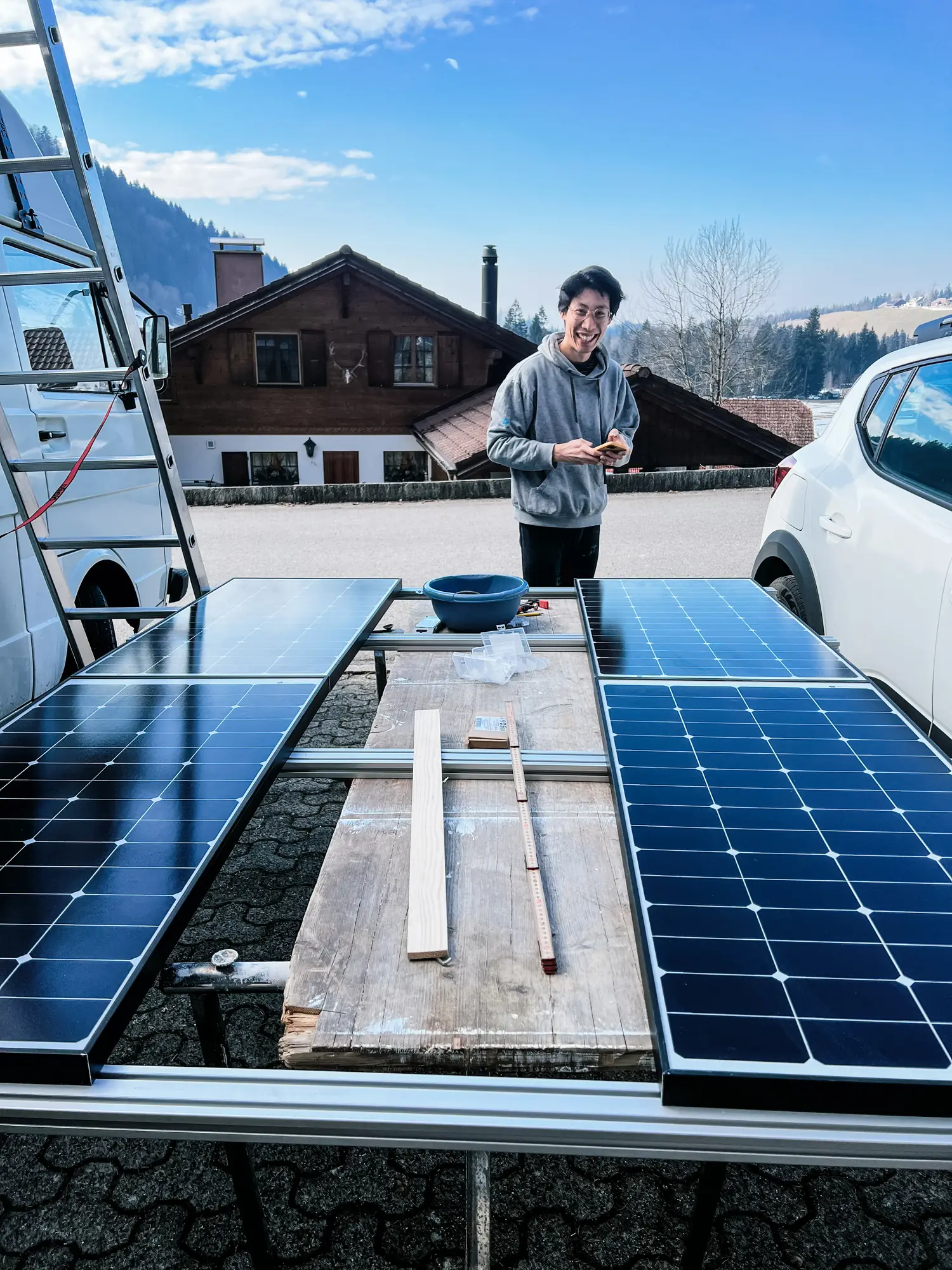
The solar panels charge our 5 kWh LiFePO4 battery through a charge controller (Victron SmartSolar MPPT 100/20). We also have a charge booster (Victron Orion-Tr 12/24 15 A) that charges Humbär while we drive.
More recently we also installed a battery charger, which lets us charge our LiFePO4 battery as soon as Humbär is plugged into shore power.
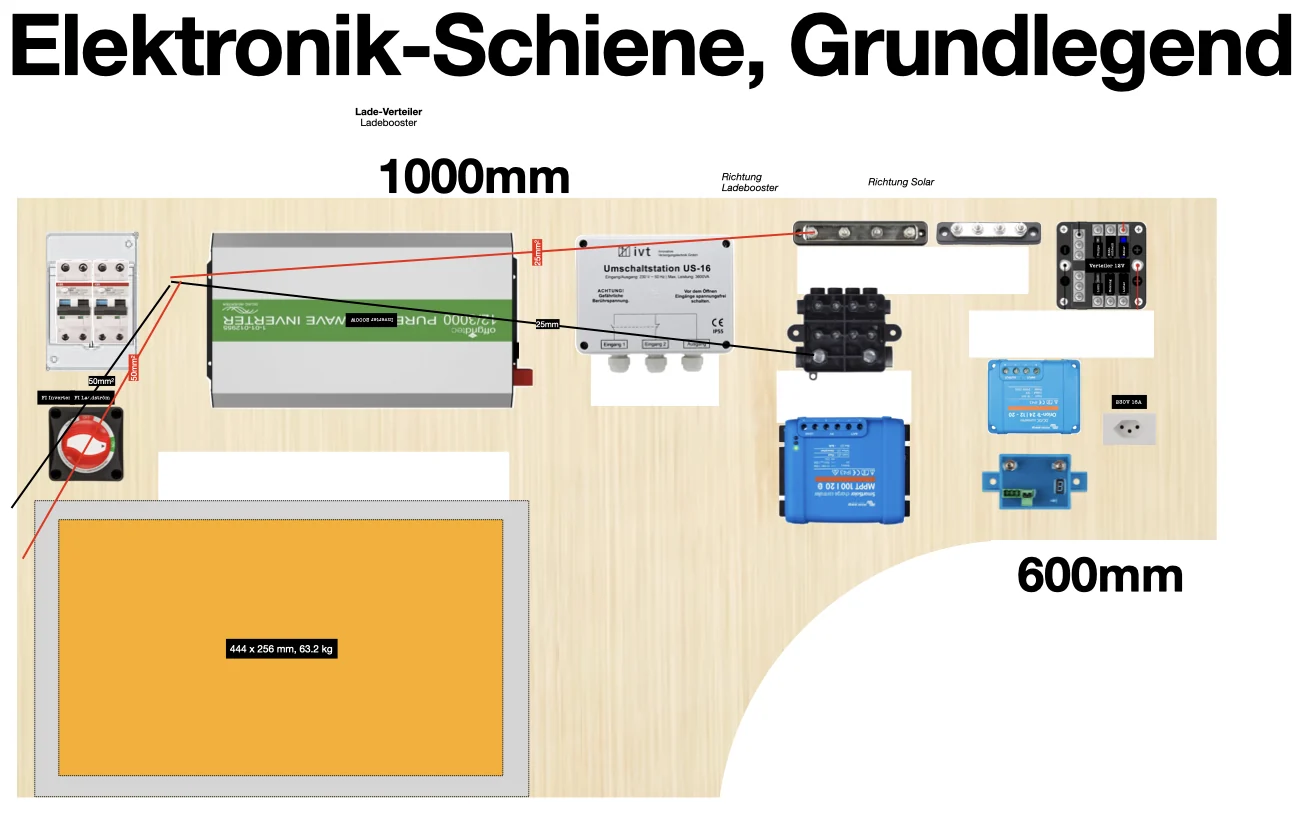
First planned onto 1000 × 600 mm …
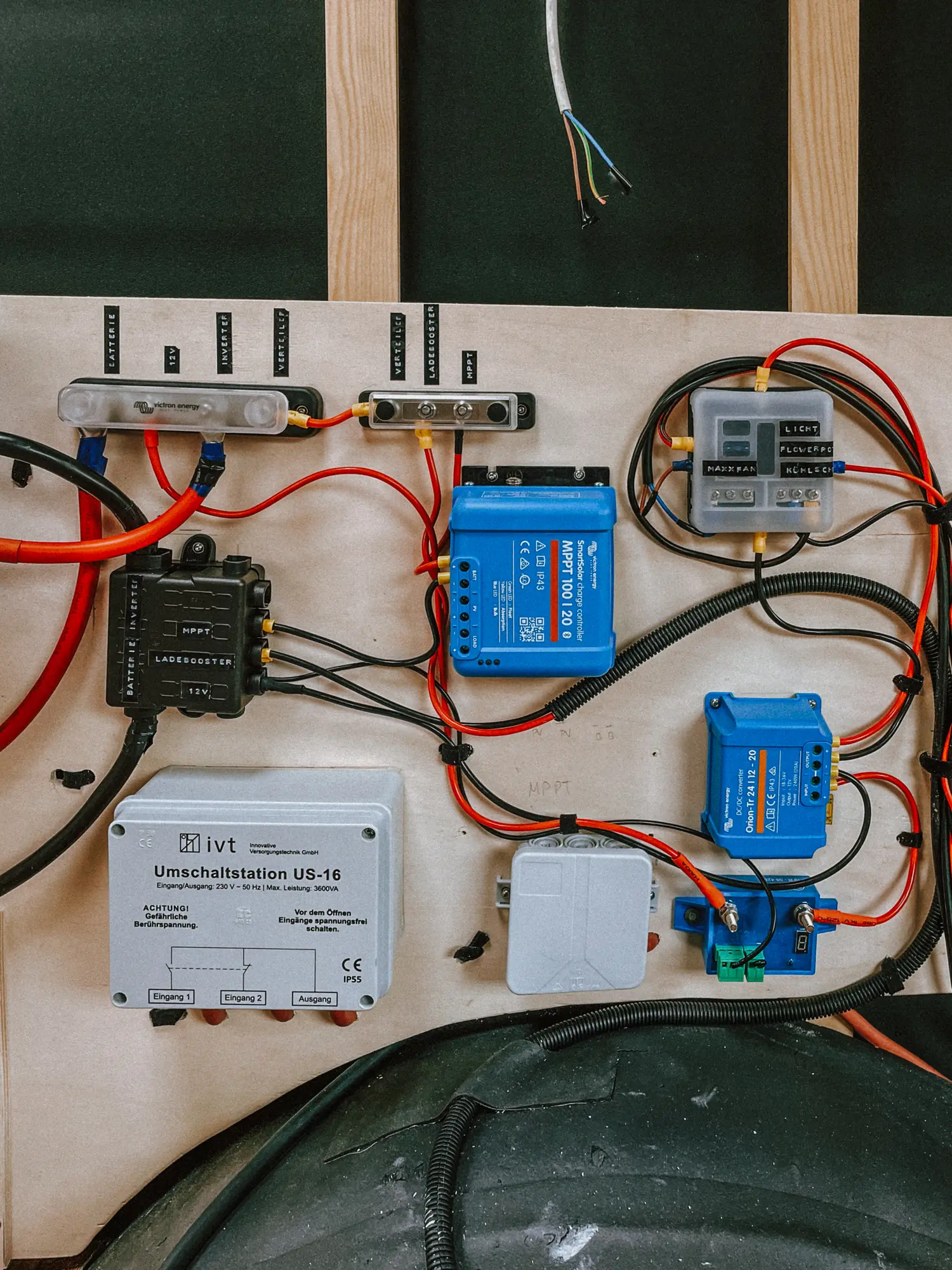
To turn 24 V DC battery voltage into 230 V AC outlet voltage, we use an inverter (Offgridtec PSI Sinus 2000 W). It can supply appliances with 1500 W continuously, 2000 W for up to 30 seconds and 3000 W for a very short moment.
That is just about enough for everything from the induction cooktop to the coffee machine - but not enough to run two big consumers at the same time.
Our 230 V AC cables are H07RN-F 3 × 2.5 mm² and fused at 16 A. We installed Swiss type J outlets. That is enough to run appliances up to 3680 W when shore power is connected.
A transfer switch makes sure that shore power really is the source in that case: as soon as shore power is present, the battery and inverter supply is disconnected and shore power takes priority.
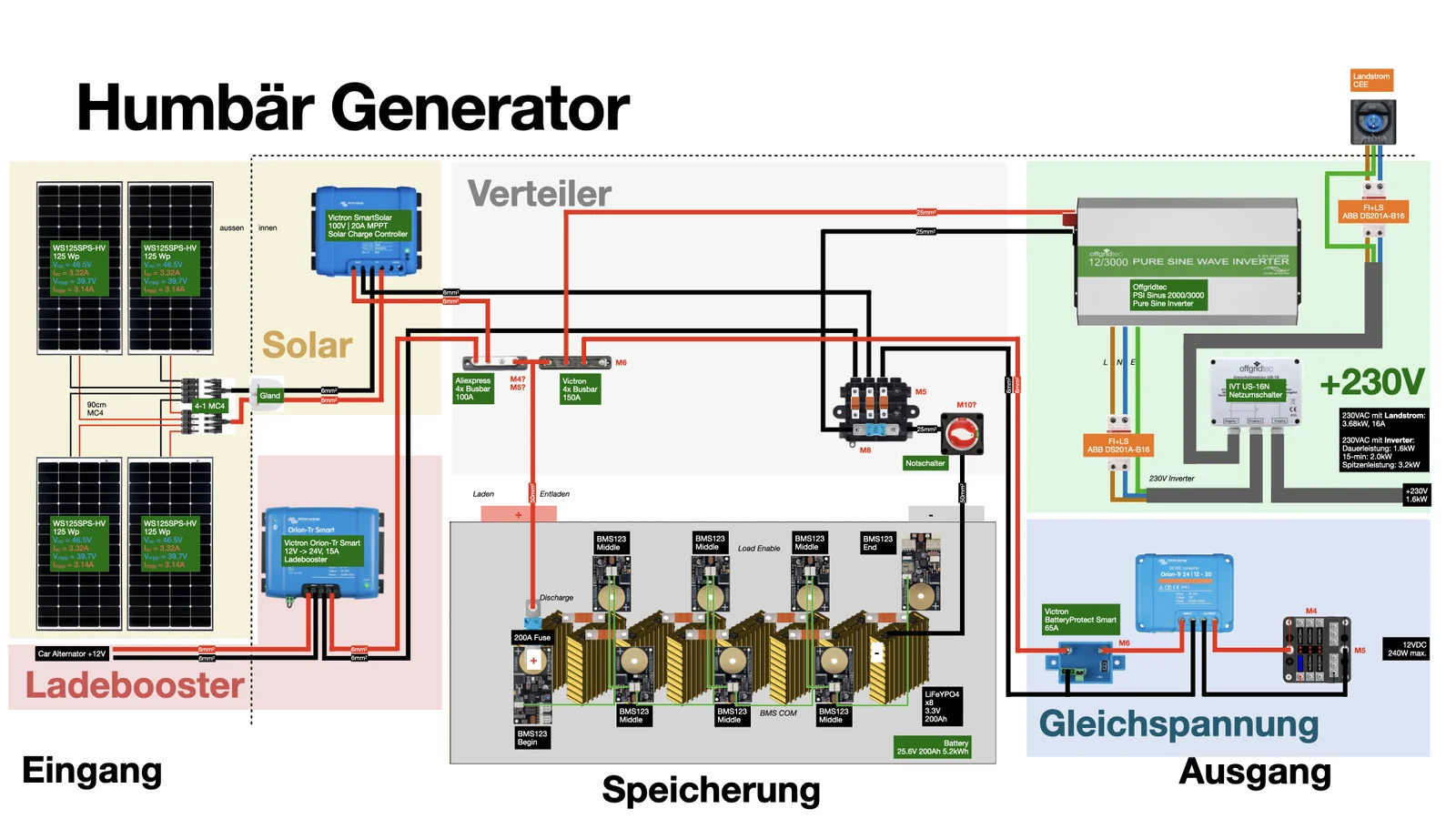
The whole "Humbär Generator" on one sheet: input, storage, distribution and output
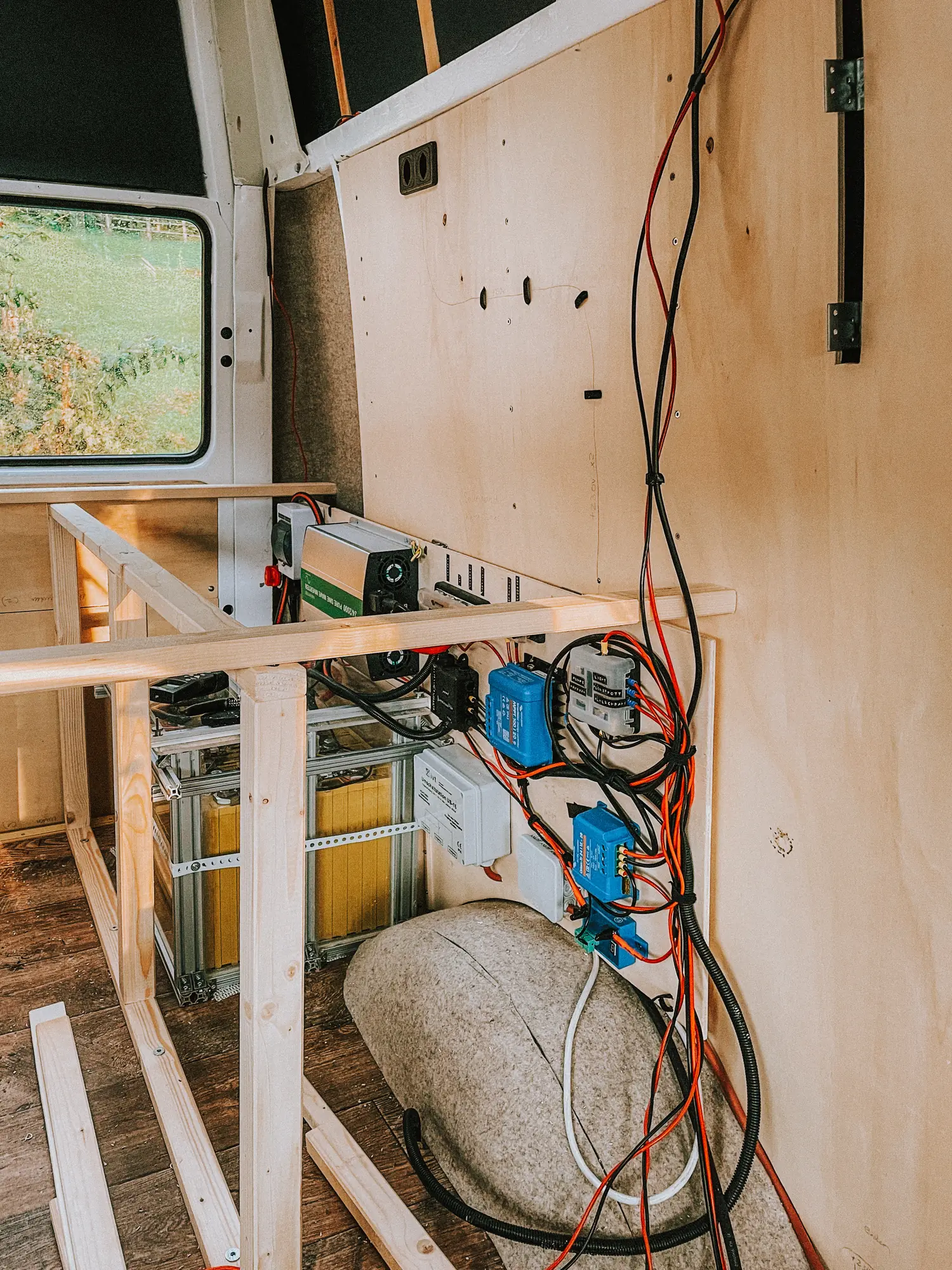
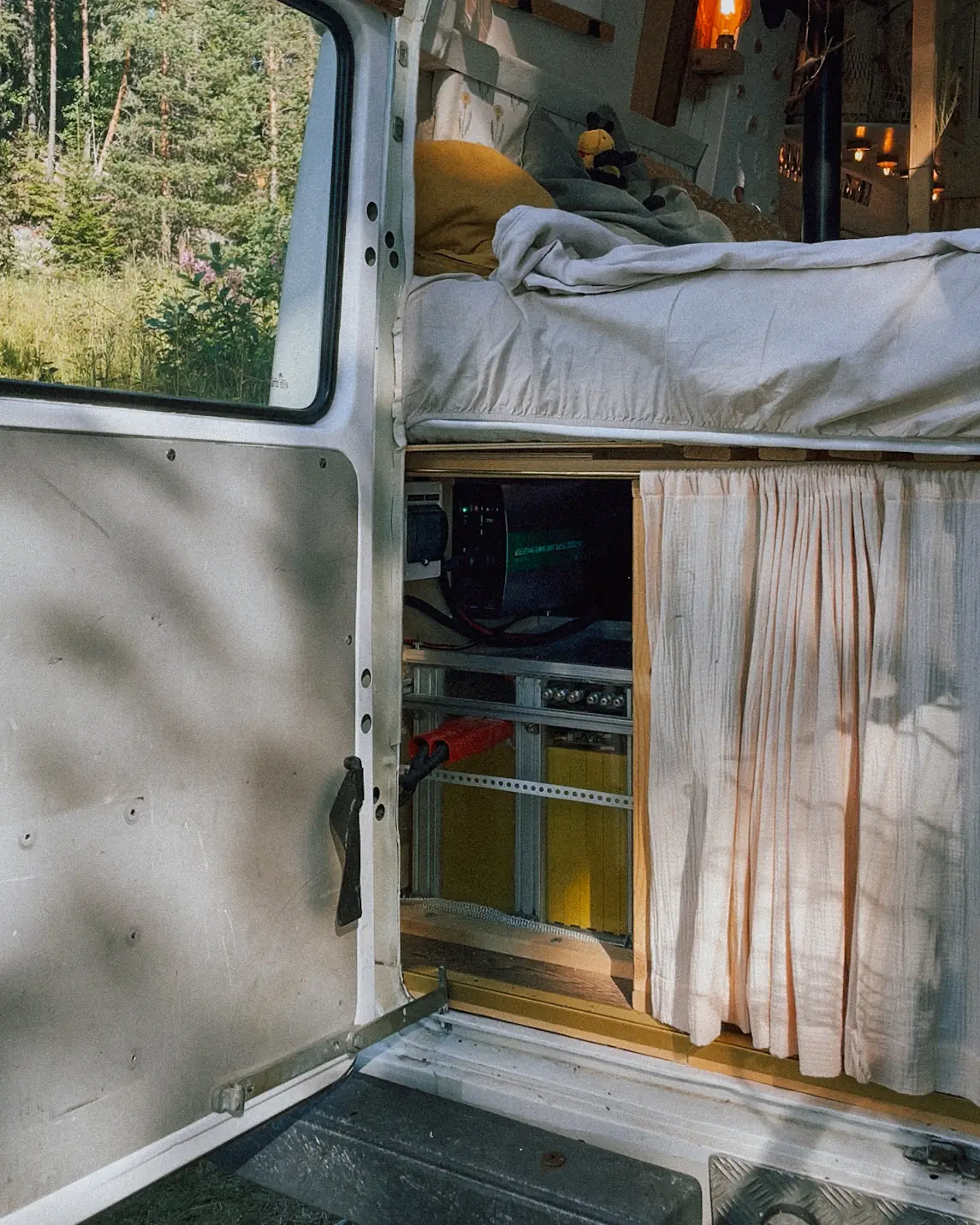
A note: a 230 V installation in a vehicle is not a place to experiment. Cable cross-sections, fuses, grounding, ground-fault protection and the switchover between shore power and inverter all have to suit the specific installation and be carried out properly. What we describe here is our own installation, not a general set of build instructions.
How much solar power does a camper produce per day?

How much comes in per day varies enormously - depending on season, weather, campsite, orientation and shading. Even slight shading can cause a sharp drop in output on a solar system with several modules.
Our own experience looks roughly like this:
- Over 3 kWh, up to 400 W: our yield was especially good in high summer in more southerly countries such as Spain and France, but also in Germany and Switzerland. Since we don't usually run the battery all the way down to 0 %, a daily yield of about 3 kWh is realistic before the battery is full again. The hotter it gets, the worse the efficiency of the solar modules.
- 1-2 kWh, up to 400 W: in Scandinavia the sun shines for a long time in summer, but it sits fairly low. Our solar system cannot be angled toward the sun.
- 1-2 kWh, up to 350 W: the same in sunny southern countries in winter - Greece, Spain or Portugal - where the sun is much lower.
- 200-500 Wh, up to 400 W: on a rainy day when the sun breaks through now and then.
- 200-500 Wh, up to 50 W: on a sunny day when Humbär is parked under a tree.
- 0 Wh: on a rainy day under a dense tree.
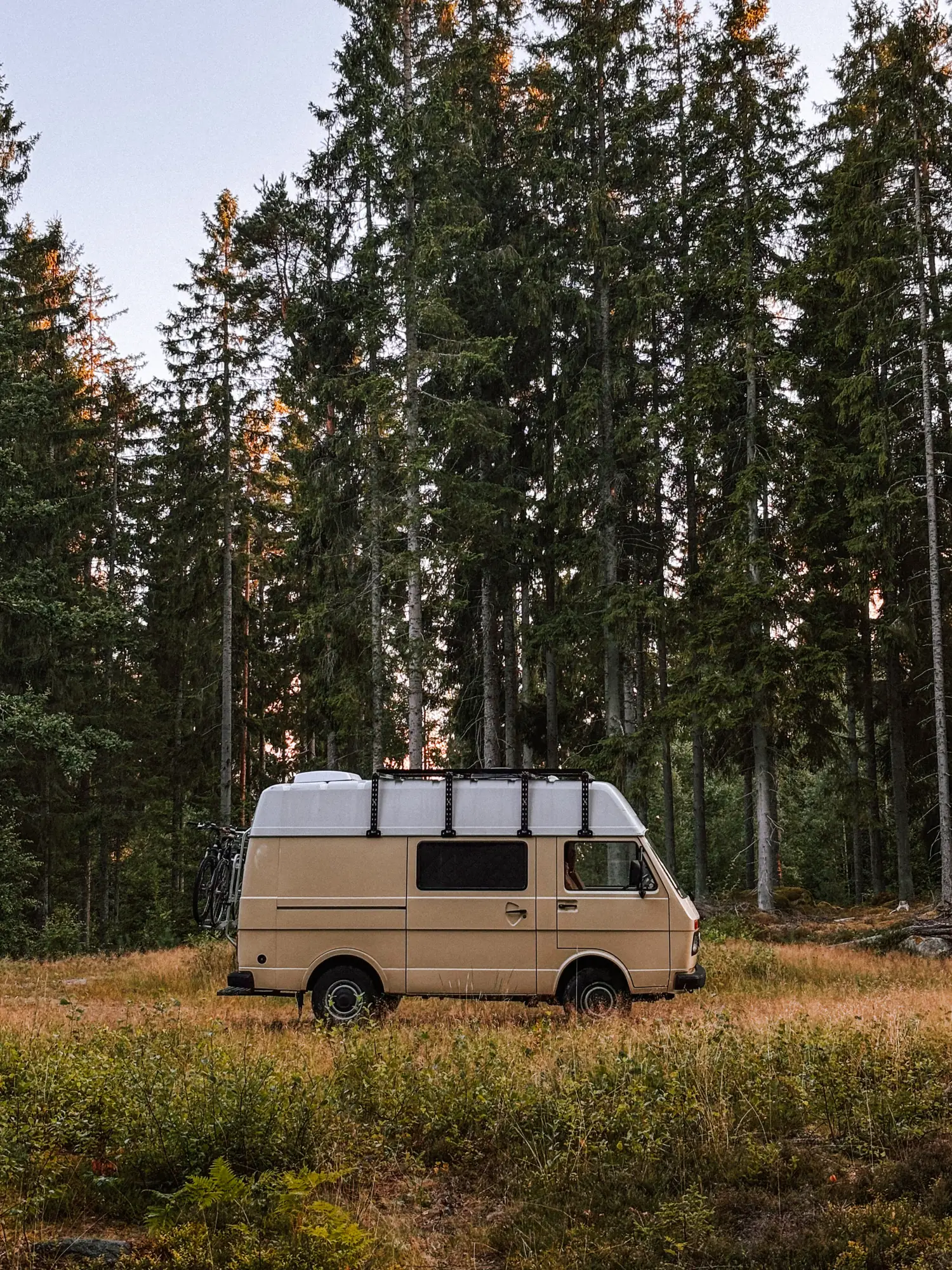
That last line is not a joke. A spot like the one above is wonderful to wake up in and produces almost nothing all day. Choosing where to park has quietly become an energy decision for us. Finding a sunny, open spot is a real priority now - not least because Starlink gets a better signal that way.
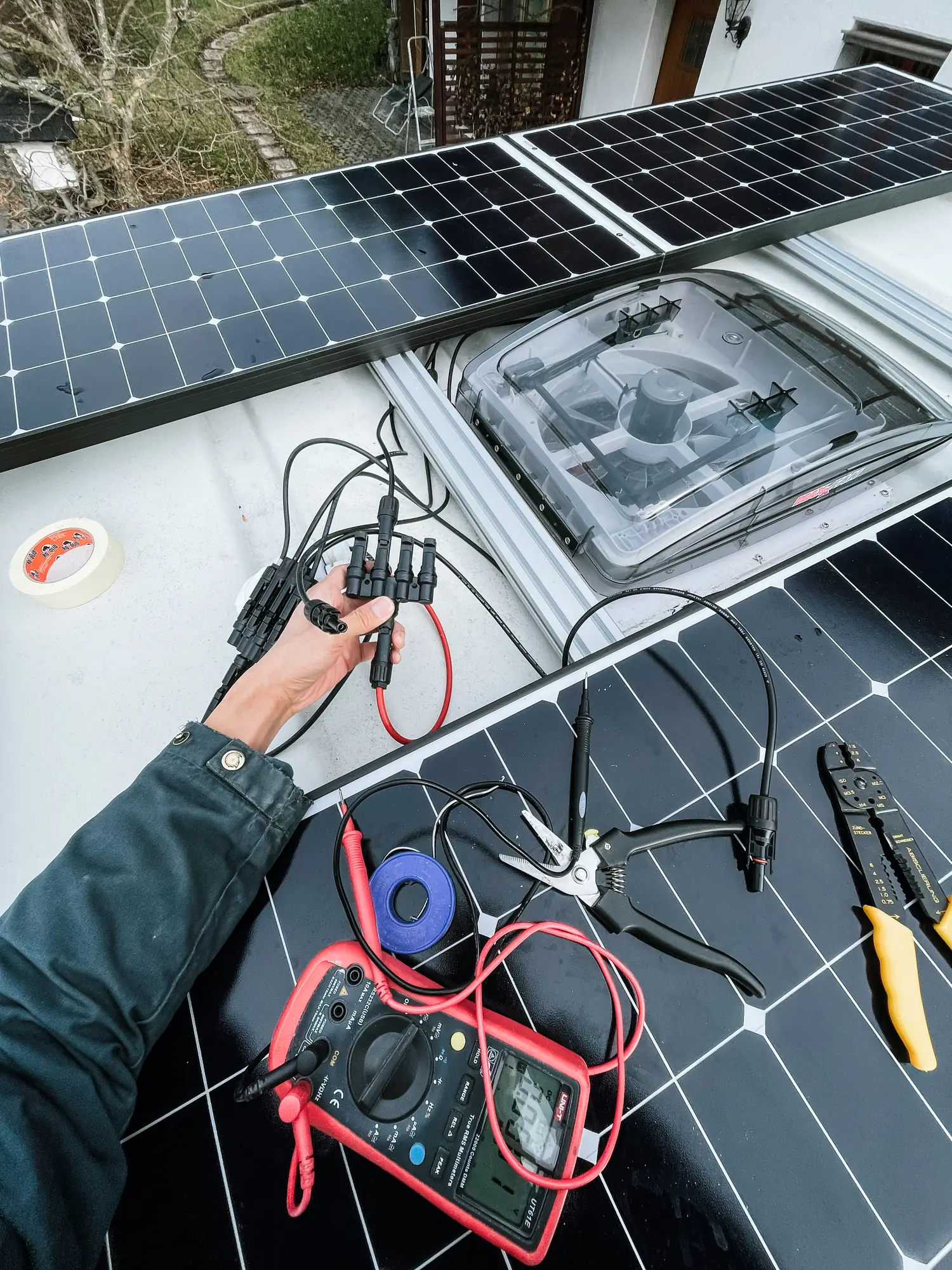
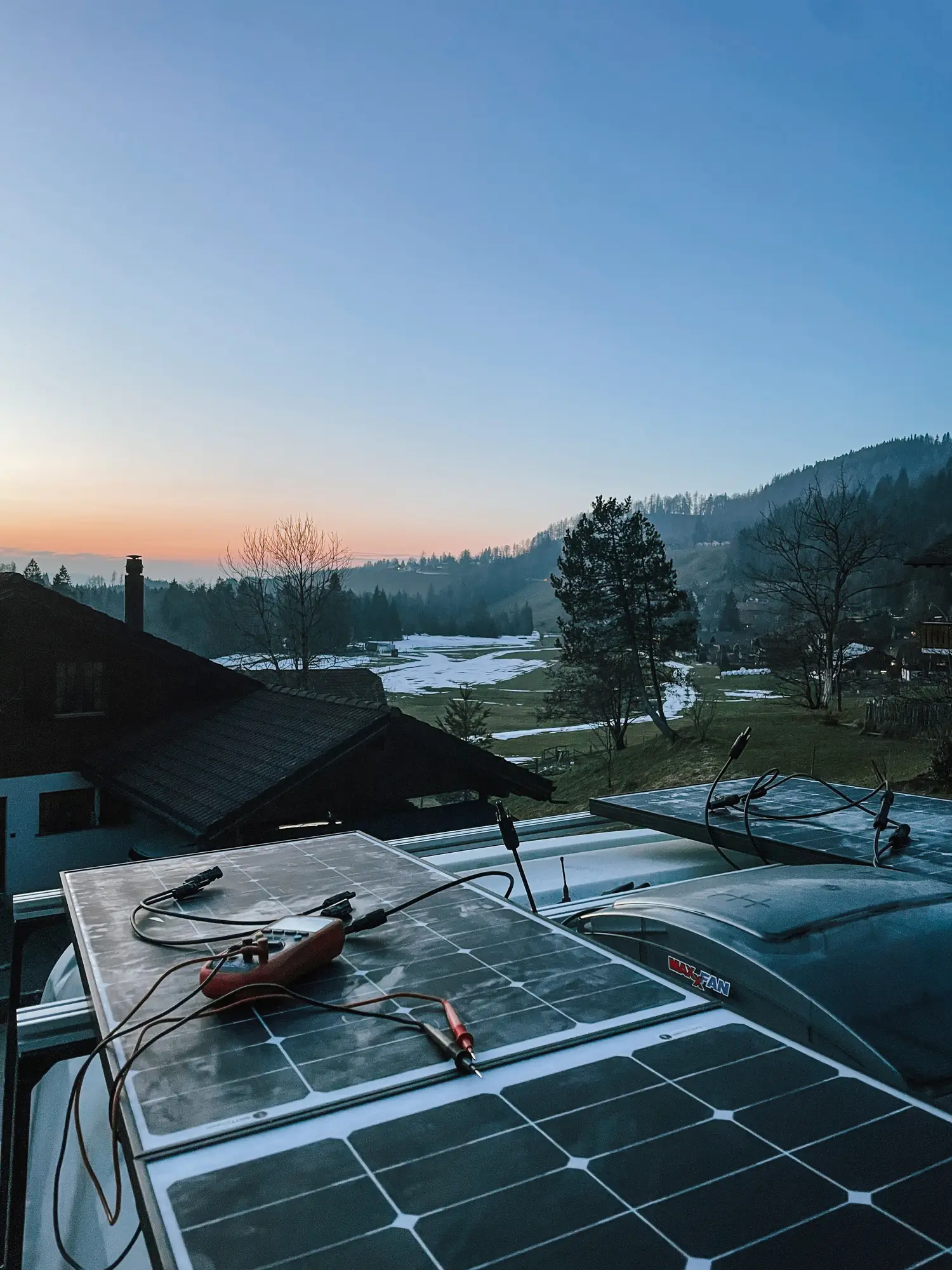
One important distinction: Wp is the rated output of the solar array, kWh is the energy actually harvested over the day. So our 500 Wp array does not simply produce 500 W × 24 hours.
What happens to camper electrics in bad weather and little sun?
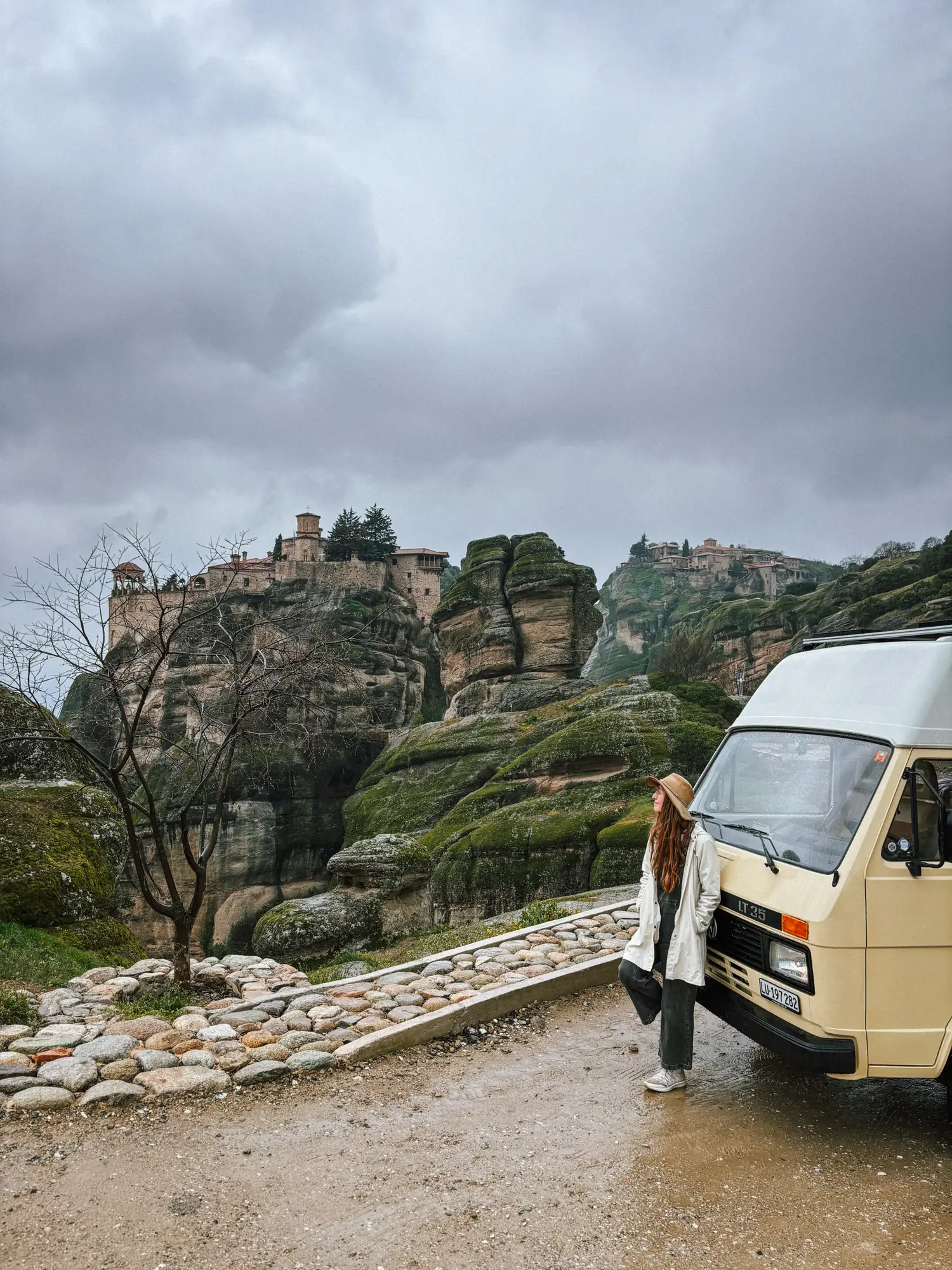
We don't like to admit it - and we wanted to believe it even less - but our battery does occasionally have to be charged at a campsite with power.
We spent the first year of vanlife with no additional way of charging at all. We still remember Norway well: several very rainy days in a row meant we had to ration our electricity heavily.
In Greece last winter we were even down to 0 % at one point. At some point we therefore decided to finally install a charger that tops up our battery as soon as Humbär is plugged into shore power.
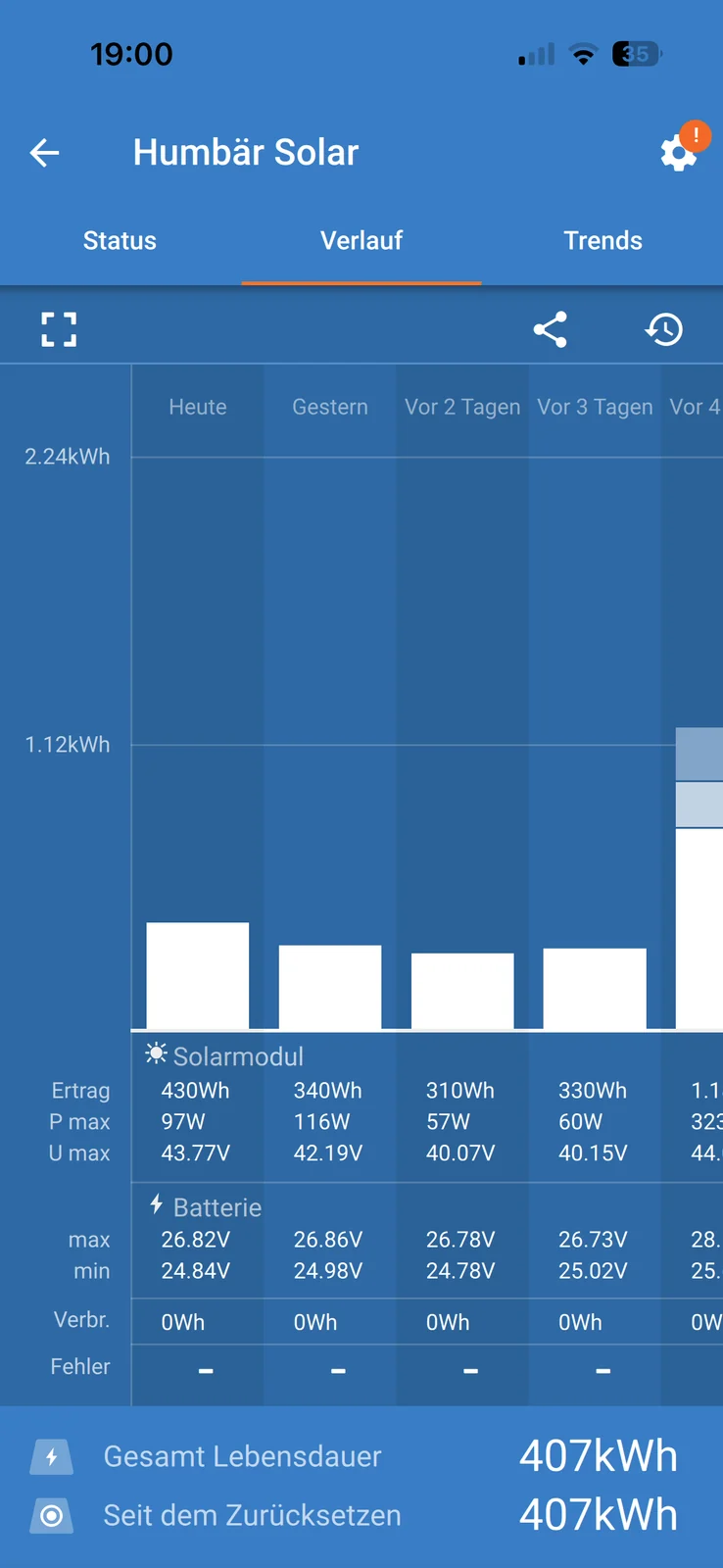
Since then, everyday life has been more relaxed. Through the Greek winter we no longer had to ration electricity, as long as we found a place roughly every seven days where we could plug Humbär in.
In Sweden in August, roughly the same applies: with generous consumption we look for a power hookup about every ten days in good weather, and more like every four days in bad weather.
And this is exactly where the real strength of our system shows for us: being self-sufficient doesn't mean never using an outlet. It means not needing one all the time.
Can you heat a camper with electricity?
We do actually have the option of heating the van electrically. Our electric fan heater is portable and rated at 1000 W.
But as is so often the case: we mostly need warmth when it is cold and cloudy - which is exactly when our solar array produces little and our battery is correspondingly less full.
If we ran the fan heater for five hours, that alone would take 5 kWh of energy. In theory, our fully charged battery would already be empty.
So it is not a particularly good combination. When we are off-grid, we therefore hardly ever use the electric heater. A few times we have heated electrically for half an hour in the early morning on a full battery. Otherwise, the electricity is simply too precious to us for that.
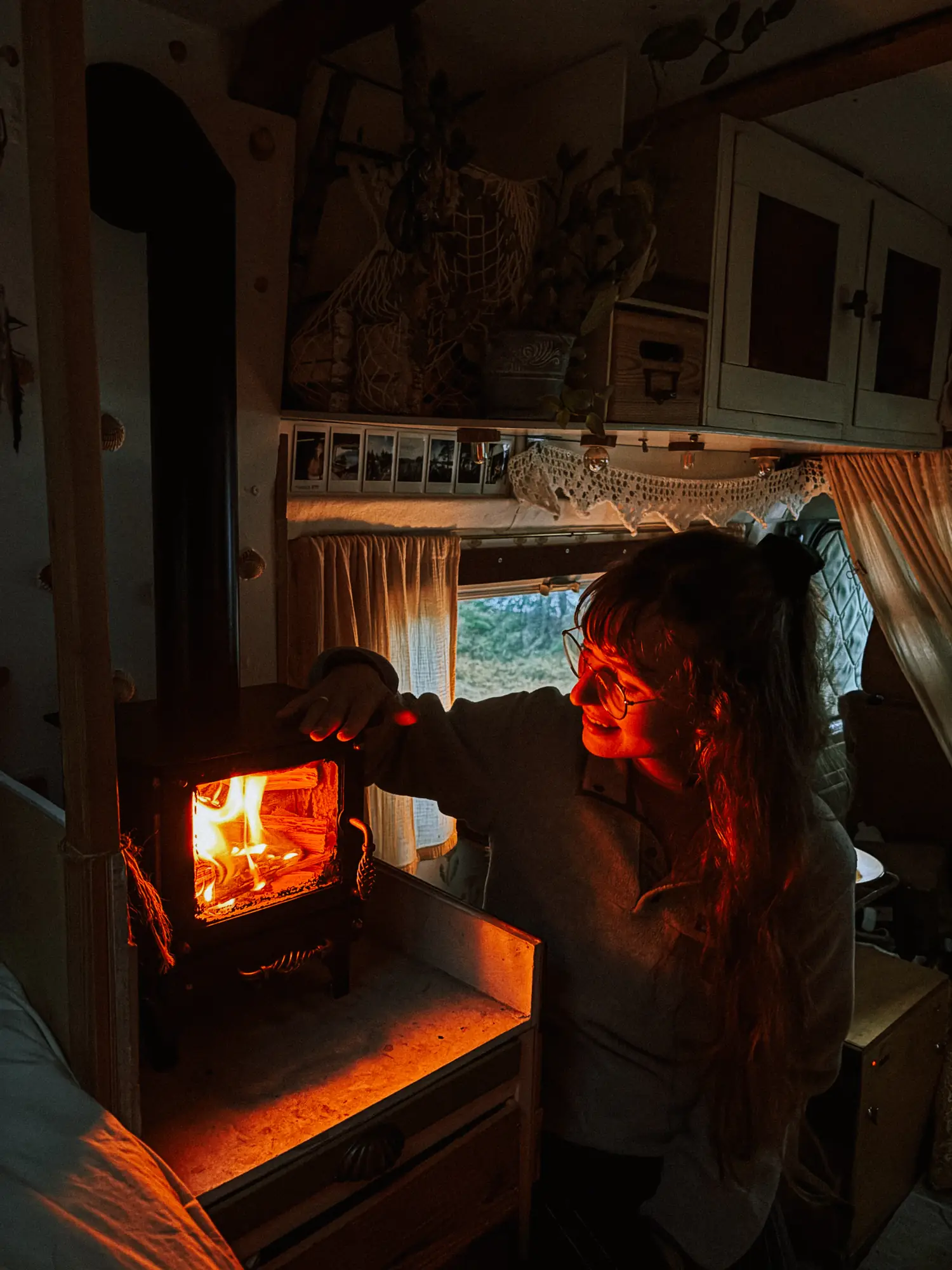
So what do we do when we are cold? Either we escape to a campsite with power - or we use our wood stove. It gives off a lovely dry heat, and it also brings a lot of coziness and a pleasant crackle.
Another genuine tip against the cold, for us, is hot water bottles, which we simply fill using the kettle at 60-70 °C. Under a good blanket they stay warm deep into the night.
How often do we have to think about our electricity use?

Right now we are traveling in Sweden in September and, to be honest: quite often. The sun is barely shining at the moment, we have to watch our consumption and find a charging spot every few days.
Improvement is in sight, though, as soon as the sun shines longer and stronger again - or we move south.
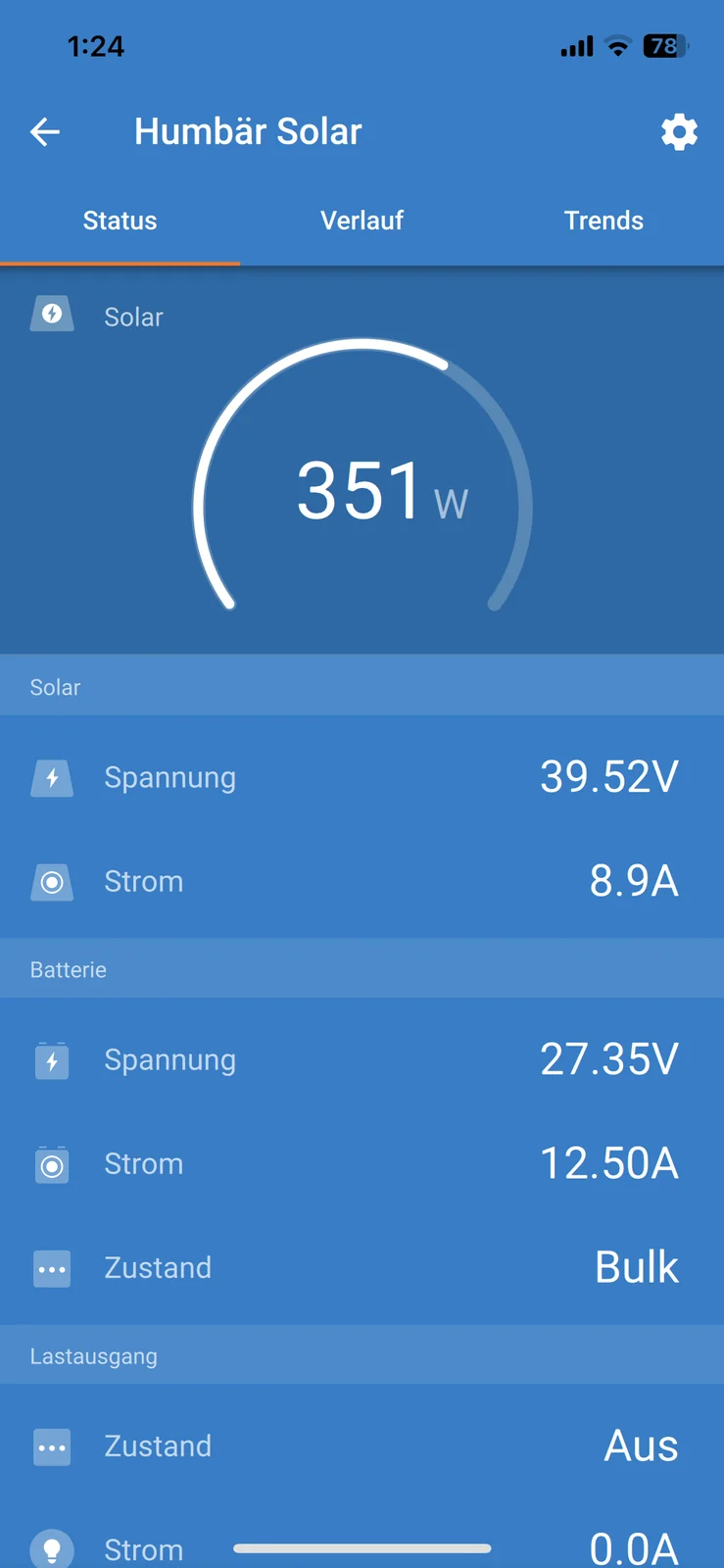
In a sunny Swiss summer, by contrast, there were weeks when we didn't have to look at our electricity at all. The battery was back at 100 % almost every day.
And perhaps that is the best description of our camper electrics for us: we don't want to think about electricity all the time. We want enough of it that it is simply there in everyday life.
Of course we still check the state of charge and the solar yield regularly. But not because we live in constant fear of running out - rather because, honestly, it is pretty cool to watch your own little power station on the roof.
Humbär's electrics at a glance

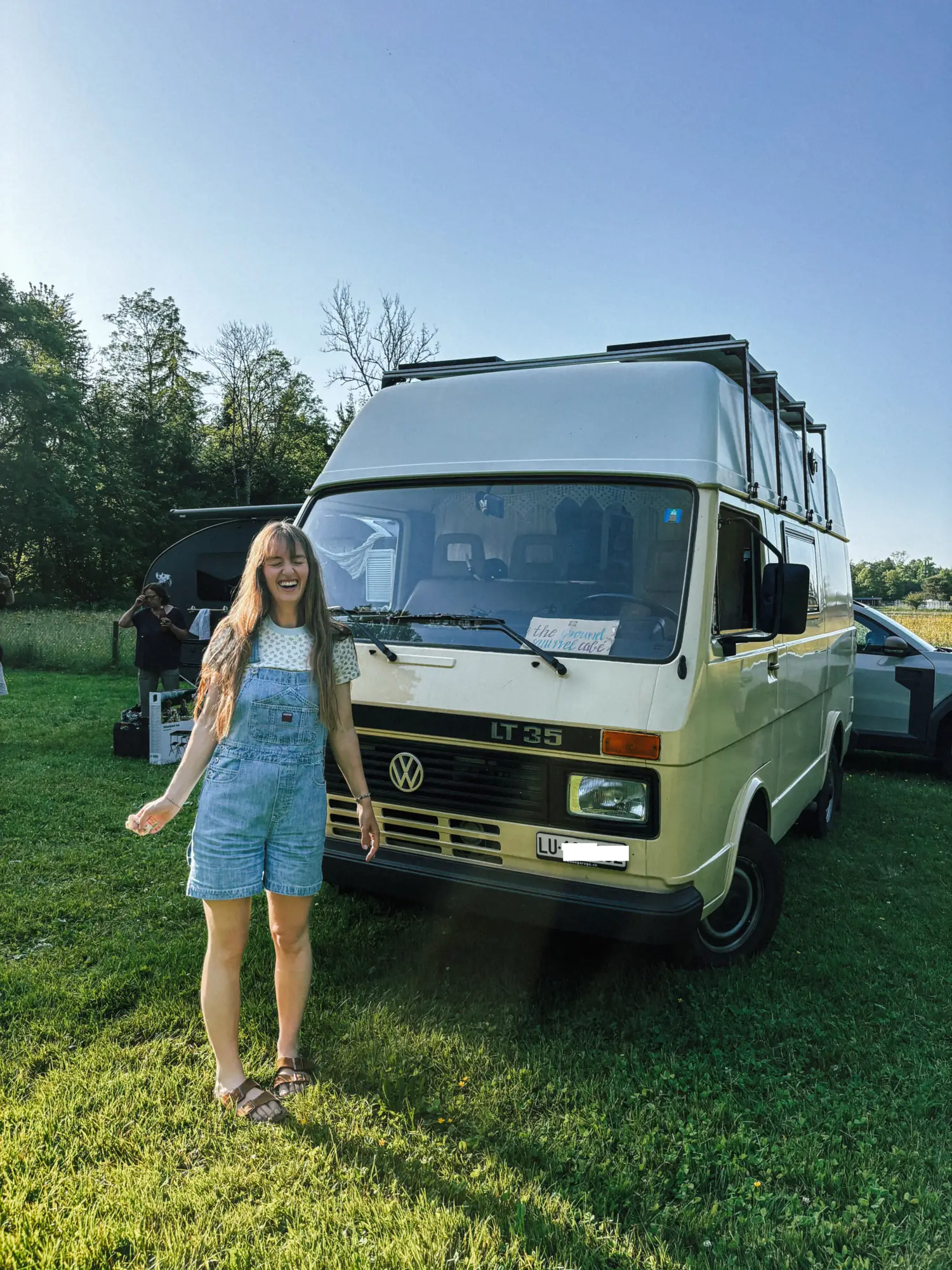
- Battery: 8 × 200 Ah LiFePO4 cells, in series to 24 V / 200 Ah - around 5 kWh
- Solar: 4 × 125 Wp Wattstunde, in parallel, 500 Wp rated output
- Charge controller: Victron SmartSolar MPPT 100/20
- Charge booster: Victron Orion-Tr 12/24 15 A, charges while driving
- Inverter: Offgridtec PSI Sinus 2000 W (1500 W continuous)
- 12 V: Victron Orion-Tr 24/12 for fridge, MaxxFan, pump, lights and composting toilet
- Shore power: CEE inlet with a ground-fault breaker and an automatic transfer switch
- And nowhere: a gas bottle
Planning your own camper electrics? Then have a look at Humbär's story too - how he came to us, and what else is hiding inside him. Maybe our solution helps you work out how much electrical system you actually need for your own van.
With 🐿️ by Frank.
Mit Humbär stehen wir seit mehr als anderthalb Jahren autark. Dank unserer Elektrik betreiben wir unterwegs haushaltsübliche Geräte wie Induktionskochplatte und Espressomaschine. Auch eine Zweikreis-Kühlbox und Starlink laufen bei uns im Alltag.
Du bist gerade dabei, die Elektrik für deinen Van-Ausbau zu dimensionieren? Dann findest du hier vielleicht ein paar Anregungen aus unserem Alltag: Was verbrauchen wir tatsächlich? Wie viel Solarstrom kommt rein? Und reicht ein 5-kWh-Akku wirklich für ein Leben ohne Gas und ohne ständigen Landstrom?
Kochen im Van ohne Gas - geht das?
Du hast keine Lust auf eine Gasprüfung, keine Lust, Gastanks zu befüllen, und keine Lust, den passenden Gasadapter zu finden? Wir haben uns deshalb ebenfalls von Anfang an dazu entschieden, ohne Gas im Van unterwegs zu sein.
Wir kochen in unserem Van Humbär ausschliesslich mit einer Induktionskochplatte. Wir verwenden eine haushaltsübliche Kochplatte von IKEA, die wir in die Arbeitsplatte eingebaut haben. Dank Induktion können wir schnell und relativ energiesparend kochen.
Unser Kochfeld verbraucht auf der höchsten Stufe 2000 W. Wir haben einen Inverter verbaut - der Inverter macht aus 24 V DC Batteriespannung 230 V AC Steckdosenspannung -, der zwar 2000 W leistet, aber dauerhaft nur mit 1500 W betrieben werden kann. Damit wir den Inverter nicht überlasten, kochen wir daher maximal auf der zweithöchsten Stufe. Das funktioniert für uns erstaunlich gut: Das Wasser kocht schnell, und beim normalen Kochen vermissen wir die volle Leistung überhaupt nicht.
Und das Beste: Wir brauchen weder Gasflasche noch Gaskasten noch Gasprüfung.
Welche elektrischen Geräte haben wir im Camper?
Die stromhungrigsten Geräte finden sich in der Küche unseres Vans: eine elektrische Kochplatte (bis 2000 W), eine Kaffeemaschine (bis 1800 W), ein Wasserkocher (bis 1850 W) und ein Kühlschrank (bis zu 70 W beim Herunterkühlen, im normalen Betrieb eher um die 20 W). Dazu kommen sogar ein tragbarer Backofen (bis 1300 W) und ein Food Processor (bis 250 W).
Also eigentlich alles wie zu Hause.
Da wir auch von unterwegs aus arbeiten, betreiben wir ausserdem Starlink über die Steckdose (rund 20 W im Normalbetrieb), haben einen Marshall Speaker (max. 35 W) und diverse Ladegeräte für Laptop (65 W), Handy (15 W), Kamera, Drohne, Akkus, Zahnbürste und Powerbank.
Unsere Verbraucher, von wenig zu viel Leistung sortiert - oben alles, was an 230 V hängt, unten die 12-V-Seite
Bis auf den Kühlschrank werden alle Geräte über haushaltsübliche 230 V betrieben. Der Kühlschrank ist über einen DC/DC-Wandler an 12 V angeschlossen. Gleiches gilt für andere Camping-spezifische Geräte wie unser Kompostklo, den Dachlüfter (MaxxFan), die Tankanzeige, Wasserpumpe und sämtliche LED-Lichter im Van.
Auch die Lämpchen sind vorher auf dem Papier entstanden - inklusive versteckter Schalter
Interessant ist dabei: Die maximale Leistung eines Geräts sagt noch nicht besonders viel über unseren tatsächlichen Tagesverbrauch aus. Eine Kochplatte kann 2000 W ziehen - aber wenn sie nur 20 Minuten läuft, verbraucht sie deutlich weniger Energie als ein kleiner Verbraucher, der 24 Stunden durchläuft.
Genau das ist der Unterschied zwischen Leistung und Energie: Watt beschreibt, wie viel ein Gerät in einem Moment zieht. Wattstunden beschreiben, wie viel es über die Zeit tatsächlich verbraucht. Und nur Letzteres entscheidet darüber, ob unsere Batterie am Abend noch etwas übrig hat.
Wie viel Strom braucht man im Van pro Tag?
Wir kochen meist einmal am Tag - am Abend und dann schon gern ziemlich lecker und ausgefallen. Dafür kalkulieren wir etwa 1 kWh für das Kochen ein, wenn unsere Kochplatte ungefähr 30 Minuten auf mittlerer Hitze läuft. Eine Lasagne beansprucht mehr Strom als ein Couscous-Salat, das ist klar.
An besonders ertragreichen Tagen erlauben wir uns gerne, auch mal zu backen. Das schlägt mit mindestens 1-1,5 kWh zu Buche.
Für einen Matcha Latte für zwei Personen am Morgen, einen Cappuccino für zwei Personen und Tee rechnen wir mit etwa 200 Wh am Tag.
Unser Kühlschrank hat zwei getrennte Fächer. Das Gefrierfach läuft bei -18 °C, das Kühlfach bei 6 °C. Um diese Temperaturen bei typischem europäischem Wetter (ca. 15 °C) zu halten, verbrauchen wir bis zu 400 Wh am Tag.
Für Starlink rechnen wir mit etwa 250 Wh am Tag, da wir das Internet am Abend in der Regel ausschalten.
Sachen, die kaum ins Gewicht fallen: Laptops aufladen, Handys aufladen und die Van-Elektrik für Licht, Kompostklo und MaxxFan.
Unser grober Tagesverbrauch
Wenn wir diese grossen Verbraucher zusammenrechnen, landen wir an einem normalen Tag bei rund 1,85 kWh:
- Kochen: ca. 1000 Wh
- Kaffee, Matcha & Tee: ca. 200 Wh
- Kühlschrank & Gefrierfach: bis zu 400 Wh
- Starlink: ca. 250 Wh
- Sonstiges: vergleichsweise wenig
An einem Backtag können allein für den Backofen zusätzlich 1-1,5 kWh dazukommen. Und an einem langen Arbeitstag mit viel Kaffee, viel Internet und einer warmen Dusche wird daraus schnell das Doppelte. Der Durchschnitt ist eben nur ein Durchschnitt.
Wie dimensioniert man die Elektrik für einen Camper?
Unsere Dimensionierung ist das Ergebnis aus Dachfläche, Budget und Bedarf. Wir haben uns von Anfang an für eine LiFePO4-Batterie entschieden. Sie ist leichter als AGM und man kann einen grossen Teil ihrer Kapazität tatsächlich nutzen.
Unsere Batterie hat Frank aus acht einzelnen 200-Ah-Zellen zusammengebaut. Die Zellen sind in Serie verschaltet. Dadurch kommen wir auf ein 24-V-System mit 200 Ah - also rund 5 kWh Speicherkapazität.
Nerd Talk: Ja, genau - 24 V!
Bei gleicher Leistung fliesst bei 24 V ungefähr halb so viel Strom wie bei 12 V. Je geringer der Strom, desto geringer sind die Leitungsverluste und desto kleiner kann - bei gleicher zulässiger Erwärmung und gleichem Spannungsabfall - der benötigte Kabelquerschnitt ausfallen.
Wir haben starre Solarpanels verbaut. Dafür haben wir das Dach ganz genau ausgemessen, einen passenden Dachträger gekauft und das gesamte Dach entsprechend geplant.
Jeder Zentimeter Dach ist verplant, bevor das erste Loch gebohrt wird
Da wir eine Dachluke und einen MaxxFan verbaut haben, verringert sich die freie, durchgehende Fläche für Solarpanels massgeblich. Die beste Nutzung der verbleibenden Fläche konnten wir mit vier 125-Wp-Solarpanels von Wattstunde erreichen. Damit kommen wir auf eine maximale Nennleistung von 500 Wp. Die vier Panels sind parallel geschaltet und fest an vier Aluprofilen am Dachträger verschraubt.
Die Solarpanels laden über einen Laderegler (Victron SmartSolar MPPT 100/20) unsere 5-kWh-LiFePO4-Batterie. Zusätzlich haben wir einen Ladebooster (Victron Orion-Tr 12/24 15 A), der Humbär während der Fahrt lädt.
Neuerdings haben wir ausserdem ein Batterieladegerät eingebaut, mit dem wir unsere LiFePO4-Batterie laden können, sobald Humbär am Landstrom hängt.
Erst auf 1000 × 600 mm geplant …
Um aus der 24-V-DC-Batteriespannung 230-V-AC-Steckdosenspannung zu machen, verwenden wir einen Inverter (Offgridtec PSI Sinus 2000 W). Dieser kann Geräte mit 1500 W dauerhaft, 2000 W bis zu 30 Sekunden und 3000 W für eine sehr kurze Zeit versorgen.
Das reicht ziemlich genau für alles von Induktionskochplatte bis Kaffeemaschine - allerdings nicht, um zwei grosse Verbraucher gleichzeitig zu betreiben.
Unsere 230-V-AC-Kabel sind H07RN-F 3 × 2,5 mm² und mit 16 A abgesichert. Wir haben schweizerische Steckdosen im J-Format verbaut. Das reicht, um bei angeschlossenem Landstrom Geräte bis 3680 W zu betreiben.
Dass in diesem Fall auch wirklich Landstrom ausgewählt wird, dafür sorgt ein Umschalter: Sobald Landstrom anliegt, wird die Batterie- und Inverterversorgung getrennt und Landstrom bevorzugt.
Der ganze «Humbär Generator» auf einem Blatt: Eingang, Speicherung, Verteiler und Ausgang
Hinweis: Die 230-V-Installation im Fahrzeug ist kein Bereich für Experimente. Kabelquerschnitte, Sicherungen, Schutzleiter, FI/RCD und die Umschaltung zwischen Landstrom und Inverter müssen zur konkreten Anlage passen und fachgerecht ausgeführt werden. Unsere Angaben beschreiben unsere eigene Installation und sind keine allgemeine Bauanleitung.
Wie viel Solarstrom produziert ein Camper am Tag?
Wie viel Strom pro Tag reinkommt, variiert extrem stark - je nach Jahreszeit, Wetter, Stellplatz, Ausrichtung und Beschattung. Selbst geringe Beschattungen können bei einem Solarsystem mit mehreren Modulen zu einem starken Leistungseinbruch führen.
Unsere Erfahrungswerte sehen ungefähr so aus:
- Über 3 kWh, bis zu 400 W: Besonders gut war unser Ertrag im Hochsommer in südlicheren Ländern wie Spanien, Frankreich, aber auch Deutschland und der Schweiz. Da wir unsere Batterie in der Regel nicht bis auf 0 % leerfahren, ist ein Tagesertrag von etwa 3 kWh realistisch, bevor die Batterie wieder voll ist. Je heisser es wird, desto schlechter wird der Wirkungsgrad der Solarmodule.
- 1-2 kWh, bis zu 400 W: In Skandinavien scheint die Sonne im Sommer lange, dafür steht sie relativ tief. Unser Solarsystem lässt sich nicht zur Sonne ausrichten.
- 1-2 kWh, bis zu 350 W: Auch in sonnigen südlichen Ländern im Winter, etwa Griechenland, Spanien oder Portugal, steht die Sonne deutlich tiefer.
- 200-500 Wh, bis zu 400 W: An einem regnerischen Tag, wenn die Sonne zwischendurch durchkommt.
- 200-500 Wh, bis zu 50 W: An einem sonnigen Tag, wenn Humbär unter einem Baum steht.
- 0 Wh: An einem regnerischen Tag unter einem dichten Baum.
Die letzte Zeile ist kein Witz. An einem Platz wie oben wacht man wunderbar auf - und das Dach liefert den ganzen Tag fast nichts. Die Wahl des Stellplatzes ist bei uns still und leise zu einer Energieentscheidung geworden. Einen sonnigen, hellen Platz zu finden hat bei uns besondere Priorität - auch weil Starlink dadurch einen besseren Empfang hat.
Ein wichtiger Unterschied: Wp ist die Nennleistung der Solaranlage, kWh sind die Energie, die tatsächlich über den Tag geerntet wird. Unsere 500-Wp-Anlage produziert also nicht einfach 500 W × 24 Stunden.
Was passiert mit der Camper-Elektrik bei schlechtem Wetter und wenig Sonne?
Wir geben es ja nicht gern zu - und noch weniger wollten wir es wahrhaben -, dass tatsächlich auch unsere Batterie ab und zu an einem Stromplatz aufgeladen werden muss.
Das erste Jahr Vanlife haben wir ganz ohne zusätzliche Lademöglichkeit verbracht. Wir erinnern uns noch gut an Norwegen: Einige sehr regnerische Tage hintereinander haben dazu geführt, dass wir unseren Strom stark rationieren mussten.
In Griechenland letzten Winter hatten wir zwischendurch sogar 0 %. Irgendwann haben wir uns deshalb dazu entschlossen, endlich ein Ladegerät einzubauen, das unsere Batterie lädt, sobald Humbär am Landstrom hängt.
Seitdem ist unser Alltag entspannter. Im griechischen Winter mussten wir den Strom nicht mehr rationieren, solange wir ungefähr alle sieben Tage einen Platz aufgesucht haben, an dem wir Humbär an die Steckdose hängen konnten.
Auch in Schweden im August gilt für uns ungefähr: Bei grosszügigem Verbrauch suchen wir bei gutem Wetter etwa alle zehn Tage einen Stromanschluss auf, bei schlechtem Wetter eher alle vier Tage.
Und genau hier zeigt sich für uns die eigentliche Stärke unseres Systems: Autarkie bedeutet für uns nicht, niemals eine Steckdose zu benutzen. Es bedeutet, dass wir sie nicht ständig brauchen.
Kann man einen Camper mit Strom heizen?
Tatsächlich haben wir im Van die Möglichkeit, auch mit Strom zu heizen. Unser elektrischer Heizlüfter ist tragbar und hat eine Leistung von 1000 W.
Aber wie es so oft ist: Wir brauchen vor allem dann Wärme, wenn es kalt und wolkig ist - also genau dann, wenn unsere Solaranlage wenig produziert und unsere Batterie entsprechend weniger voll ist.
Würden wir den Heizlüfter fünf Stunden lang betreiben, wären allein dafür 5 kWh Energie nötig. Unsere vollständig geladene Batterie wäre damit theoretisch schon leer.
Das ist also kein besonders gutes Zusammenspiel. Wenn wir autark unterwegs sind, nutzen wir die elektrische Heizung deshalb so gut wie nie. Ein paar Mal haben wir bei voller Batterie am frühen Morgen eine halbe Stunde elektrisch eingeheizt. Sonst ist uns der Strom dafür schlicht zu schade.
Was machen wir also, wenn uns kalt ist? Entweder wir flüchten auf einen Stellplatz mit Strom - oder wir benutzen unseren Holzofen. Der gibt nicht nur eine schöne, trockene Wärme ab, sondern sorgt auch für viel Gemütlichkeit und ein angenehmes Knistern.
Ein echter Tipp gegen Kälte für uns sind ausserdem Wärmflaschen, die wir ganz einfach mit dem Wasserkocher auf 60-70 °C erhitzen. Unter einer guten Decke halten sie bis tief in die Nacht warm.
Wie oft müssen wir uns Gedanken über unseren Stromverbrauch machen?
Momentan sind wir in Schweden im September unterwegs und ehrlich gesagt: ziemlich oft. Die Sonne scheint gerade kaum, wir müssen auf unseren Stromverbrauch achten und alle paar Tage einen Ladeplatz aufsuchen.
Besserung ist aber in Sicht, sobald die Sonne wieder länger und kräftiger scheint - oder wir Richtung Süden ziehen.
Im sonnigen Schweizer Sommer gab es dagegen auch Wochen, in denen wir überhaupt nicht auf unseren Strom schauen mussten. Die Batterie war fast täglich wieder bei 100 %.
Und vielleicht ist genau das für uns die beste Beschreibung unserer Camper-Elektrik: Wir wollen nicht ständig über Strom nachdenken. Wir wollen genug davon haben, dass er im Alltag einfach da ist.
Natürlich schauen wir trotzdem regelmässig auf den Ladezustand und den Solarertrag. Aber nicht, weil wir permanent Angst haben müssten, dass uns der Strom ausgeht - sondern weil es ehrlich gesagt ziemlich cool ist, sein eigenes kleines Kraftwerk auf dem Dach zu beobachten.
Humbärs Elektrik auf einen Blick
- Batterie: 8 × 200 Ah LiFePO4-Zellen, in Serie zu 24 V / 200 Ah - rund 5 kWh
- Solar: 4 × 125 Wp Wattstunde, parallel, 500 Wp Nennleistung
- Laderegler: Victron SmartSolar MPPT 100/20
- Ladebooster: Victron Orion-Tr 12/24 15 A, lädt während der Fahrt
- Inverter: Offgridtec PSI Sinus 2000 W (1500 W dauerhaft)
- 12 V: Victron Orion-Tr 24/12 für Kühlschrank, MaxxFan, Pumpe, Licht und Kompostklo
- Landstrom: CEE-Einspeisung mit FI/LS und automatischem Umschalter
- Und nirgends: eine Gasflasche
Du planst gerade deine eigene Camper-Elektrik? Dann schau dir auch Humbärs Geschichte an - wie er zu uns kam und was sonst noch alles in ihm steckt. Vielleicht hilft dir unsere Lösung dabei, herauszufinden, wie viel Elektrik du für deinen eigenen Van tatsächlich brauchst.
Mit 🐿️ von Frank
Written by

Engineer, barista & solar wizard
Frank likes lavender, fluffy bumblebees, golden larch trees in fall, and playing the guitar with just four chords.