
September 5, 2026
Building a Camper Van Water System: Fresh Water, Filters and Waste Water
Wassersystem im Camper selber bauen: Frischwasser, Filter und Abwasser
Humbär's water system
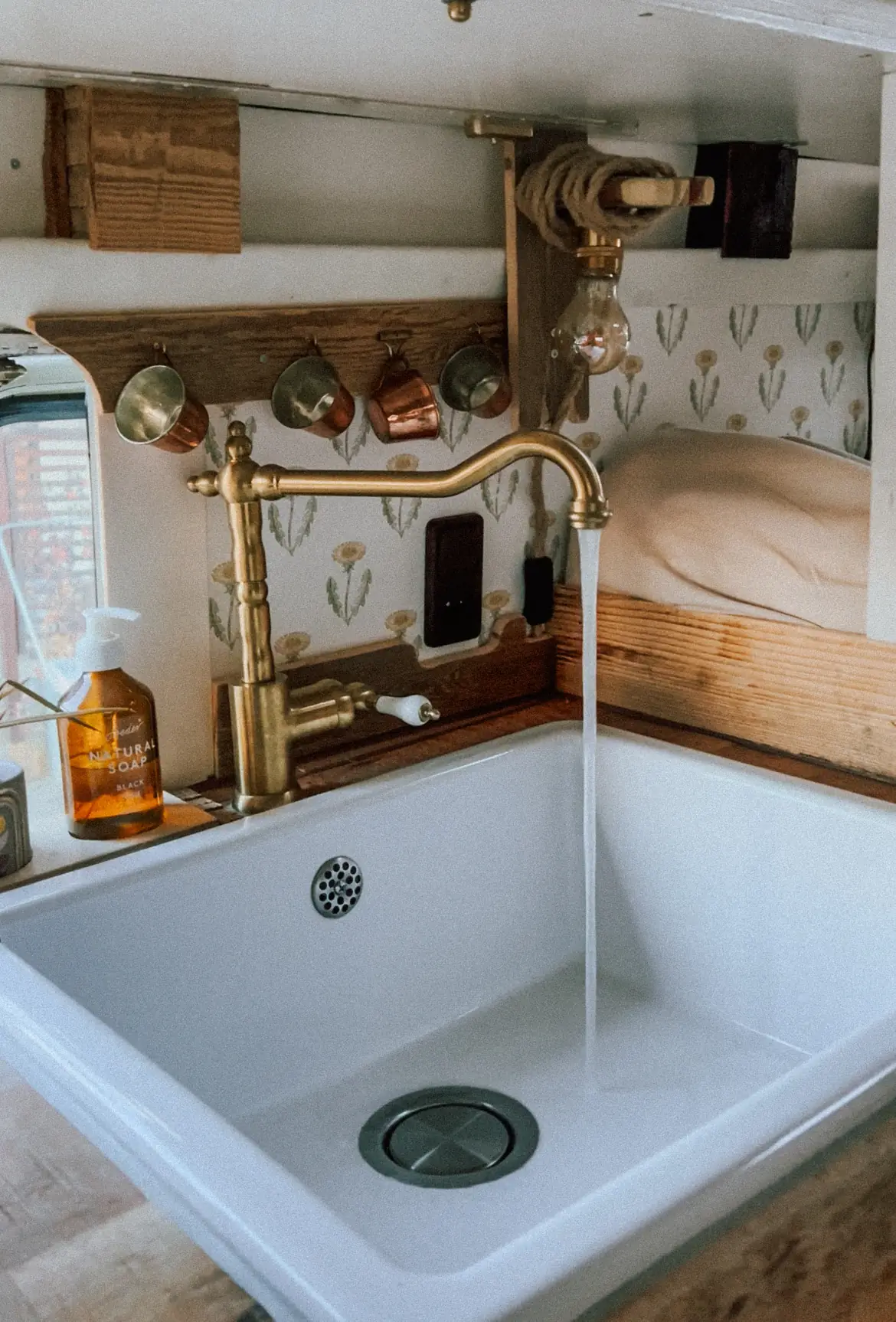
Our van has a high-quality, modern water setup. Thanks to our filter system we get very good water quality wherever we are, and thanks to a generous fresh water tank we can stay off-grid for several days. The system is comparatively simple, and we were able to put it together ourselves with no previous experience in this field. Here you can read what our water system consists of, how it is built, and what we have learned from living with it.
We built ours into a VW LT35, but nothing about the setup is tied to that van. It is made of parts anyone can buy, and it carries over just as well to any other campervan, panel van or motorhome. What changes from vehicle to vehicle is mainly the size of the tanks and where they can sit.
The short version, if you are only here for the filters
We filter with the Alb Filter Pro Camper set, plus the Protect pre-filter while filling up and the Nano germ barrier before the tap. Through our link you currently get 10% off.
To the Pro Camper set with 10% off (ad link)
10% instead of 5%: Alb Filter has raised the discount for our readers for a limited time. The 10% runs until 8 October 2026, after which it goes back to a permanent 5%. The discount code is weltenhummler.
Our setup, simple and dependable
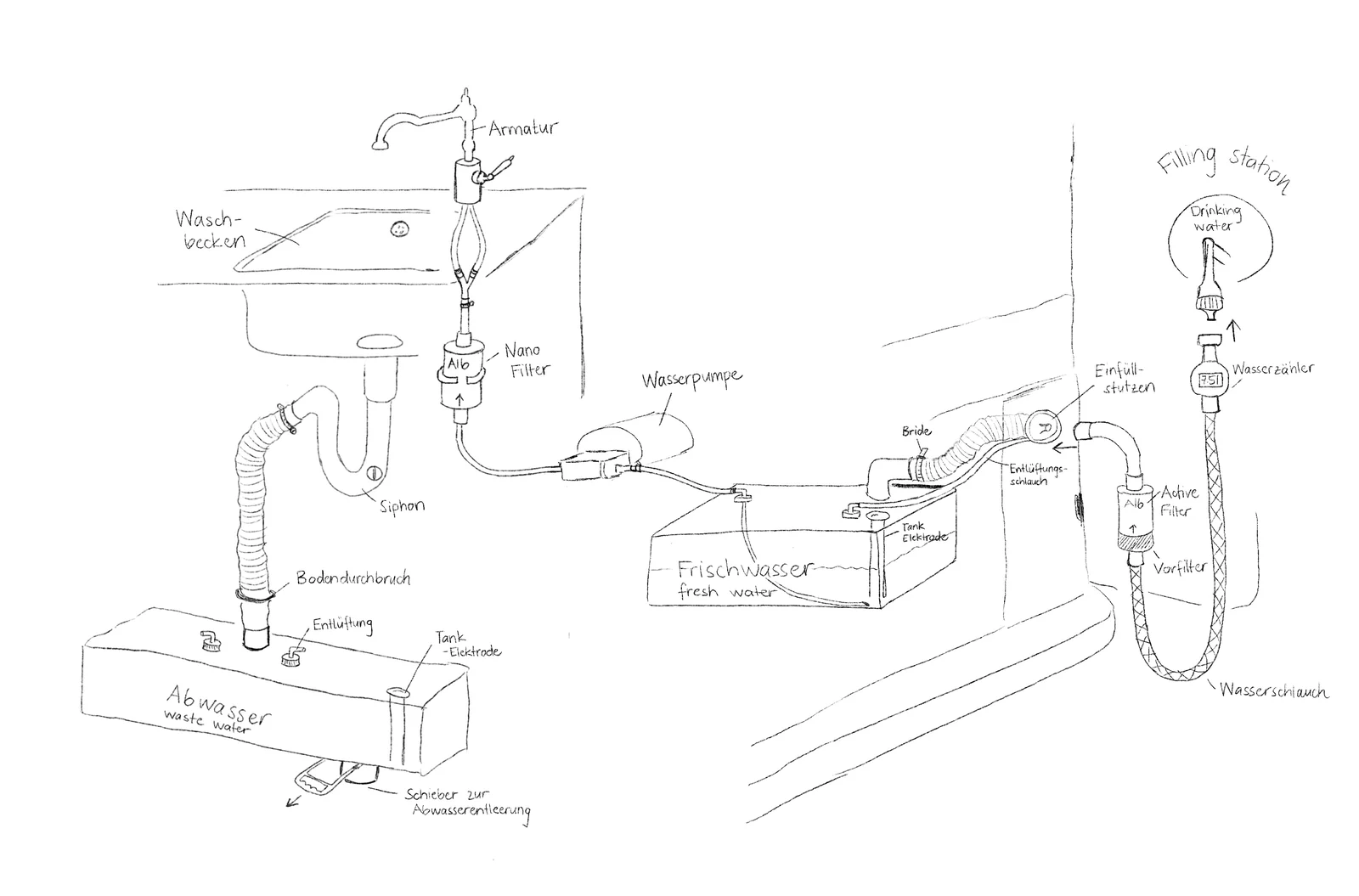
A sketch of the water system we built in
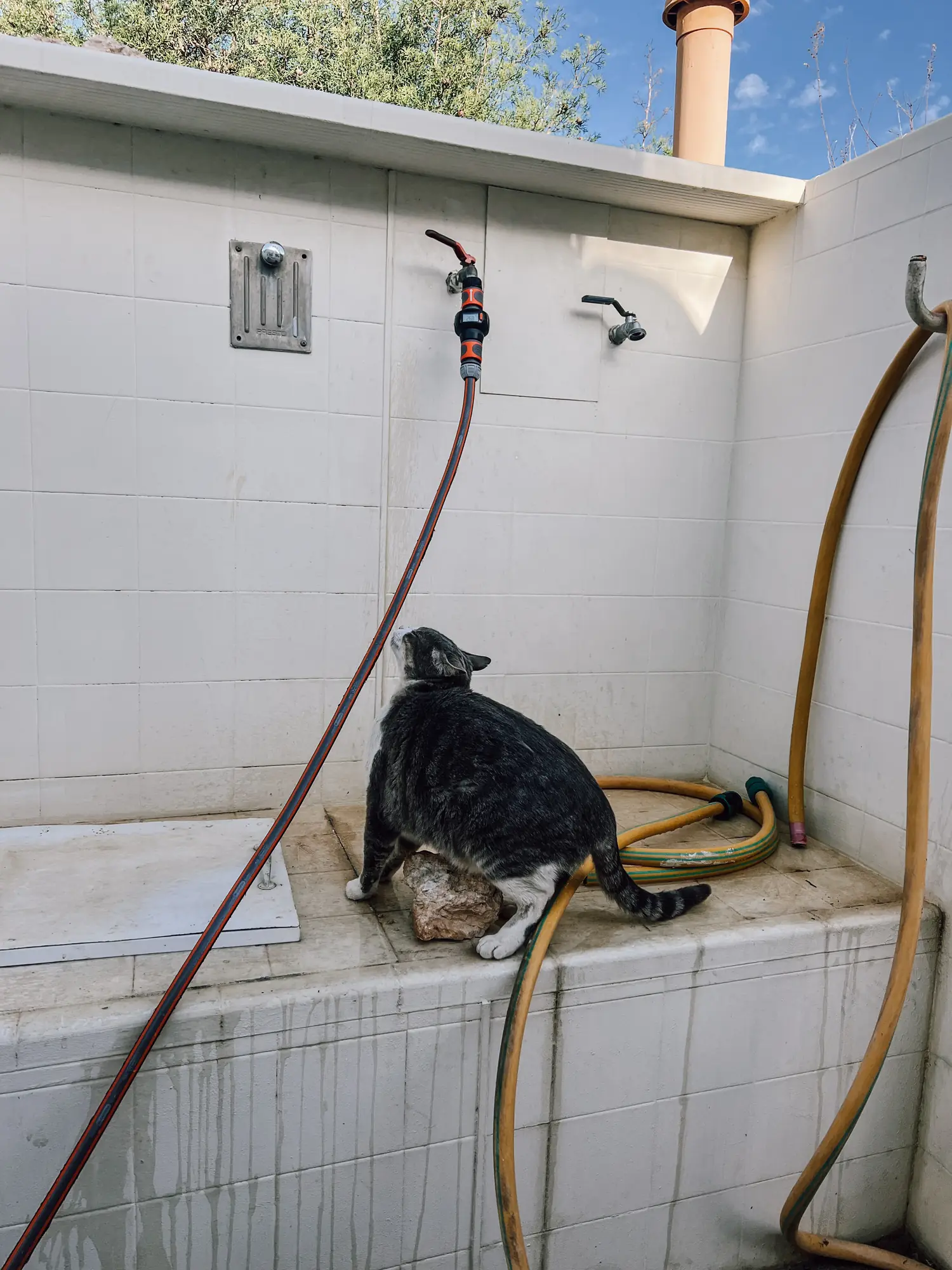
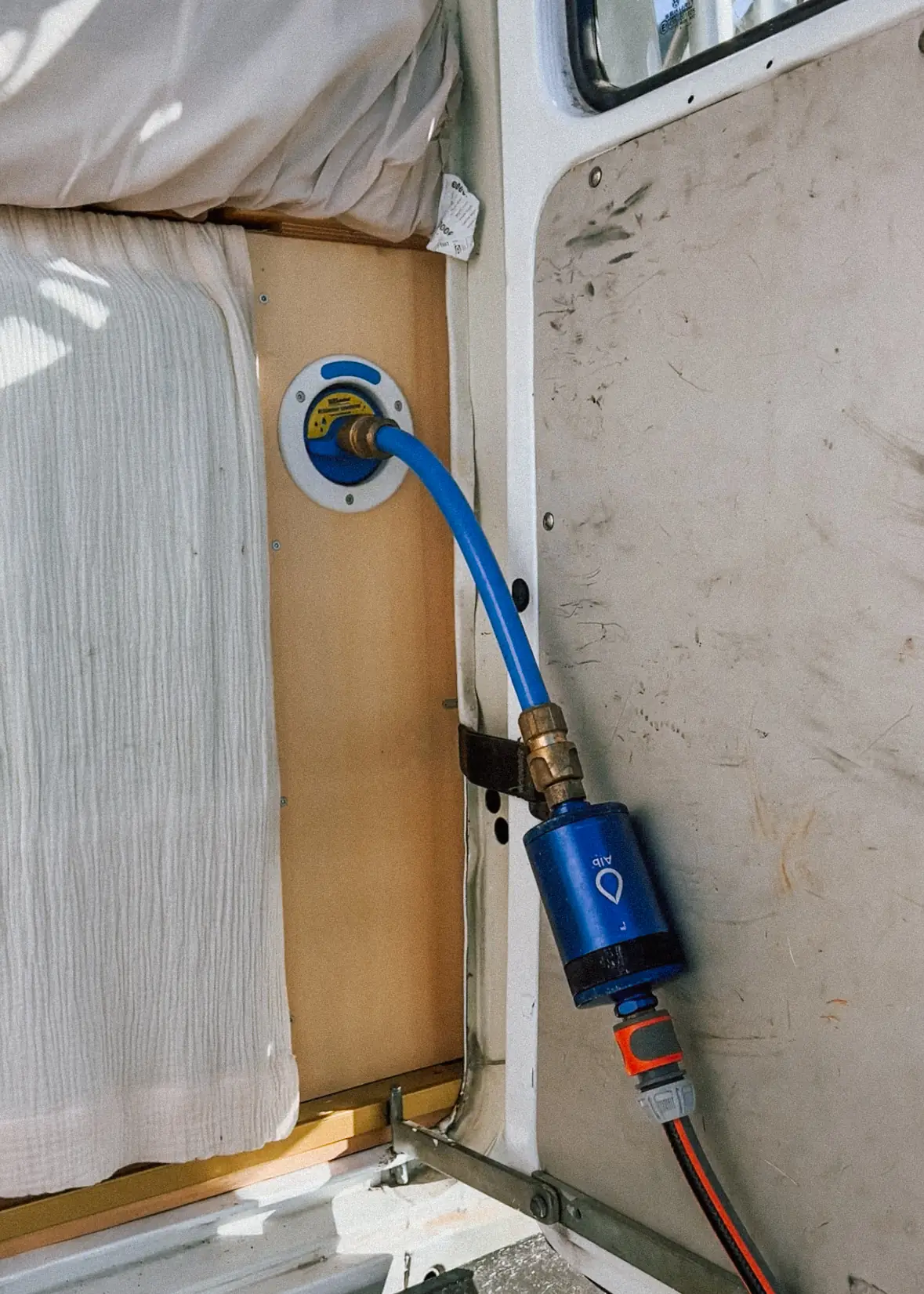
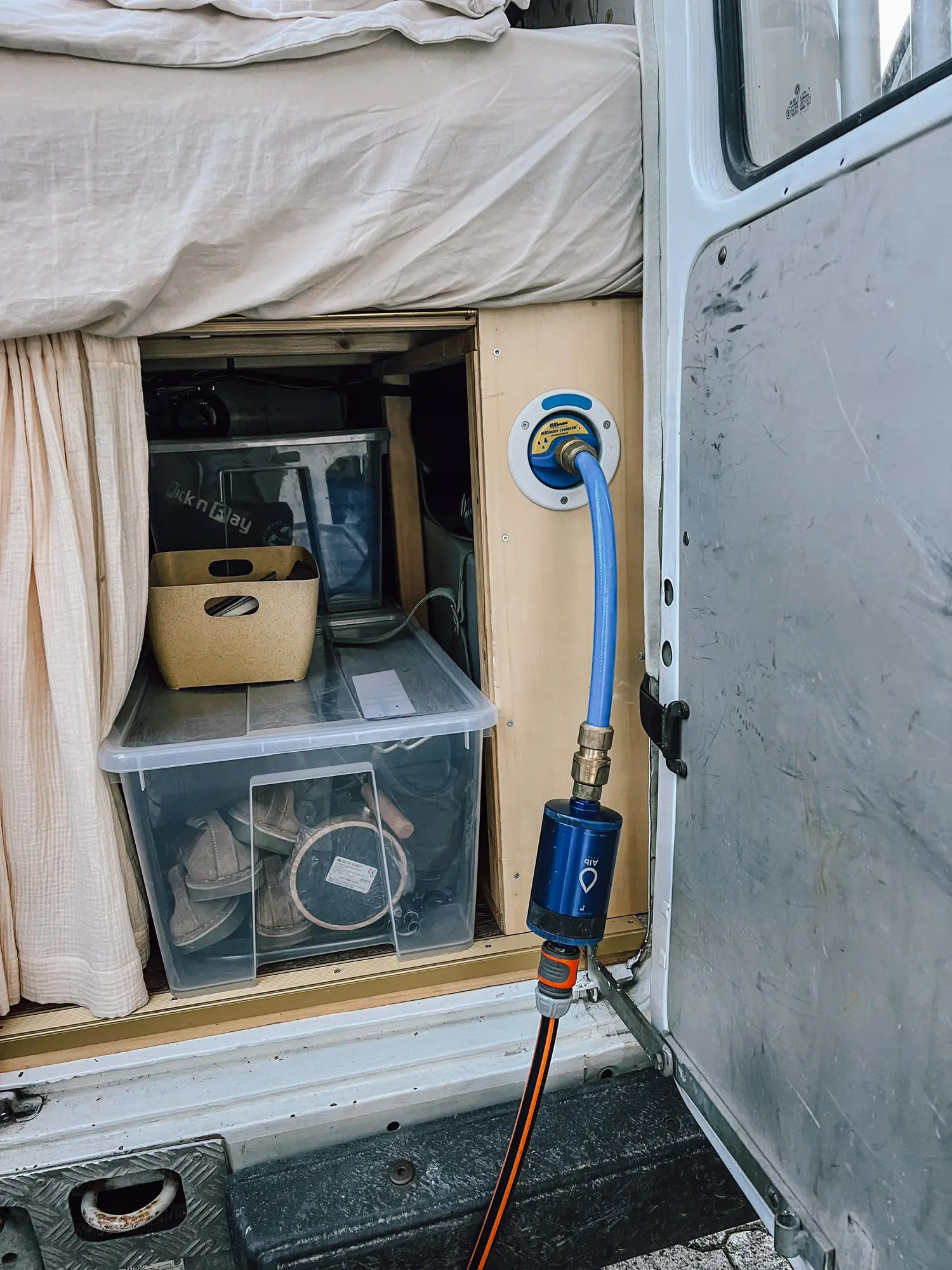
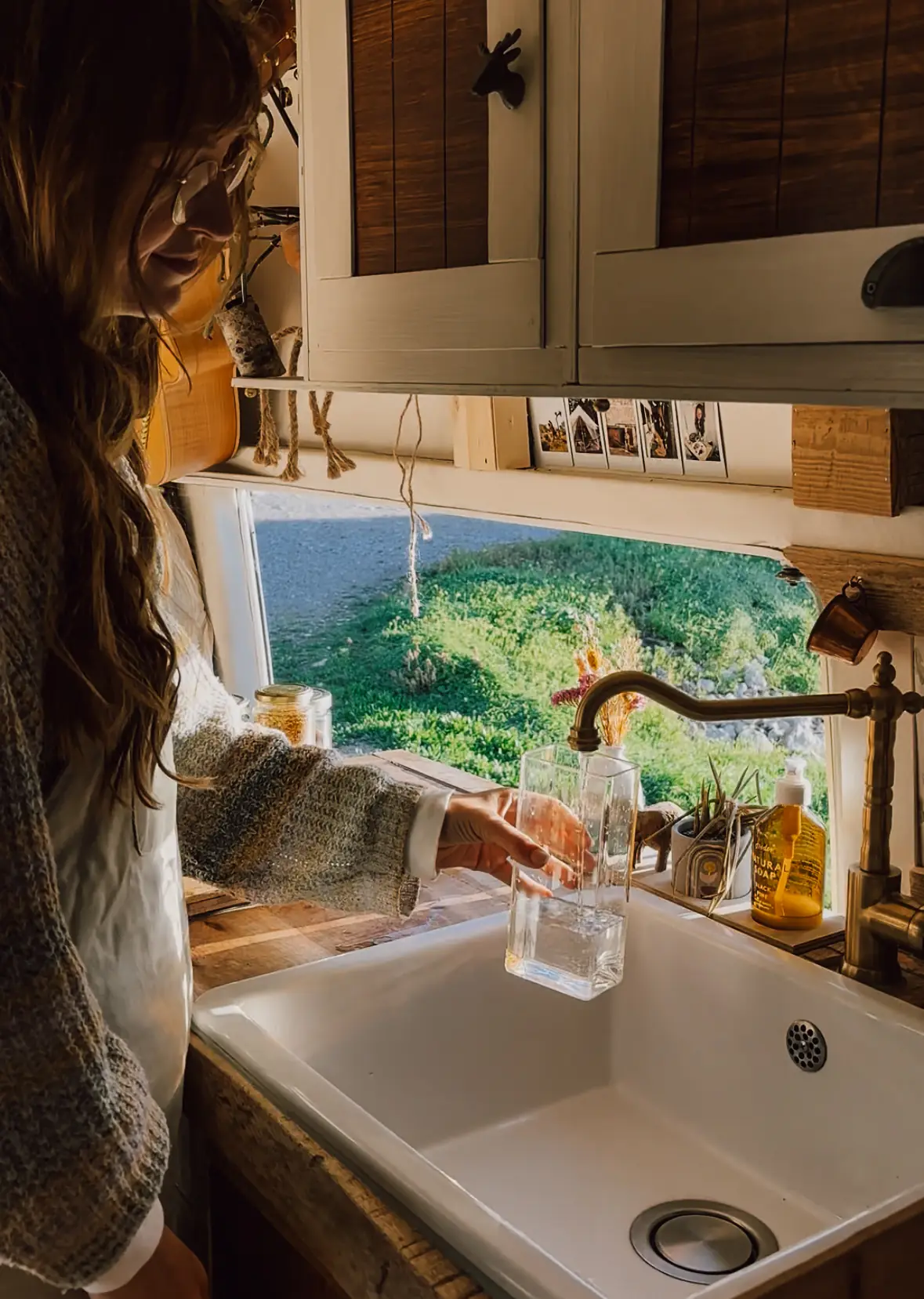
The fresh water runs through a tap adapter and our water meter into the water hose. Before it reaches the fresh water tank it passes through a Protect pre-filter. This holds back larger particles such as sand or sediment, and in doing so it also protects the filter stages that follow.
The water then runs through an Active cartridge with activated carbon. Among other things, this reduces chlorine, substances affecting taste and smell, various organic pollutants and other unwanted substances. The filtered water then reaches our fresh water tank, where it is stored.
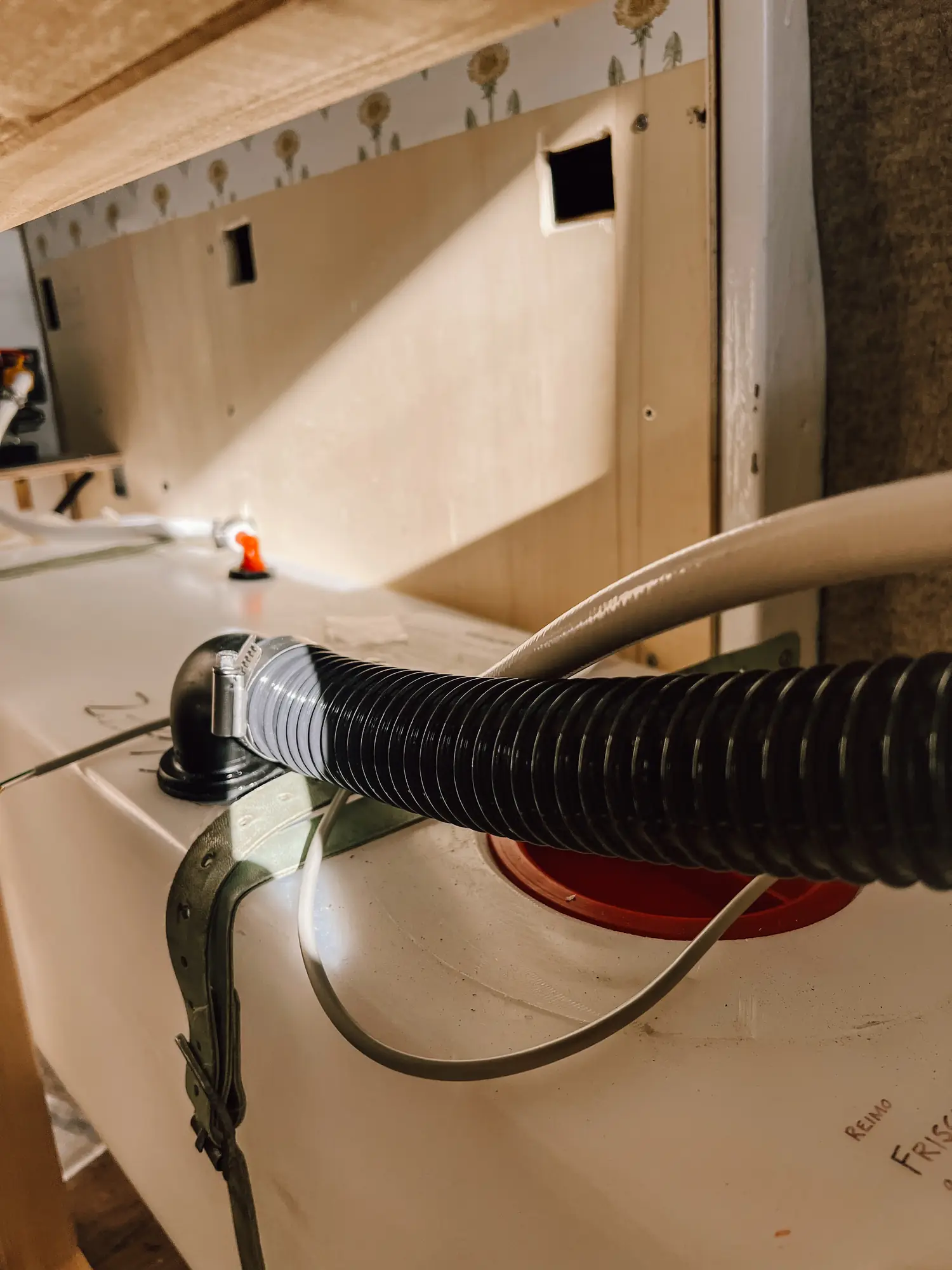
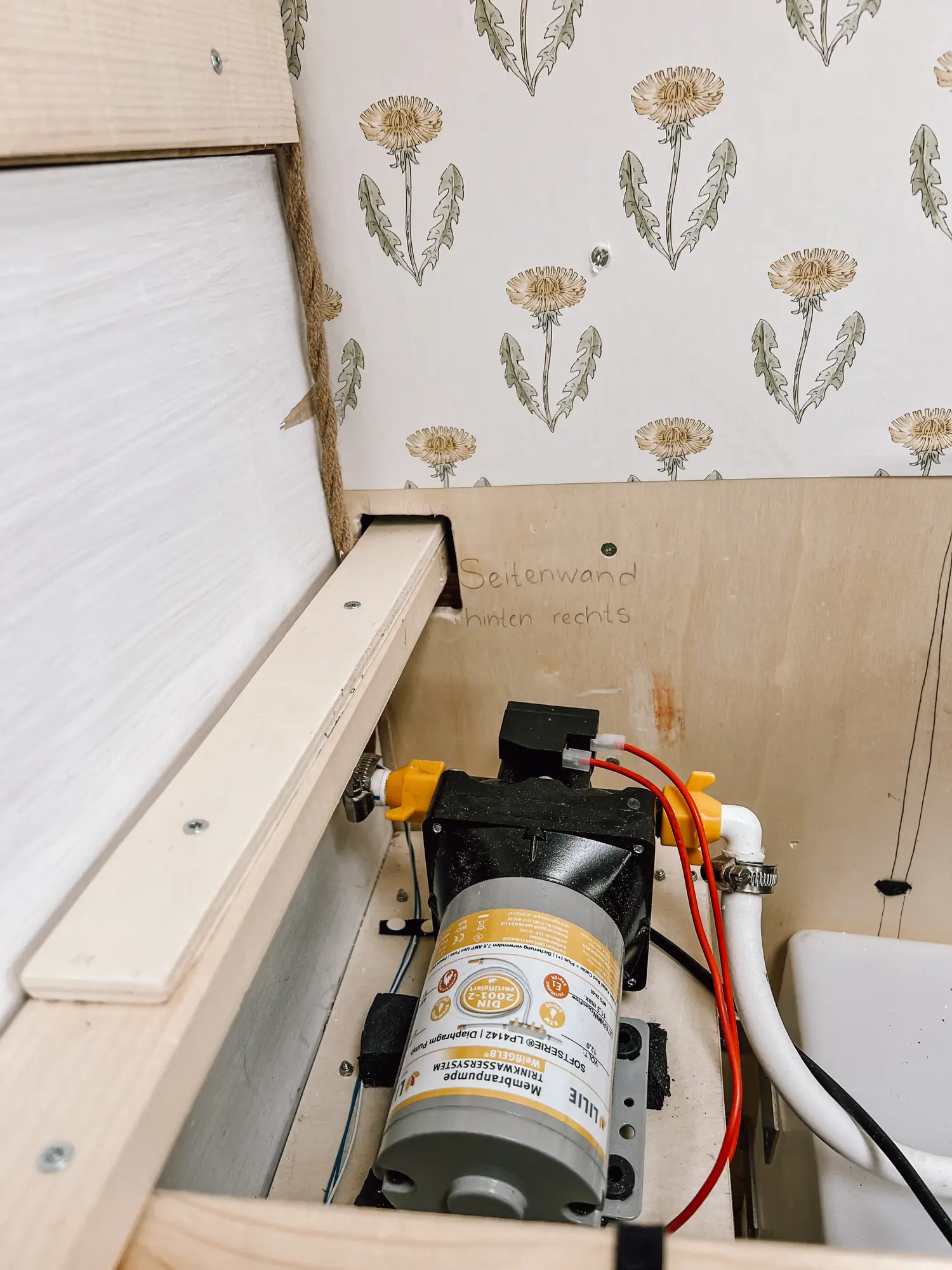
As soon as we need water, we switch on our water pump. It moves the water out of the fresh water tank into our pipework and builds up the pressure needed for the water to flow evenly from the tap. After the pump, the water passes through the Nano germ barrier - a hollow fiber membrane that mechanically holds back germs and bacteria. From there it flows through our mixer tap and out of the faucet.
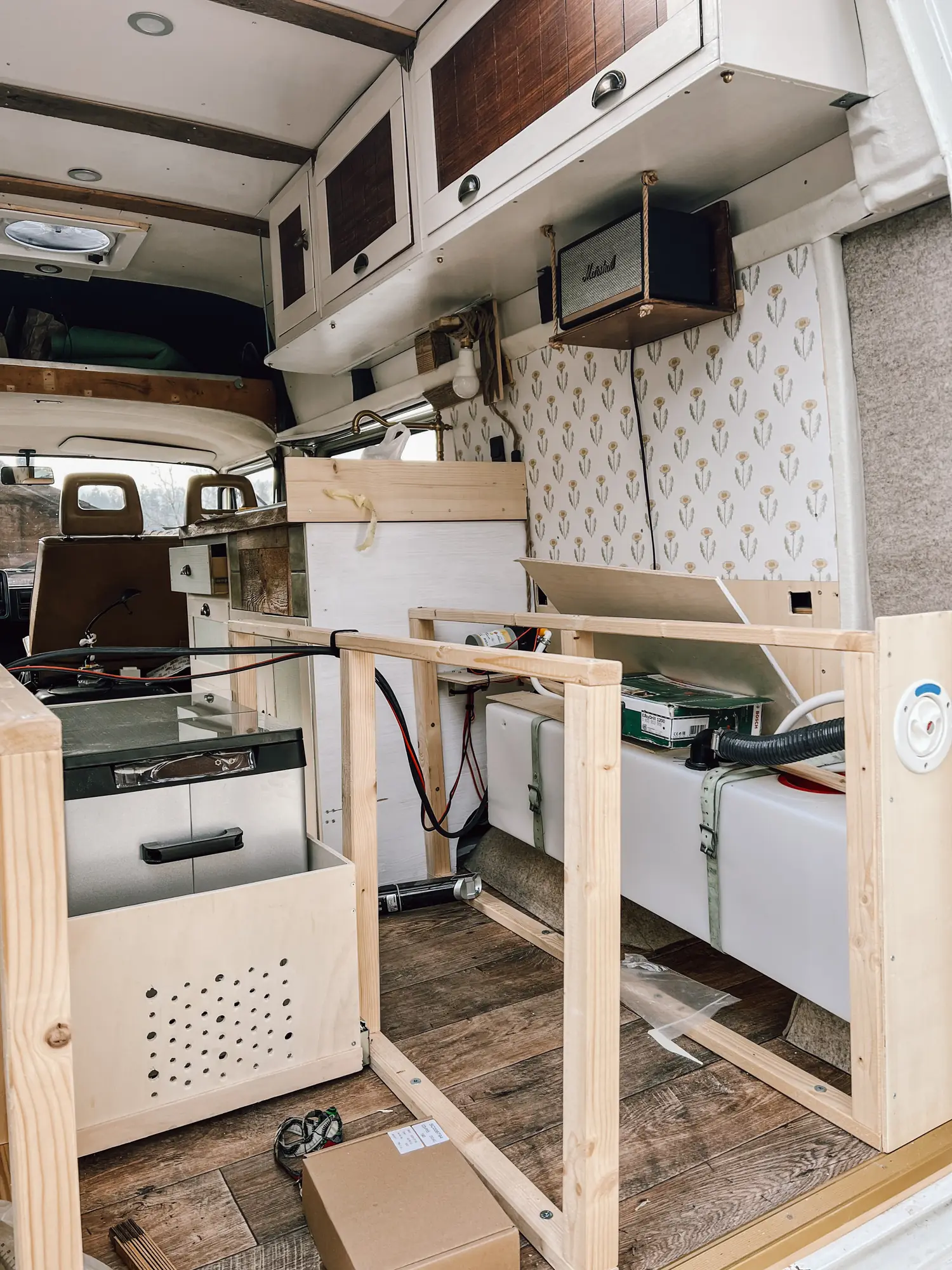
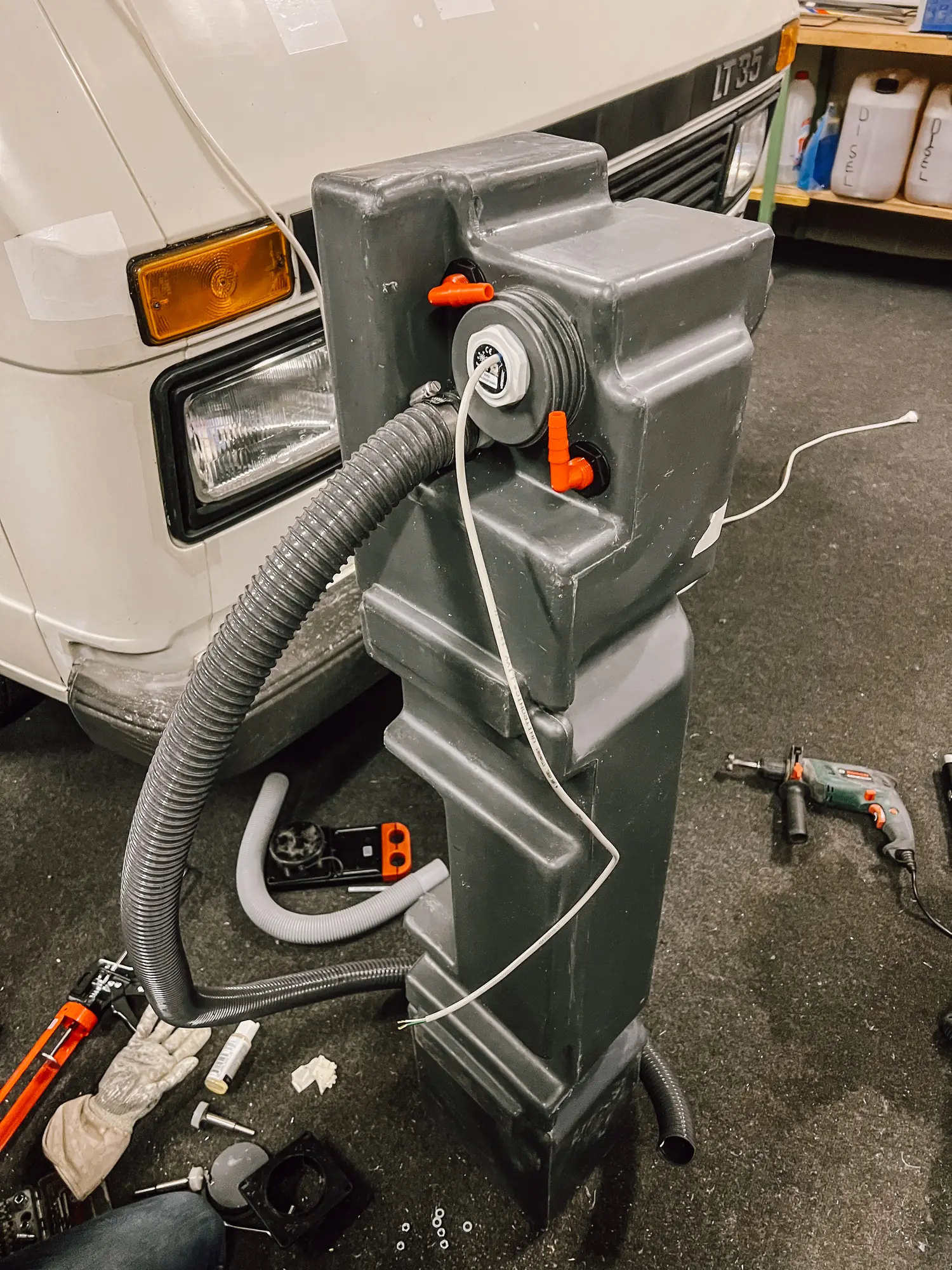
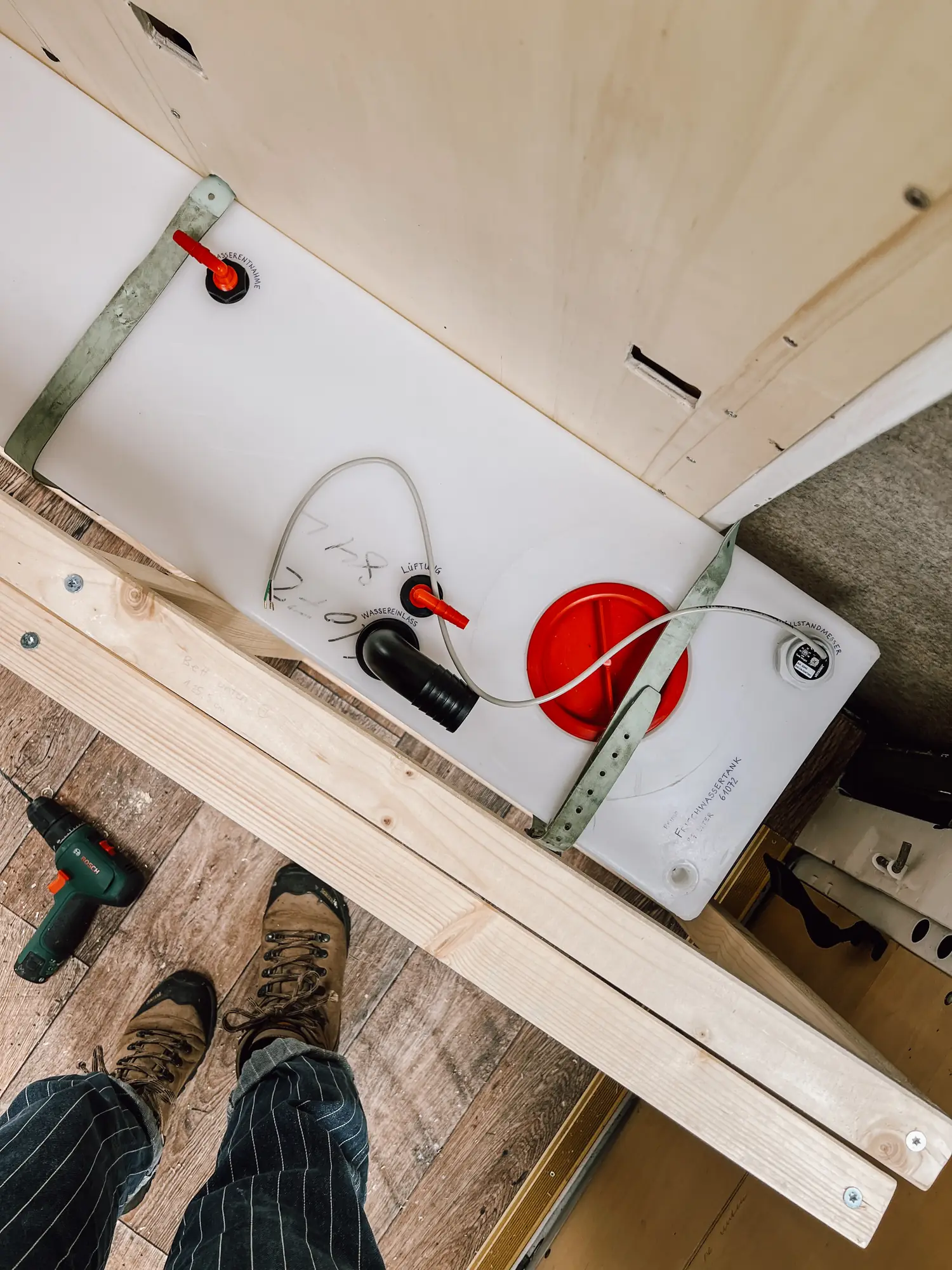
The used water then drains through the siphon. The siphon forms an odor barrier, because there is always water standing in it. From there the waste water runs into our underfloor waste water tank.
The drain into the waste water tank under the vehicle
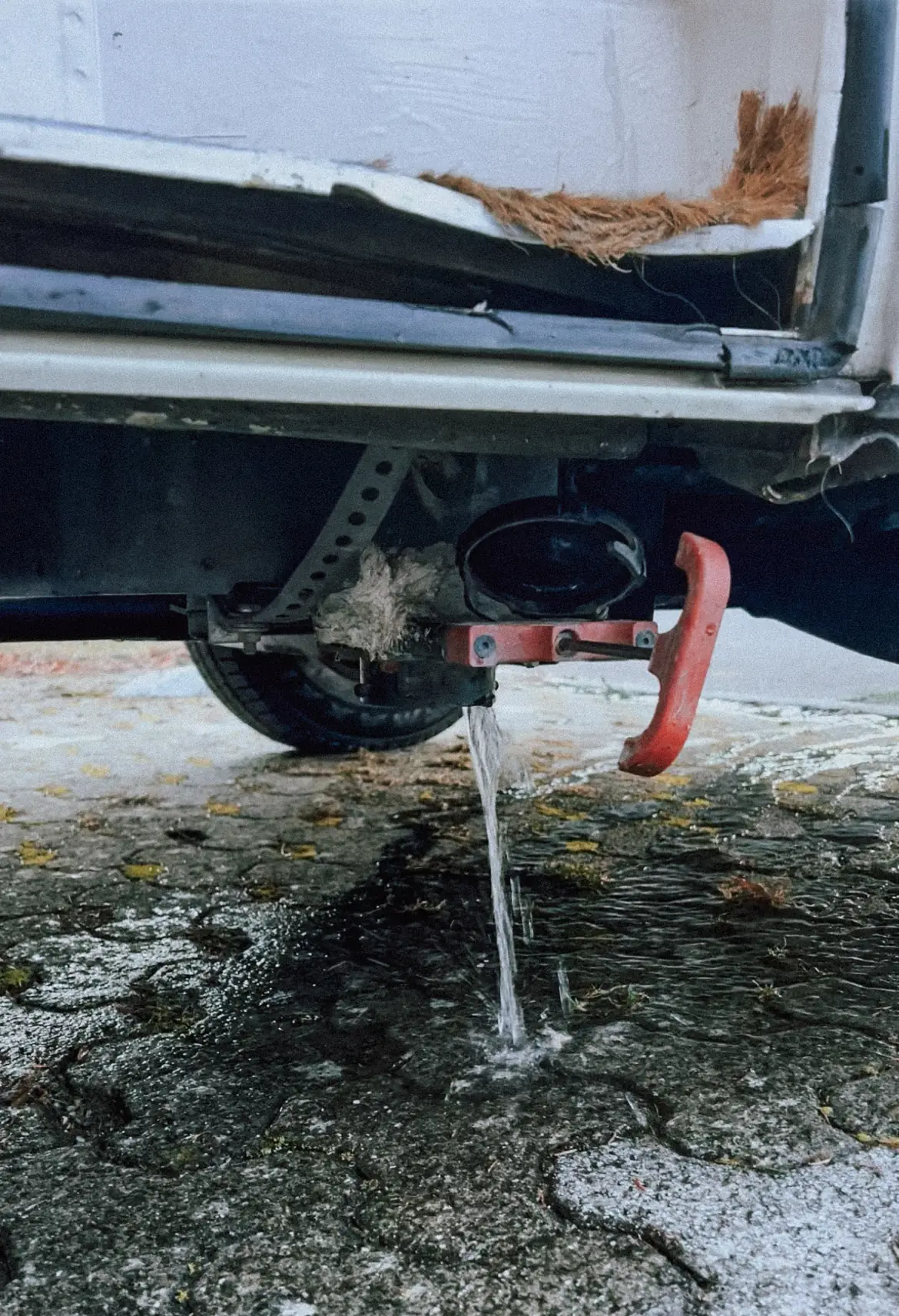
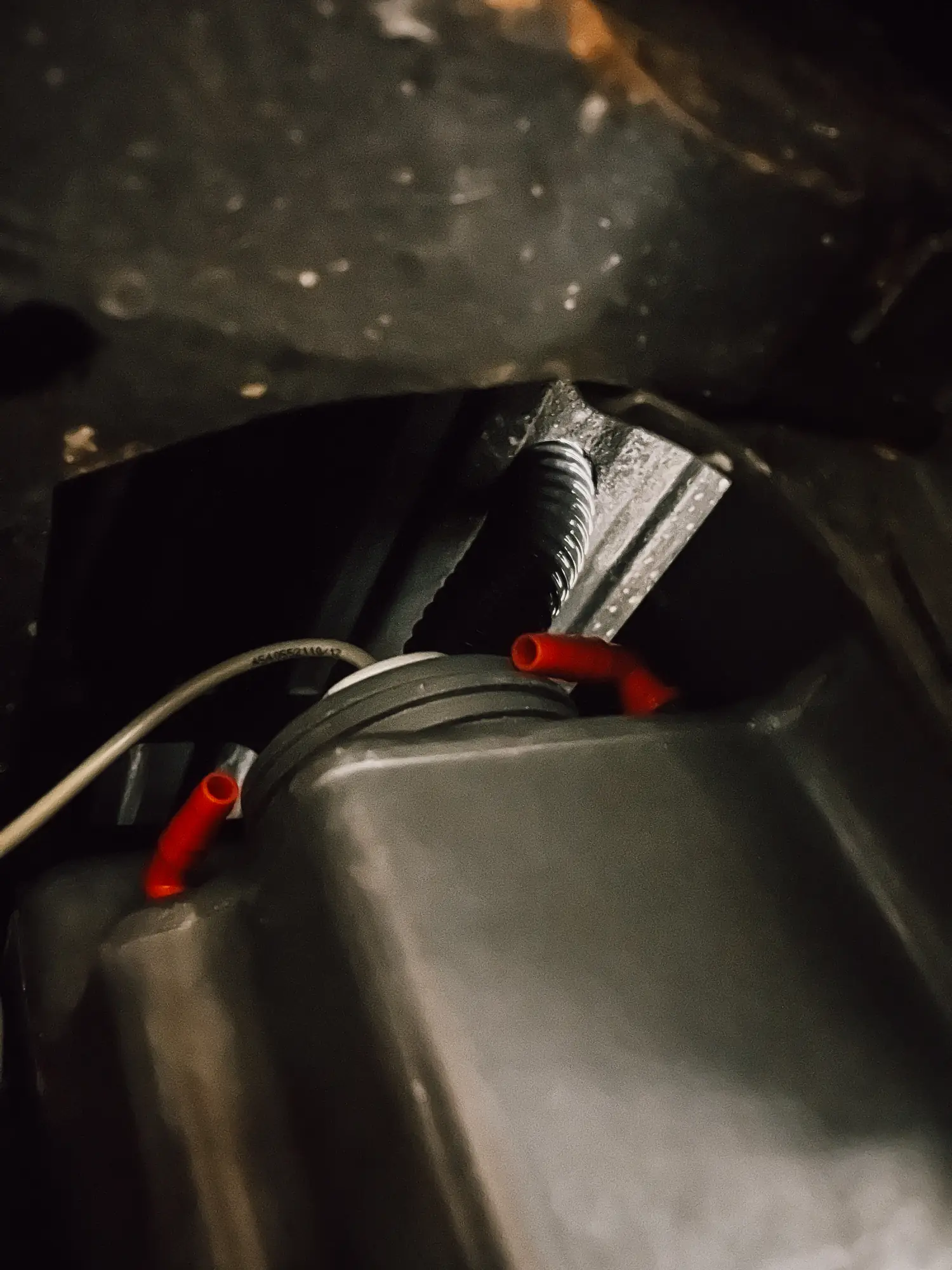
Tank electrodes and an LED display let us check the level in both tanks. Once the waste water tank is full, we can empty it through a valve at a suitable gray water disposal station.
For now we decided against a hot water installation. A boiler or an instantaneous water heater could in principle still be retrofitted later. For that, our pipework would have to be extended and the water routed to the heater or to a mixer tap. As things stand, we therefore do not use the hot water side of our mixer tap either.
Clean, drinkable water, any time
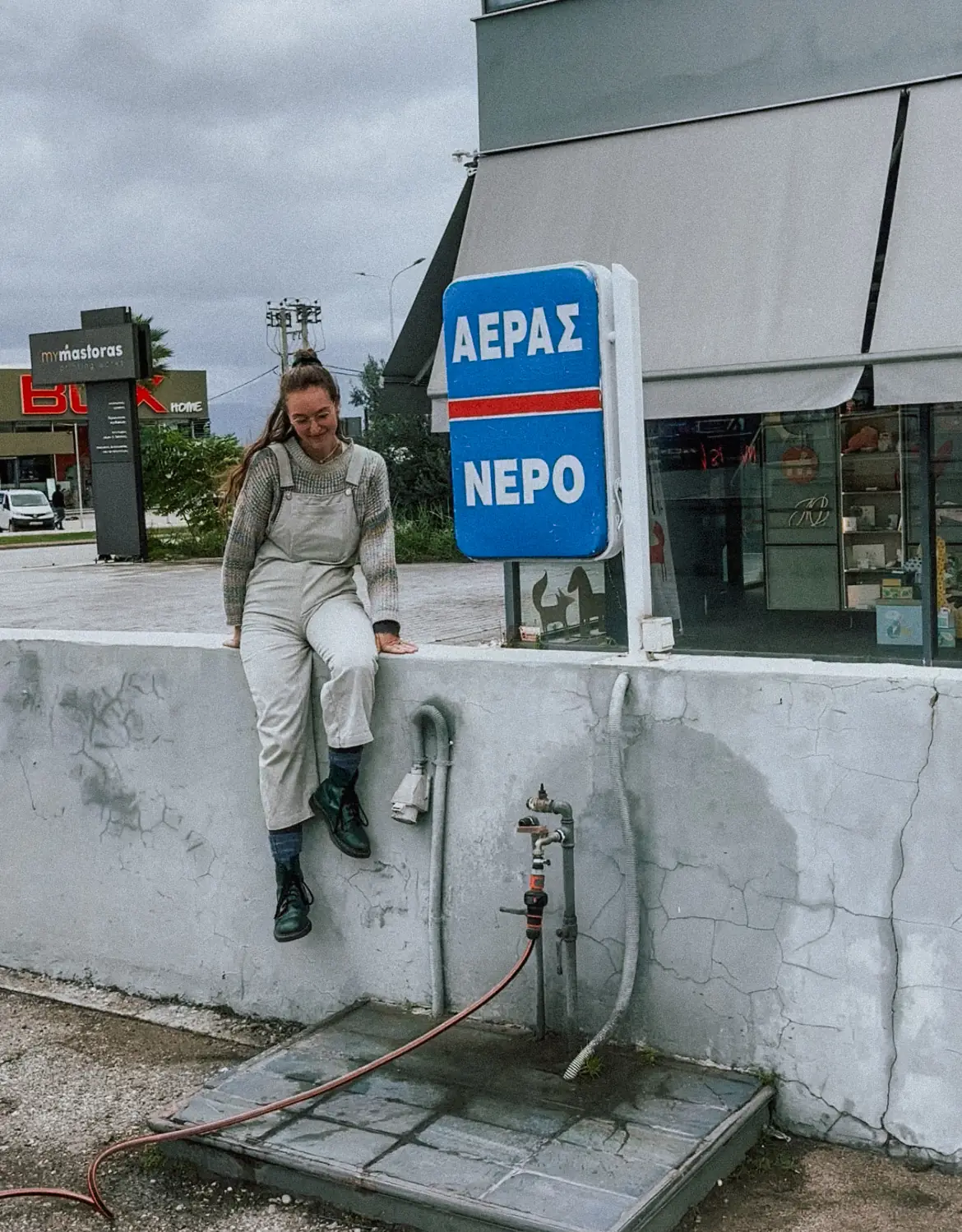
Being as independent and flexible as possible with our drinking water matters a lot to us on the road. We make a point of taking water only from designated drinking water sources. Our filter system then gives us one more stage of filtration before we drink it.
With water from sources like these, we drink it straight from our tap after filtering and do not need to boil it as well.

Clean drinking water thanks to Alb Filter
We filter our water with high-quality water filters from Alb Filter. Depending on the cartridge used, chlorine, microplastics, pharmaceutical residues, pesticides and PFAS can be reduced or held back. At the same time substances affecting taste and smell can be reduced, which can also improve the taste of tap water.
Another advantage for us: the filter cartridges we use are designed so that valuable minerals stay in the water.
And as a nice side effect, we save a great many single-use bottles on the road and can simply prepare our own water.
How the filters work
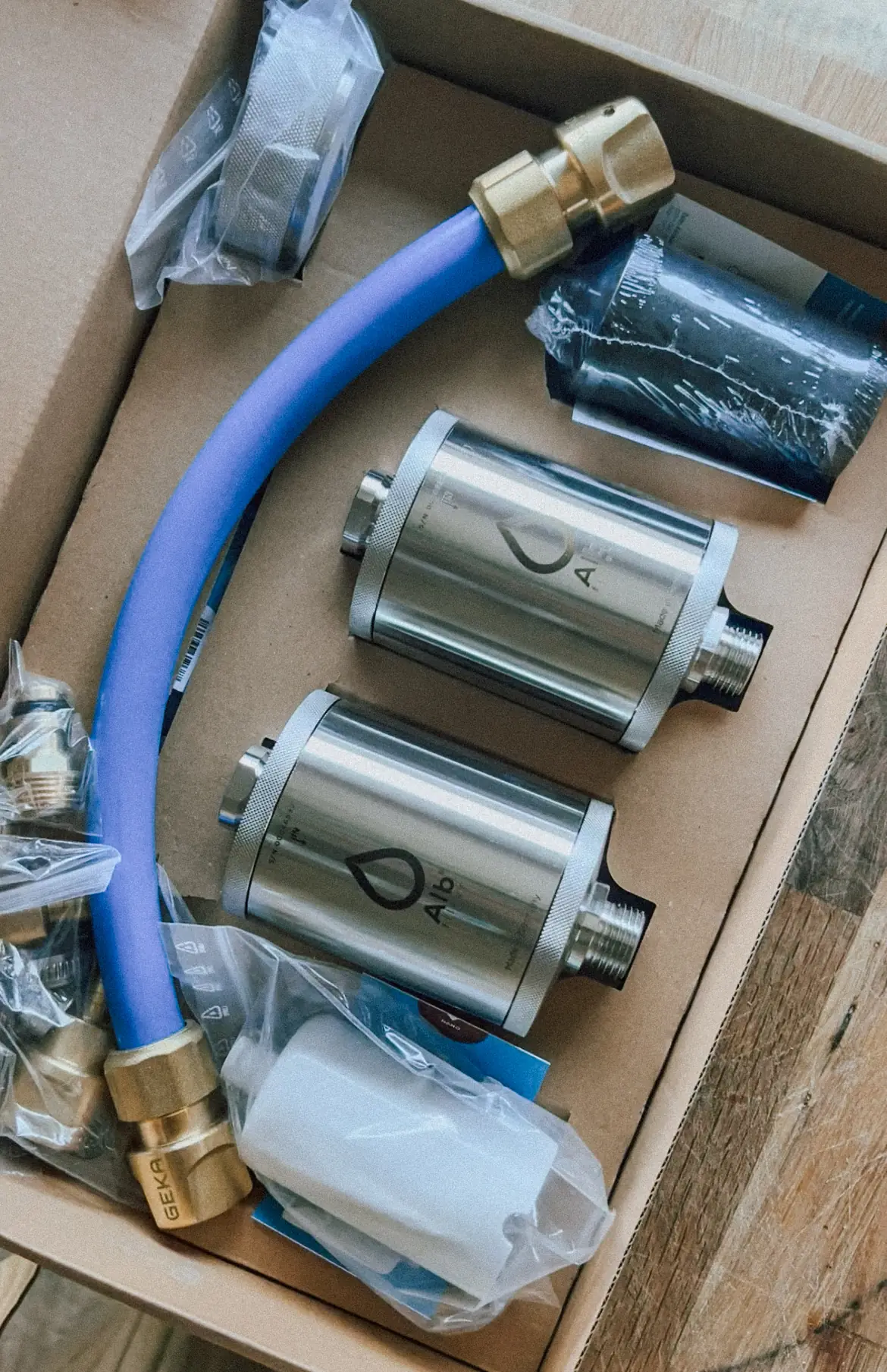
You order the set you need for your project once. In our case that was the Pro Camper set from Alb Filter, for a permanently installed filter system in our vehicle. Alb Filter also offers systems for the home as well as travel filters that do not have to be installed permanently and are easy to take along.
The set contains everything we need for the installation, including a first set of filter cartridges. That also includes the high-quality stainless steel housings the cartridges are fitted into. The Protect pre-filter, which we hang on the hose while filling up, comes in two versions: the aluminium one in a blue housing, which is what we have, and a stainless steel one.
After that, all that is needed is to replace the cartridges regularly, depending on use and water quality.
How long the filters last
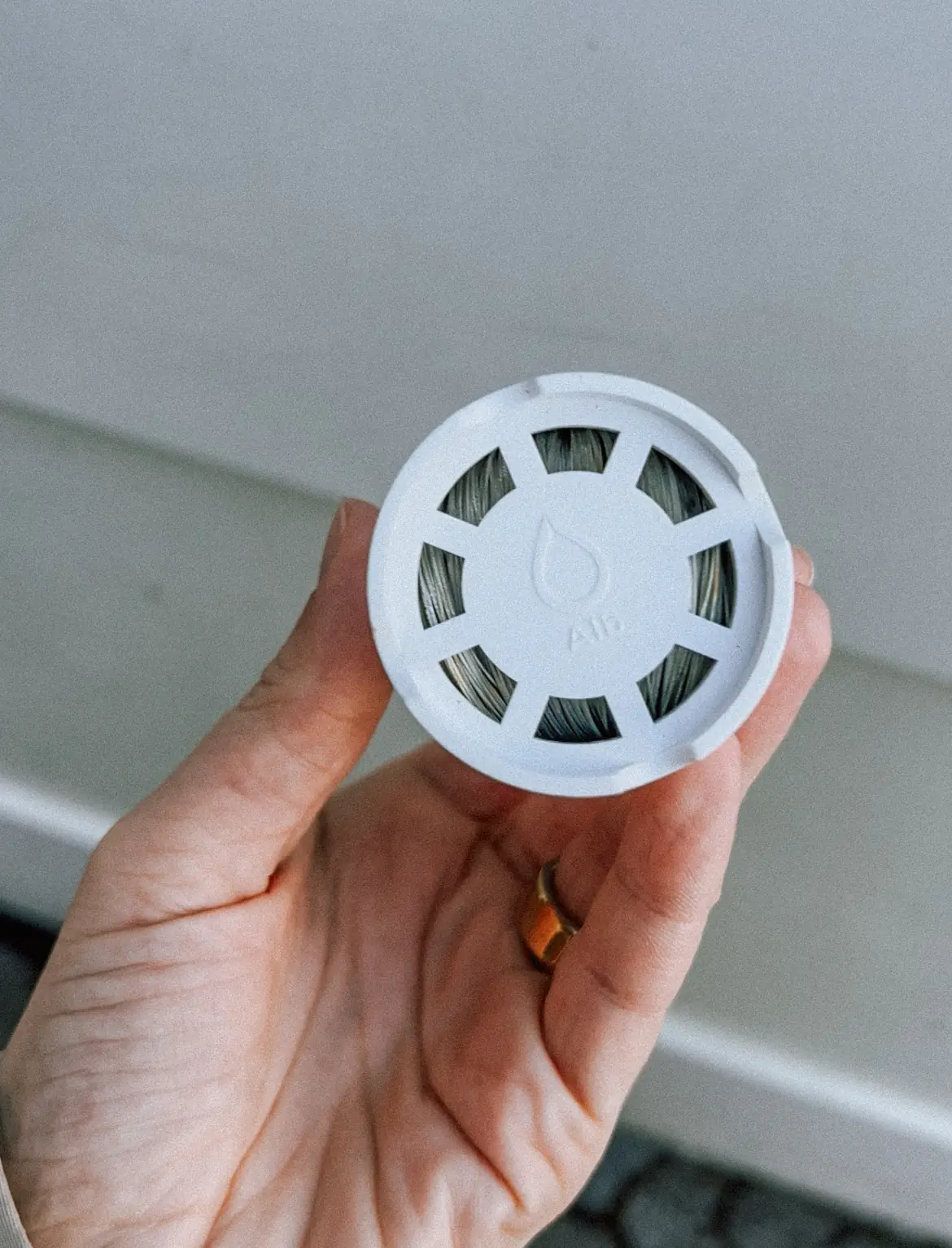
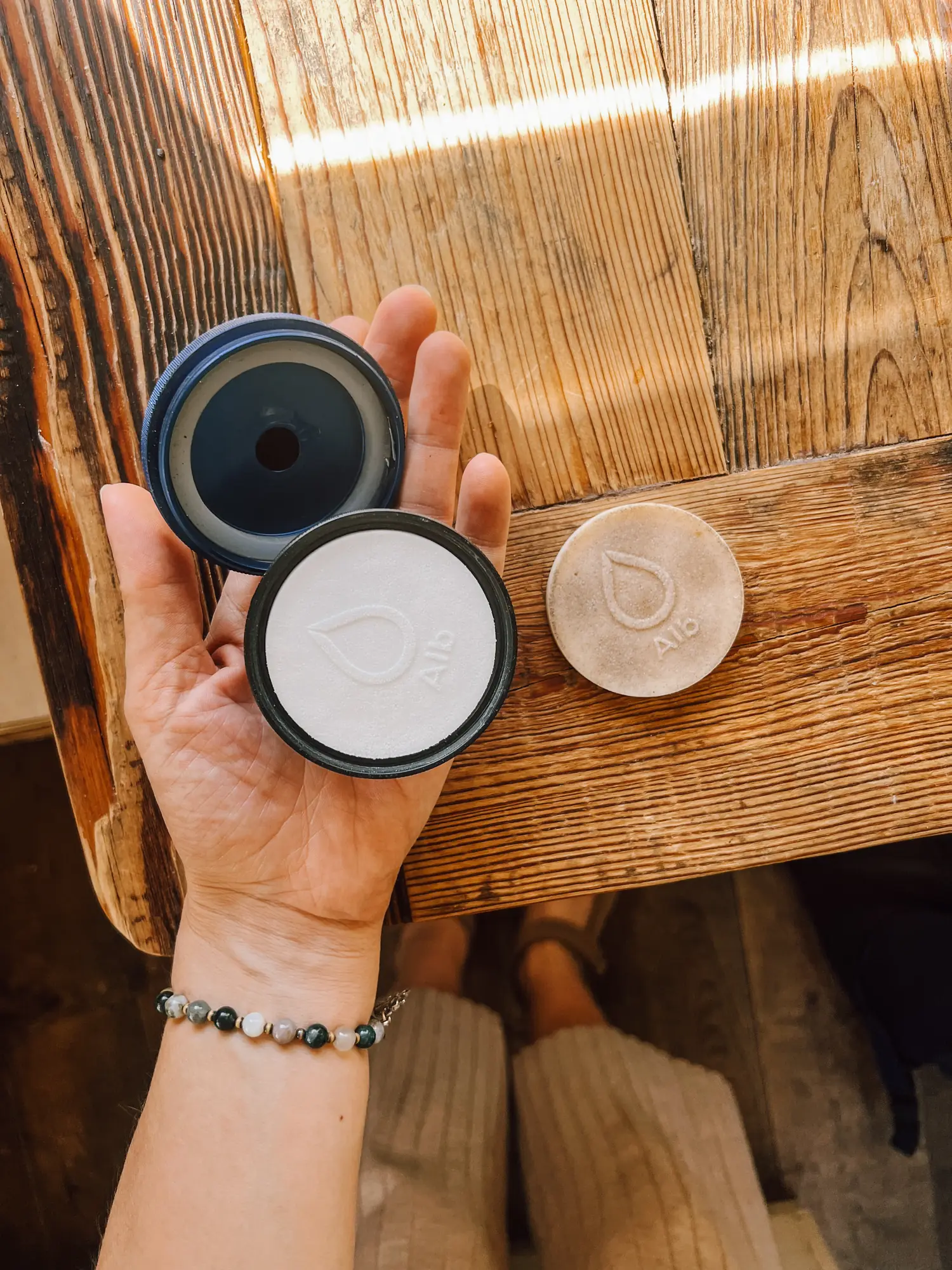
How long a cartridge can be used depends among other things on how much water flows through it and on the quality of the water going in. The more particles or other substances the water carries, the harder the filter has to work.
With every new cartridge, Alb Filter includes a small card where we can note the date we put it into service. That way we keep track of when a cartridge went in.
The flow rate can be another sign that a filter should be changed. If the water flow becomes noticeably slower, that can point to a clogged filter.
We also look at the filters themselves regularly. If our pre-filter is heavily soiled, for instance, we swap it out.
As a rough guide we go by the replacement intervals given by the manufacturer. Actual service life can vary with use and water quality.
- Active cartridge: approx. 4 months
- Nano germ barrier: approx. 6 months
- Protect pre-filter: currently approx. 3 months for us
With the pre-filter in particular we notice how much difference water quality makes. Those three months are therefore our own experience, not a generally valid figure.
If you are working out how often you will need to reorder: replacement cartridges come with 10% off using the code weltenhummler (until 8 October 2026, 5% after that).
Replacement cartridges with 10% off (ad link)
Tank cleaning and hygiene
A good filter system alone does not make a hygienically sound water system. The fresh water tank, the pipes, the fittings and the tap all have to be kept clean and washed out regularly.
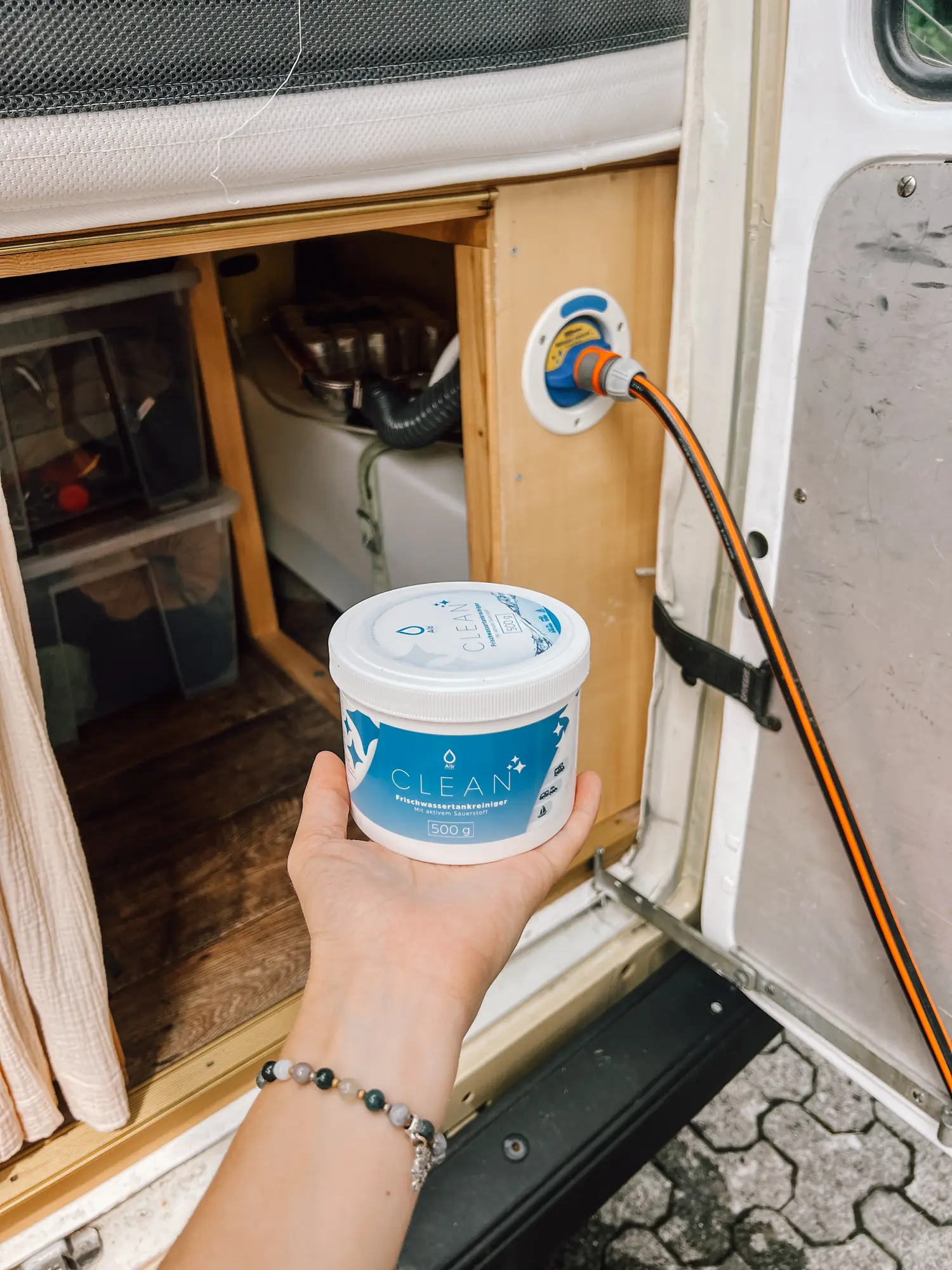
Precisely because our water stays in the tank for several days, cleaning the system is as much a part of water hygiene for us as changing the filters. We get our cleaning agent from Alb Filter too, the Alb Clean tank cleaner, and can warmly recommend it.
If you are planning your own water system, we would not only invest in good filters but also build the whole system to be as hygienic and as easy to reach as possible.
If there is one place in your van conversion not to save money, it is here. Especially when you travel a lot, water quality can differ from source to source and from country to country. We would rather not simply trust that water coming out of a tap somewhere automatically has the quality we want for our drinking water.
Where to find the water filters
To the Alb Filter water filters with 10% off (ad link)
10% off with the code weltenhummler, until 8 October 2026. A permanent 5% after that. Ordering through our link saves you money and at the same time helps us keep traveling with Humbär for a long time to come. That really would make us very happy!
Straight to the individual products: Pro Camper set · Protect pre-filter · Active cartridge · Nano germ barrier · Alb Clean tank cleaner
The full parts list
From fresh water to waste water: everything built into Humbär's water setup, sorted by function.
Fresh water: tank and supply
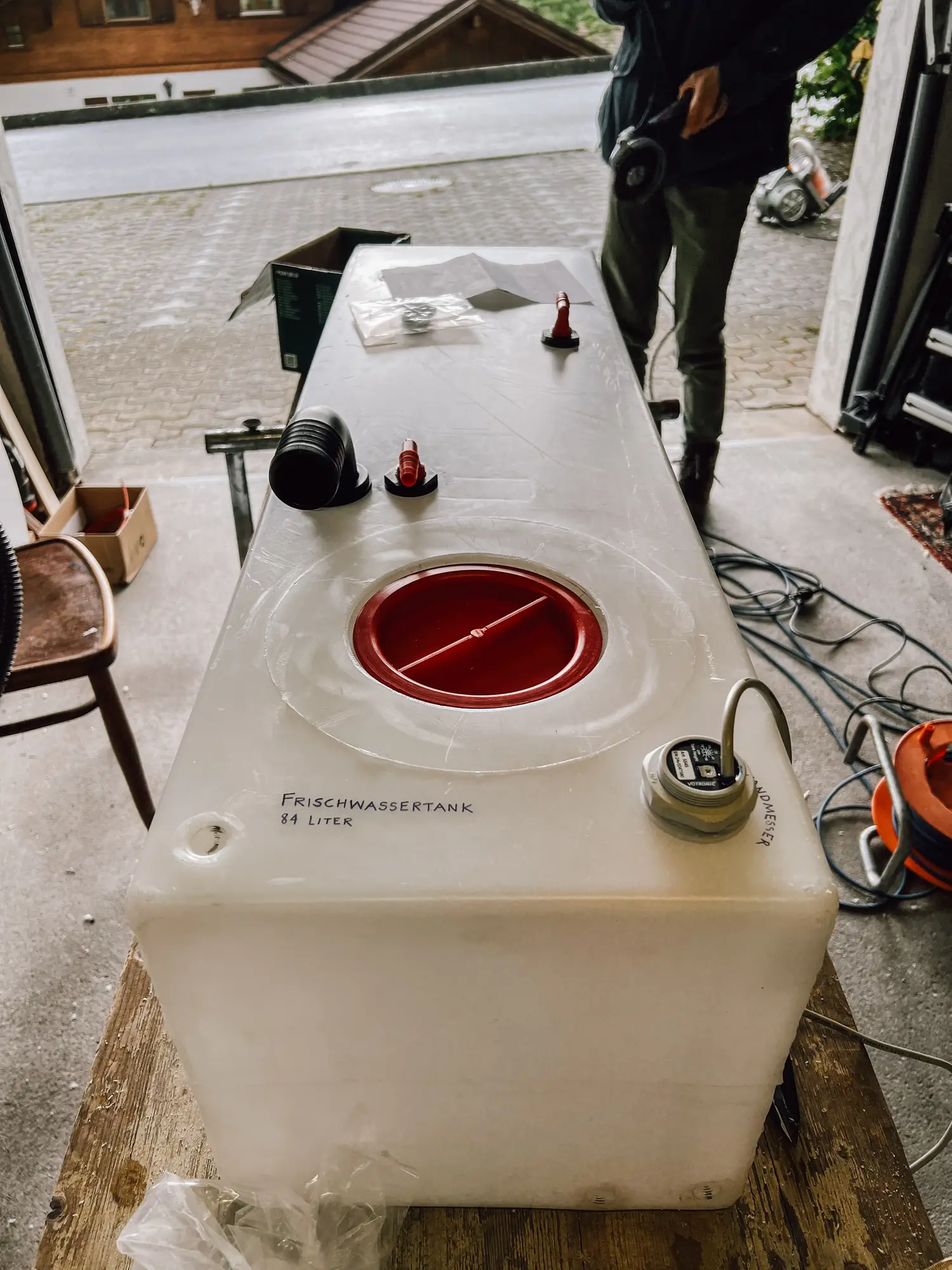
- Fresh water tank: 84 l, rear right in the vehicle
- Water filler neck: Lilie, white
- Hose clamps: Lilie, seawater resistant, 12-22 mm, pack of 2
- Universal water connector: HEOSwater Connector (5251)
- Water hose: Gardena complete set, suitable for drinking water
- Tap connector: Gardena, 21 mm (G 1/2 inch)
- Tap adapter for indoor taps: Gardena
- Water meter: Gardena AquaCount
- Pre-filter: Alb Filter Protect pre-filter and Alb Filter Active activated carbon cartridge
- Tank electrode: Votronic 15-50 K
- Fresh water tank gauge: Votronic LED bar display, 12/24 V
- Tank connection fitting: angled, 40 mm
Fresh water: outlet
-
Pressure pump: Lilie Soft series LP4142, 11.3 l/min, 2.1 bar
-
Alb Filter Nano germ barrier: Nano germ barrier from the Alb Filter Pro Camper set
-
Drinking water hose: Lilie Native, 10/16 mm, blue, cold water, 5 m
-
Y-piece: 10 mm, with 2 shut-off valves
-
Hose tails: 2 x 3/8 inch, household tap to 10 mm hose
-
Tank cleaner: Alb Clean, for the fresh water tank and the pipework
Sink and kitchen
- Sink: IKEA HAVSEN
- Siphon: IKEA Lillviken
- Cover cap: IKEA Lillviken
- Tap: IKEA Glittran
Waste water
- Waste water tank: 53 l, underfloor (sold as a water tank for the VW T4, 1990-2003)
- Mounting kit: for water tanks
- Waste water valve: 3", SB
- Tank electrode: Votronic 12-24 K (waste water)
- Waste water tank gauge: Votronic S, 12/24 V, LED bar display
Shared between fresh and waste water
- Tank connection fitting: straight, 40 mm
- Spiral hose: 2 x ultra-flexible, 40 mm
- Elbow fittings: 4 x for water outlets
- Hose clamps: 4 x worm drive, 30-45 mm
Deliberately left out
- Hot water: no boiler and no instantaneous heater, though both could be retrofitted
- Shower: a solar shower on the outside of the van instead of a wet room inside
All components are matched to one another for a self-sufficient fresh and waste water system. Ours sit in a VW LT35, but the same setup carries over to any other camper or motorhome conversion.
Questions and answers
How big should the water tanks in a camper be?
That depends entirely on how much water you use, what you have planned and how big your camper is.
We built in an 84 l fresh water tank and a 53 l waste water tank. We are very happy with the amount of fresh water. It lets us stay off-grid for up to a week if we use it sparingly.
That said, we like washing dishes with a bit more water, we occasionally use it for showering too, and so we prefer to change our fresh water about every five days.
Our waste water tank sits underfloor. We would have liked it a little bigger - around 70 l would have been ideal for us - but the way our vehicle is built, that unfortunately was not possible.
So it is usually not the fresh water but the waste water that forces us to find a disposal station. With the way we use it, though, our waste water tank also lasts a good four to five days.
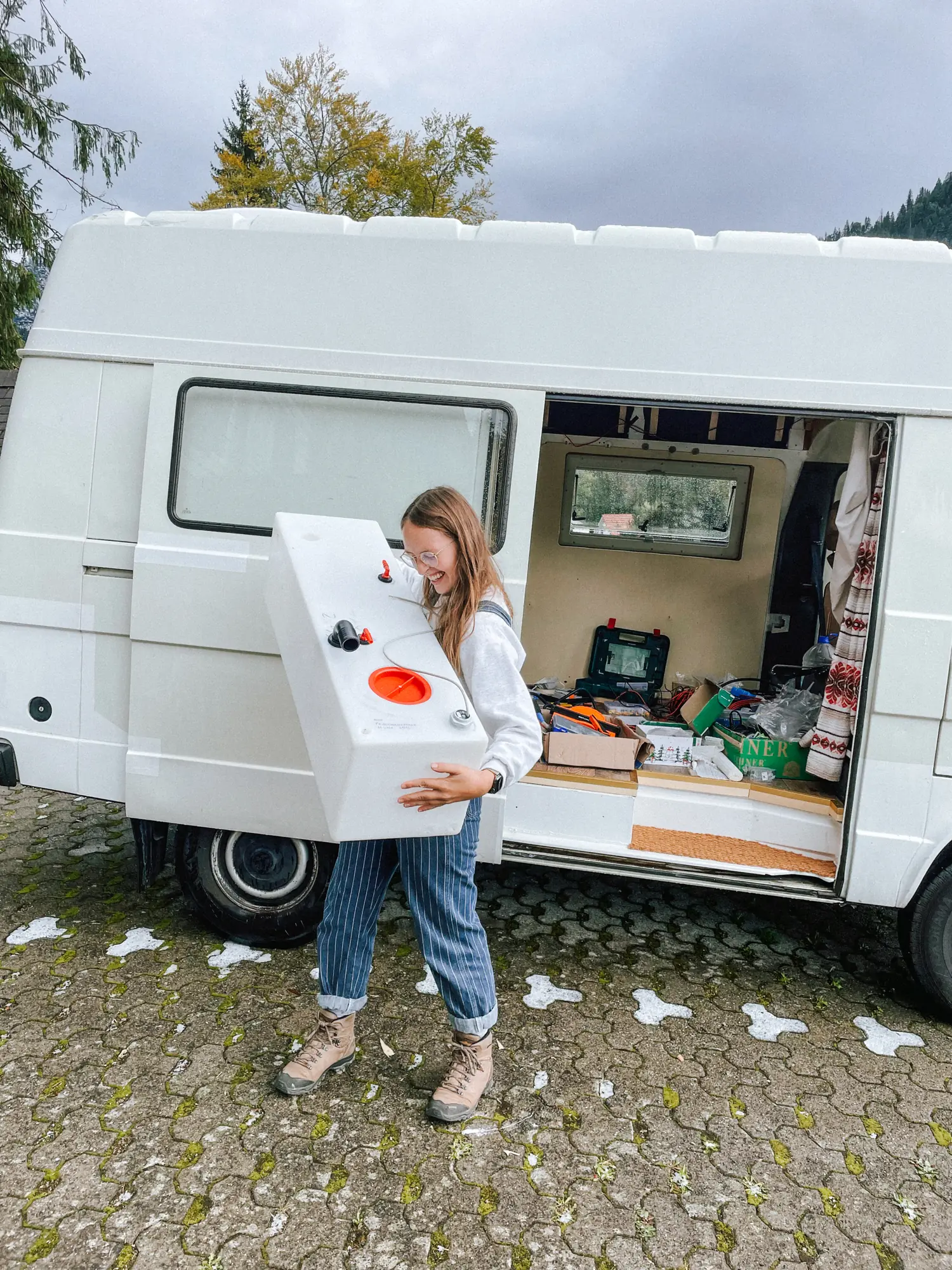
How do you fill a fresh water tank?
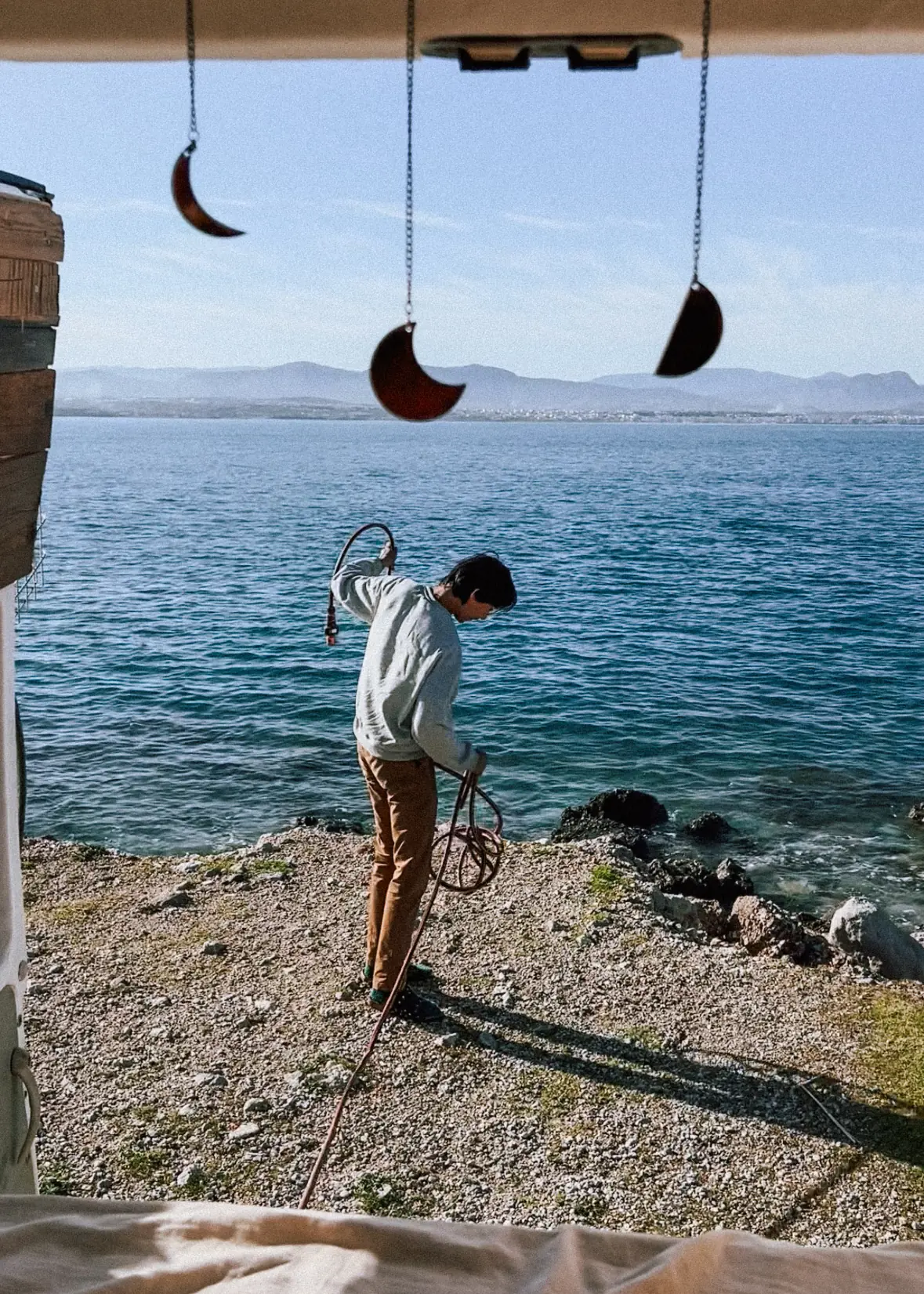
For filling up we use our Gardena water hose, which is suitable for drinking water.
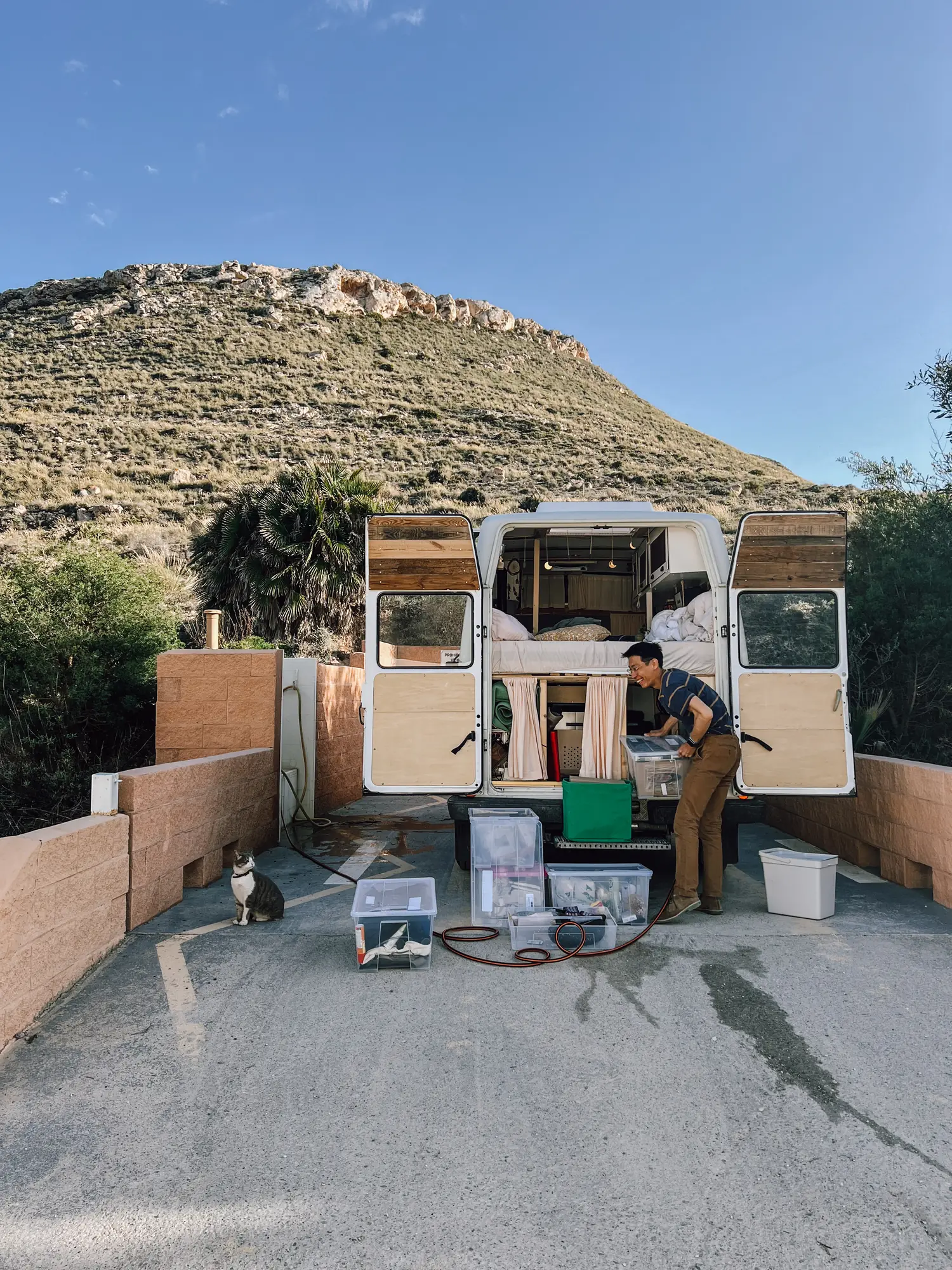
At the water source we fit a matching adapter, to which we then connect our water meter and the hose. It pays to carry adapters in several diameters, because connections differ from country to country and from source to source.
We also carry a tap adapter for indoor taps. With it we can fill up even when our adapter will not connect directly to the tap.
At the other end of the hose we fit our Protect pre-filter and the Active cartridge from Alb Filter. That way the water is already pre-filtered while the tank is filling, with various unwanted substances reduced and particles held back before it ever reaches our fresh water tank.
How does the water get from the tank to the tap?
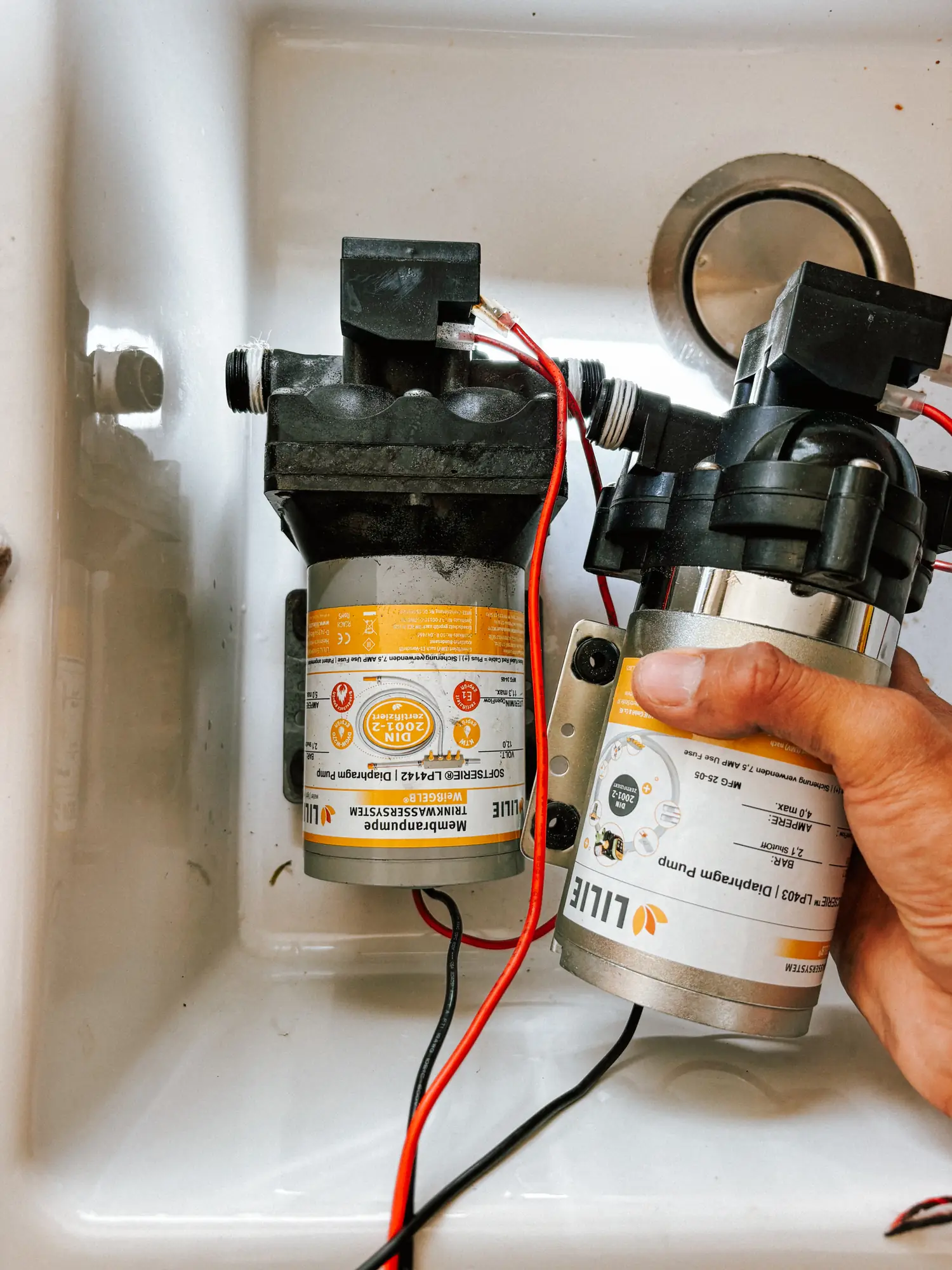
We built in a pressure water pump, which we switch on with an on/off switch.
The pump moves the water out of the fresh water tank into our pipework and builds up the pressure needed. That is what lets the water flow evenly from our tap.
After the pump, the water passes through the Nano germ barrier. The hollow fiber membrane inside it mechanically holds back germs and bacteria.
From there the water goes through our mixer tap and out of the faucet.
How do we shower in vanlife?
Because our vehicle only offers limited space, we decided against a shower inside.
Instead we carry a simple solar shower that we can hang on the outside of the van. When it is colder, we heat the water in our kettle and then pour it into the solar shower.
When showering outdoors we make sure to use biodegradable products and to keep a good distance from any body of water.
We also quite like visiting a public shower now and then, going to an indoor pool, or using our emergency shower - for which we simply turn our big kitchen sink into a small "shower".
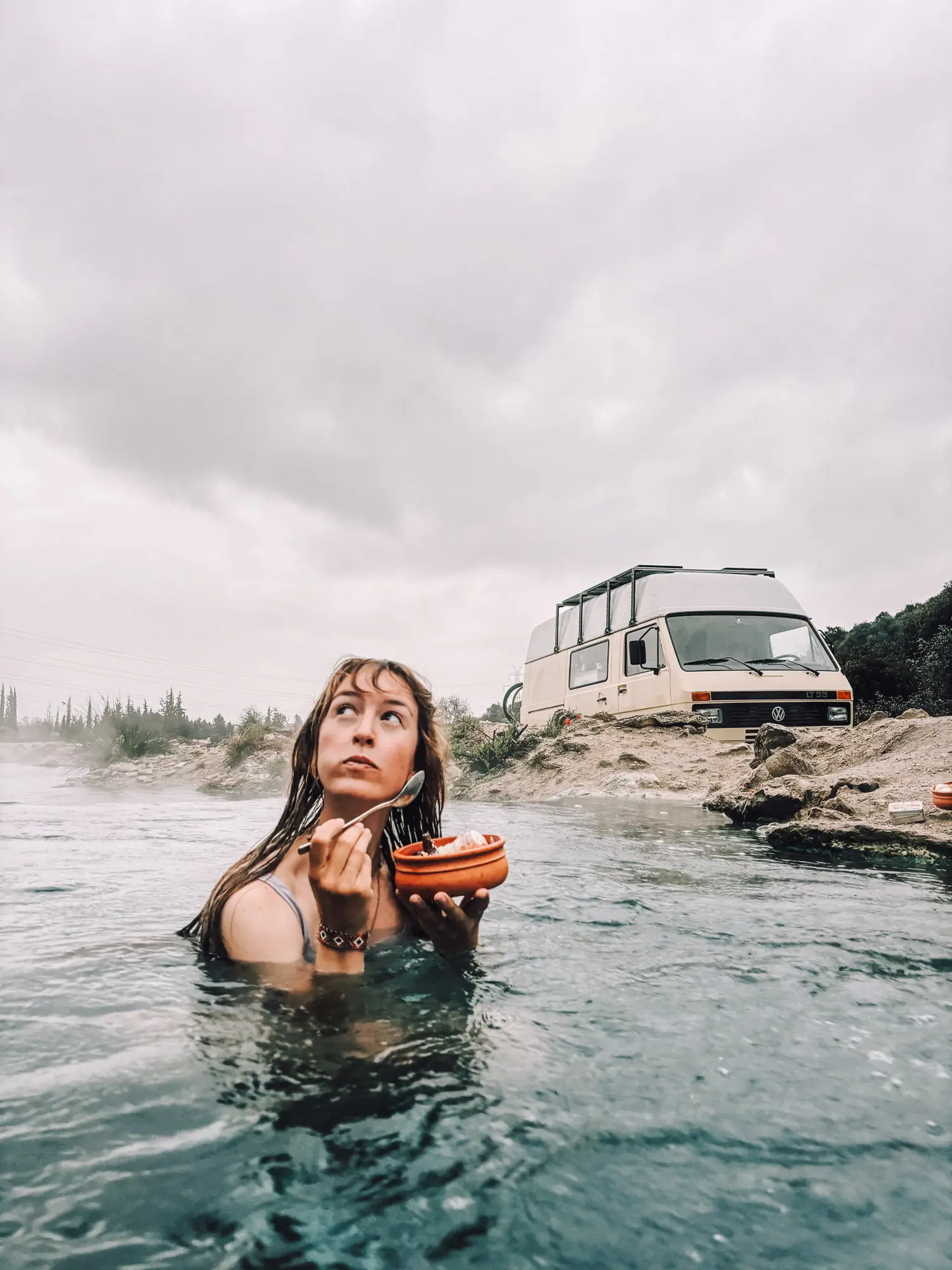

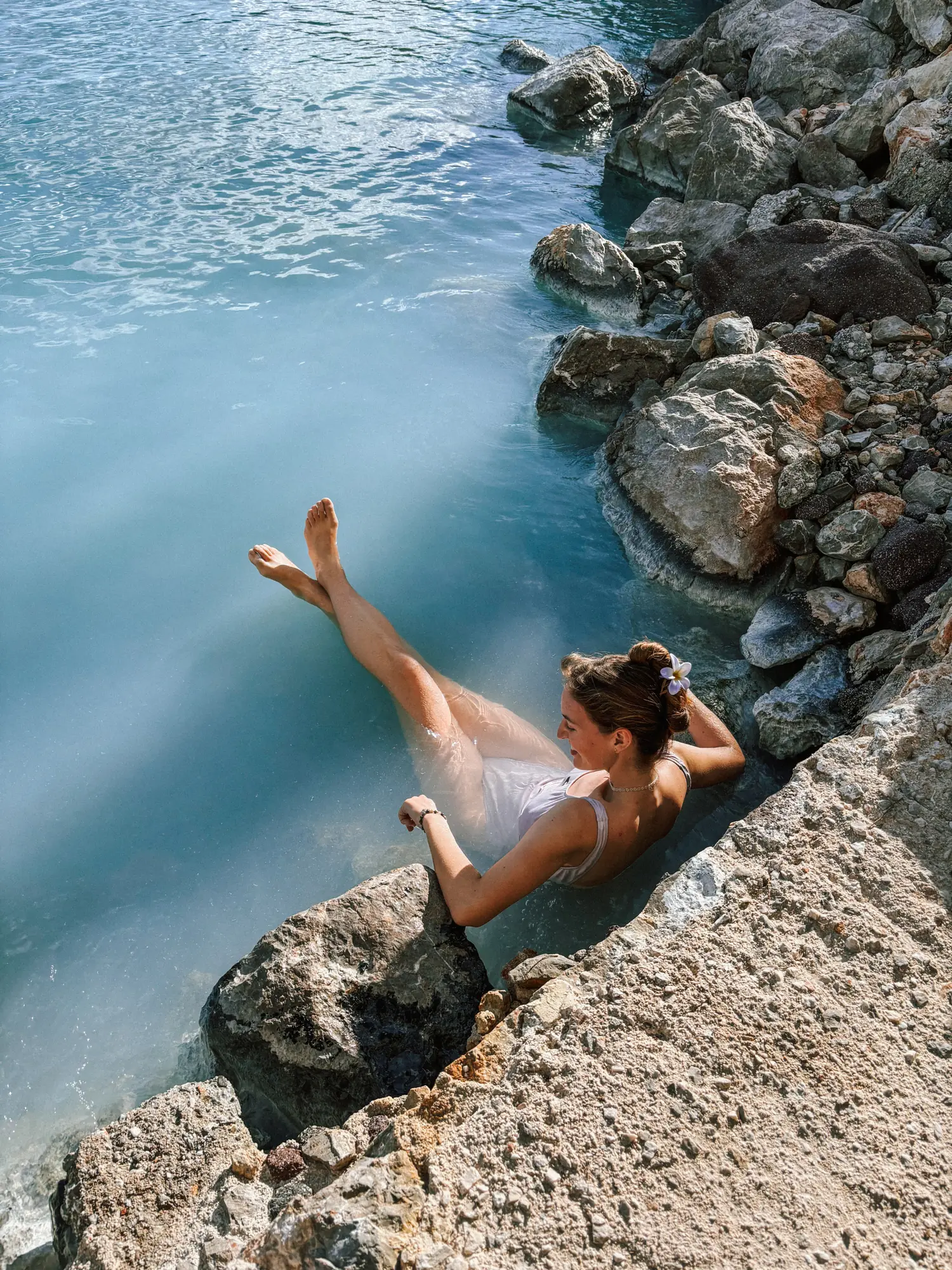
Wellness in the sea
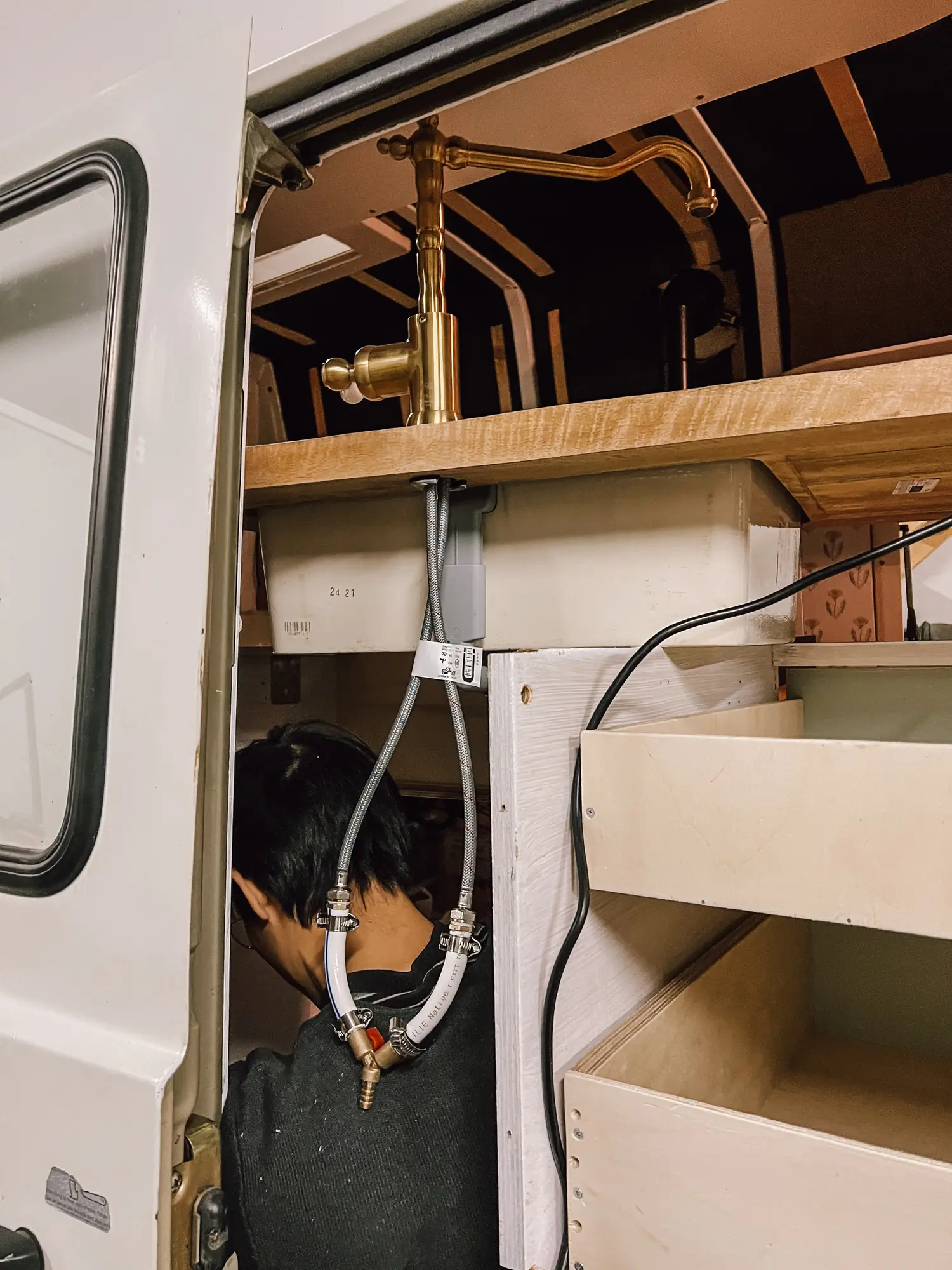
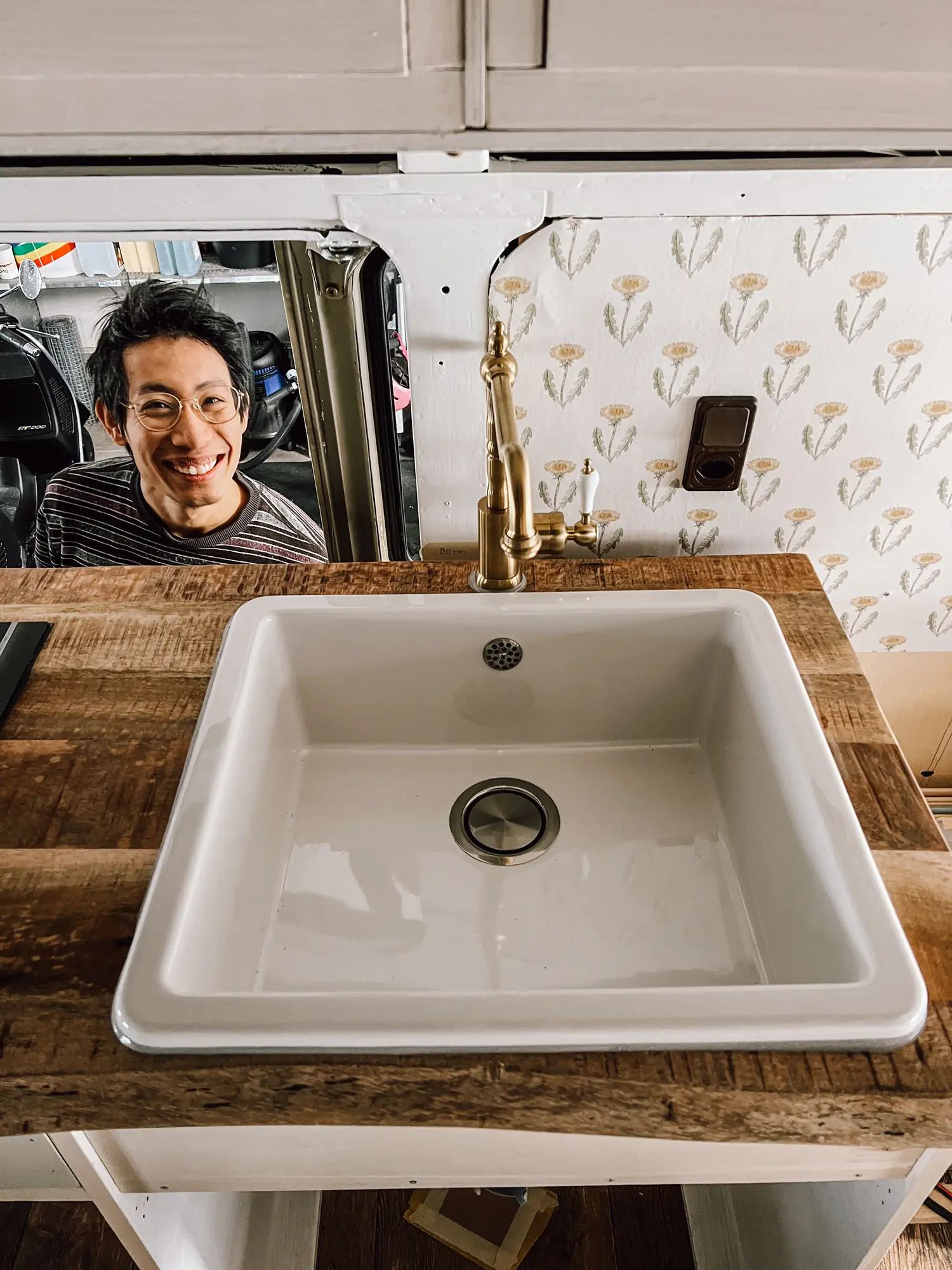
How did we manage to fit an ordinary household tap in the camper?
The installation is fairly simple in principle. Hardware stores sell adapter pieces that let you connect an ordinary household tap to a camper's pipework.
With the pump, though, you do have to make sure it suits the pressure required and the tap you are using. Which connectors and adapters you need depends on the tap itself and on the pipework you have.
Do you have more questions about our water system?
Then please do write to us!
With 🐿️ by Evelyne
Wassersystem, Humbär
Unser Van verfügt über ein qualitativ hochwertiges und modernes Wasser-Setup. Mit unserem Filtersystem können wir unterwegs eine sehr gute Wasserqualität geniessen und dank unseres grosszügigen Frischwassertanks zudem mehrere Tage frei stehen. Das System ist vergleichsweise einfach aufgebaut und wir konnten es selbst ohne Vorerfahrung in diesem Bereich zusammenbauen. Hier erfährst du, was unser Wassersystem alles beinhaltet, wie es aufgebaut ist und welche Erfahrungen wir damit gemacht haben.
Gebaut haben wir es in unseren VW LT35. Gebunden ist das System aber nicht daran: Es besteht aus frei erhältlichen Einzelteilen und lässt sich genauso in jeden anderen Campervan, Kastenwagen oder ins Wohnmobil übernehmen. Was sich von Fahrzeug zu Fahrzeug ändert, sind vor allem die Tankgrössen und der Platz, an dem die Tanks sitzen.
Kurz für alle, die nur die Filter suchen
Wir filtern mit dem Alb Filter Pro Camper Set, dazu der Protect Vorfilter beim Befüllen und die Nano Keimsperre vor dem Hahn. Über unseren Link bekommst du aktuell 10 % Rabatt darauf.
Zum Pro Camper Set mit 10 % Rabatt (Werbelink)
10 % statt 5 %: Alb Filter hat den Rabatt für unsere Leserinnen und Leser befristet erhöht. Die 10 % gelten noch bis zum 8. Oktober 2026, danach sind es wieder dauerhaft 5 %. Der Rabattcode lautet weltenhummler.
Unser Aufbau, einfach und zuverlässig
Skizze unseres verbauten Wassersystems
Das Frischwasser läuft über einen Wasserhahnadapter und unseren Wasserzähler in den Wasserschlauch. Bevor es in den Frischwassertank gelangt, wird es durch einen Protect-Vorfilter geleitet. Dieser hält grössere Partikel wie beispielsweise Sand oder Sedimente zurück und schützt damit auch die nachfolgenden Filterstufen.
Anschliessend läuft das Wasser durch eine Active-Kartusche mit Aktivkohle. Diese reduziert unter anderem Chlor, Geschmacks- und Geruchsstoffe sowie verschiedene organische Schadstoffe und weitere unerwünschte Stoffe. Danach gelangt das gefilterte Wasser in unseren Frischwassertank, wo es gespeichert wird.
Sobald wir Wasser benötigen, aktivieren wir unsere Wasserpumpe. Sie fördert das Wasser aus dem Frischwassertank in unser Leitungssystem und baut den nötigen Druck auf, damit das Wasser gleichmässig aus der Armatur fliesst. Nach der Pumpe wird das Wasser durch die Nano-Keimsperre geleitet. Dabei handelt es sich um eine Hohlfasermembran, die Keime und Bakterien mechanisch zurückhält. Anschliessend fliesst das Wasser durch unsere Armatur und aus dem Wasserhahn.
Das verwendete Wasser fliesst anschliessend über den Siphon ab. Der Siphon bildet eine Geruchsbarriere, da sich darin ständig Wasser befindet. Von dort läuft das Abwasser in unseren Unterflur-Abwassertank.
Abfluss in den Abwassertank unter dem Fahrzeug
Über Tank-Elektroden und eine LED-Anzeige können wir den Füllstand unserer Tanks kontrollieren. Ist der Abwassertank voll, können wir ihn über einen Ablass in einer geeigneten Grauwasser-Entsorgungsstation entleeren.
Wir haben uns bei unserem Wassersystem vorerst gegen eine Warmwasserinstallation entschieden. Ein Warmwasserboiler oder Durchlauferhitzer könnte später grundsätzlich noch nachgerüstet werden. Dafür müsste unser Wasserleitungssystem entsprechend erweitert und das Wasser zum Warmwassergerät bzw. zur Mischarmatur geführt werden. Dementsprechend nutzen wir zurzeit auch die Warmwasserfunktion unserer Mischbatterie nicht.
Sauberes, trinkbares Wasser, jederzeit
Für uns ist es unterwegs besonders wichtig, möglichst unabhängig und flexibel mit unserem Trinkwasser zu sein. Dabei achten wir darauf, unser Wasser nur aus ausgewiesenen Trinkwasserquellen zu beziehen. Unser Filtersystem gibt uns zusätzlich eine weitere Filterstufe, bevor wir das Wasser trinken.
Bei Wasser aus solchen Trinkwasserquellen trinken wir das Wasser nach der Filterung direkt aus unserem Hahn und müssen es nicht zusätzlich abkochen.
Sauberes Trinkwasser dank Alb Filter
Wir filtern unser Wasser mit qualitativ hochwertigen Wasserfiltern von Alb Filter. Je nach verwendeter Kartusche können unter anderem Chlor, Mikroplastik, Arzneimittelrückstände, Pestizide und PFAS reduziert bzw. zurückgehalten werden. Gleichzeitig können Geschmacks- und Geruchsstoffe reduziert werden, wodurch sich auch der Geschmack des Leitungswassers verbessern kann.
Ein weiterer Vorteil für uns: Die von uns verwendeten Filterkartuschen sind so ausgelegt, dass wertvolle Mineralien im Wasser erhalten bleiben.
Und ganz nebenbei sparen wir dadurch unterwegs auch jede Menge Einwegflaschen und können unser Wasser einfach selbst aufbereiten.
So funktionieren die Filter
Du bestellst dir einmalig das Set, welches du für dein Vorhaben benötigst. Bei uns war es das Pro Camper Set von Alb Filter für ein fest verbautes Filtersystem in unserem Fahrzeug. Alb Filter bietet aber auch Filtersysteme für den Haushalt sowie Reisefilter an, die nicht fest eingebaut werden müssen und sich problemlos mitnehmen lassen.
In unserem Set erhalten wir alles, was wir für die Installation benötigen, inklusive eines ersten Sets an Filterkartuschen. Dazu gehören auch die hochwertigen Edelstahl-Gehäuse, in welche die Filterkartuschen eingesetzt werden. Den Protect Vorfilter, den wir beim Befüllen an den Schlauch hängen, gibt es in zwei Ausführungen: als Aluminium-Variante im blauen Gehäuse, so wie bei uns, und als Edelstahl-Variante.
Danach müssen lediglich die Filterkartuschen je nach Nutzung und Wasserqualität regelmässig ersetzt werden.
Langlebigkeit der Filter
Wie lange eine Filterkartusche verwendet werden kann, hängt unter anderem davon ab, wie viel Wasser durch sie fliesst und welche Qualität das Ausgangswasser hat. Je stärker das Wasser mit Partikeln oder anderen Stoffen belastet ist, desto stärker wird der Filter beansprucht.
Bei jeder neuen Kartusche erhalten wir von Alb Filter eine kleine Karte, auf der wir das Datum der Inbetriebnahme notieren können. So behalten wir den Überblick darüber, wann wir die Kartusche eingesetzt haben.
Auch die Durchflussgeschwindigkeit kann ein Hinweis darauf sein, dass ein Filter gewechselt werden sollte. Wenn der Wasserdurchfluss deutlich langsamer wird, kann dies auf einen zugesetzten Filter hindeuten.
Auch die Filter selbst schauen wir regelmässig an. Wenn beispielsweise unser Vorfilter stark verschmutzt ist, tauschen wir ihn entsprechend aus.
Als grobe Orientierung gelten für unsere Kartuschen die vom Hersteller angegebenen Wechselintervalle. Die tatsächliche Lebensdauer kann je nach Nutzung und Wasserqualität variieren.
- Active-Kartusche: ca. 4 Monate
- Nano-Keimsperre: ca. 6 Monate
- Protect-Vorfilter: bei uns aktuell ca. 3 Monate
Gerade beim Vorfilter merken wir, dass die Wasserqualität einen grossen Unterschied macht. Deshalb sind die drei Monate bei uns lediglich ein persönlicher Erfahrungswert und keine allgemeingültige Angabe.
Wenn du gerade ausrechnest, wie oft du nachkaufen musst: Die Ersatzkartuschen bekommst du mit dem Code weltenhummler und 10 % Rabatt (befristet bis 8. Oktober 2026, danach 5 %).
Ersatzkartuschen mit 10 % Rabatt (Werbelink)
Tankreinigung und Hygiene
Ein gutes Filtersystem allein macht noch kein hygienisch einwandfreies Wassersystem. Auch Frischwassertank, Leitungen, Anschlüsse und Wasserhahn müssen sauber gehalten und regelmässig gereinigt werden.
Gerade weil unser Wasser mehrere Tage im Tank bleibt, gehört die Reinigung unseres Wassersystems für uns genauso zur Wasserhygiene wie der regelmässige Filterwechsel. Wir beziehen unser Reinigungsmittel ebenfalls von Alb Filter, den Alb Clean Tankreiniger, und können ihn wärmstens weiterempfehlen.
Wenn du dein Wassersystem selbst planst, würden wir nicht nur in gute Filter investieren, sondern das gesamte System möglichst hygienisch und gut zugänglich aufbauen.
Wenn du an einer Stelle bei deinem Vanausbau nicht sparen solltest, dann hier. Gerade wenn man viel unterwegs ist, kann die Qualität des Wassers je nach Wasserquelle und Land unterschiedlich sein. Wir möchten uns deshalb nicht allein darauf verlassen, dass das Wasser, das irgendwo aus einem Wasserhahn fliesst, automatisch die Qualität hat, die wir uns für unser Trinkwasser wünschen.
Hier geht's zu den Wasserfiltern
Zu den Alb Filter Wasserfiltern mit 10 % Rabatt (Werbelink)
10 % Rabatt mit dem Code weltenhummler, bis zum 8. Oktober 2026. Danach dauerhaft 5 %. Indem du über unseren Link bestellst, sparst du beim Kauf und unterstützt uns gleichzeitig dabei, dass wir noch lange mit Humbär unterwegs sein können. Das würde uns wirklich sehr freuen!
Direkt zu den einzelnen Produkten: Pro Camper Set · Protect Vorfilter · Active Kartusche · Nano Keimsperre · Alb Clean Tankreiniger
Steckbrief unseres Wassersystems
Vom Frischwasser bis zum Abwasser: Das ist alles, was in Humbärs Wassersetup verbaut ist, sauber sortiert nach Funktion.
Frischwasser: Tank und Zuleitung
- Frischwassertank: 84 l, im Fahrzeug hinten rechts
- Wasser-Einfüllstutzen: Lilie, weiss
- Schlauchschellen: Lilie, seewasserfest, 12-22 mm, 2er-Pack
- Universal-Wasseranschluss: HEOSwater Connector (5251)
- Wasserschlauch: Gardena Komplettset, für Trinkwasser geeignet
- Hahnverbinder: Gardena, 21 mm (G 1/2 Zoll)
- Wasserdieb: Gardena
- Wasserzähler: Gardena AquaCount
- Vorfilter: Alb Filter Protect Vorfilter und Alb Filter Active Aktivkohle-Kartusche
- Tankelektrode: Votronic 15-50 K
- Frischwasser-Tankanzeige: Votronic LED-Balkenanzeige, 12/24 V
- Tankanschlussverschraubung: gewinkelt, 40 mm
Frischwasser: Entnahme
-
Druckpumpe: Lilie Soft-Serie LP4142, 11,3 l/min, 2,1 bar
-
Alb Filter Nano Keimsperre: Nano Keimsperre aus dem Alb Filter Pro Camper Set
-
Trinkwasserschlauch: Lilie Native, 10/16 mm, blau, für Kaltwasser, 5 m
-
Y-Stück: 10 mm, mit 2 Absperrhähnen
-
Schlauchtüllen: 2 x 3/8 Zoll, für Haushaltswasserhahn auf 10-mm-Schlauch
-
Tankreiniger: Alb Clean, für Frischwassertank und Leitungen
Spüle und Küche
- Spülbecken: IKEA HAVSEN
- Siphon: IKEA Lillviken
- Abdeckkappe: IKEA Lillviken
- Armatur: IKEA Glittran
Abwasser
- Abwassertank: 53 l, Unterflur (verkauft als Wassertank für den VW T4, 1990-2003)
- Montage-Set: für Wassertanks
- Abwasserschieber: 3", SB
- Tankelektrode: Votronic 12-24 K (Abwasser)
- Abwasser-Tankanzeige: Votronic S, 12/24 V, LED-Balkenanzeige
Gemeinsam genutzt, Frisch- und Abwasser
- Tankanschlussverschraubung: gerade, 40 mm
- Spiralschlauch: 2 x ultraflexibel, 40 mm
- Winkelverschraubung: 4 x zur Wasserentnahme
- Schlauchschellen: 4 x Schneckengewinde, 30-45 mm
Bewusst nicht verbaut
- Warmwasser: kein Boiler und kein Durchlauferhitzer, liesse sich aber nachrüsten
- Dusche: Solardusche aussen am Fahrzeug statt Nassraum im Innenraum
Alle Komponenten sind aufeinander abgestimmt für ein autarkes Frisch- und Abwassersystem. Bei uns stecken sie in einem VW LT35, das System lässt sich aber genauso in jeden anderen Camper oder Wohnmobil-Ausbau übernehmen.
Fragen und Antworten
Wie gross sollten die Wassertanks im Camper sein?
Das hängt natürlich ganz von deinem Wasserverbrauch, deinem Vorhaben und der Grösse deines Campers ab.
Wir haben einen 84-l-Frischwassertank und einen 53-l-Abwassertank verbaut. Mit unserer Frischwassermenge sind wir sehr zufrieden. Sie ermöglicht es uns, bei sparsamem Verbrauch bis zu einer Woche frei zu stehen.
Wir mögen es allerdings, Geschirr mit etwas mehr Wasser abzuwaschen, nehmen das Wasser ab und zu auch zum Duschen und wechseln unser Frischwasser daher am liebsten ungefähr alle fünf Tage.
Unser Abwassertank ist im Unterflur verbaut. Wir hätten ihn gerne etwas grösser gewählt, ca. 70 l wären für uns ideal gewesen, das war aufgrund des Aufbaus unseres Fahrzeugs aber leider nicht möglich.
So ist es bei uns meistens nicht das Frischwasser, sondern das Abwasser, das uns zu einer Entsorgungsstation zwingt. Vier bis fünf Tage hält unser Abwassertank bei unserer Nutzung aber ebenfalls gut durch.
Wie befüllt man einen Frischwassertank?
Wir verwenden zum Einfüllen unseren für Trinkwasser geeigneten Wasserschlauch von Gardena.
An der Wasserquelle wird ein passender Adapter angebracht, an den wir anschliessend unseren Wasserzähler und den Wasserschlauch anschliessen können. Es empfiehlt sich, Adapter mit unterschiedlichen Durchmessern dabeizuhaben, da sich die Anschlüsse je nach Land und Wasserquelle unterscheiden können.
Wir haben zusätzlich einen Wasserdieb dabei. Damit können wir auch Wasser auffüllen, wenn sich unser Adapter nicht direkt an den Wasserhahn anschliessen lässt.
Am anderen Ende des Schlauches montieren wir unseren Protect-Vorfilter und die Active-Kartusche von Alb Filter. So wird das Wasser bereits während des Befüllens vorgefiltert und von verschiedenen unerwünschten Stoffen reduziert bzw. von Partikeln zurückgehalten, bevor es in unseren Frischwassertank gelangt.
Wie kommt das Wasser vom Frischwassertank in den Wasserhahn?
Wir haben eine Druckwasserpumpe verbaut, die wir über einen Ein-/Aus-Schalter aktivieren.
Die Pumpe fördert das Wasser aus dem Frischwassertank in unser Leitungssystem und baut den benötigten Druck auf. Dadurch kann das Wasser gleichmässig aus unserer Armatur fliessen.
Nach der Pumpe wird das Wasser durch die Nano-Keimsperre geleitet. Die darin enthaltene Hohlfasermembran hält Keime und Bakterien mechanisch zurück.
Anschliessend gelangt das Wasser durch unsere Armatur und aus dem Wasserhahn.
Wie duschen wir im Vanlife?
Da unser Fahrzeug nur begrenzt Platz bietet, haben wir uns gegen eine Dusche im Innenraum entschieden.
Wir haben stattdessen eine einfache Solardusche dabei, die wir aussen am Fahrzeug aufhängen können. Bei kälteren Temperaturen erhitzen wir das Wasser für die Dusche in unserem Wasserkocher und füllen es anschliessend in die Solardusche.
Beim Outdoor-Duschen achten wir darauf, biologisch abbaubare Produkte zu verwenden und ausreichend Abstand zu Gewässern einzuhalten.
Wir suchen auch ganz gerne ab und zu eine öffentliche Dusche auf, besuchen Hallenbäder oder nutzen unsere Notfalldusche. Dafür verwandeln wir unseren grossen Küchenwaschtrog kurzerhand in eine kleine «Dusche».
Wellness im Meer
Wie haben wir es beim Camper geschafft, eine haushaltsübliche Armatur einzubauen?
Der Einbau ist im Grunde relativ einfach. Im Baumarkt lassen sich passende Adapterstücke kaufen, mit denen sich eine haushaltsübliche Armatur an das Wasserleitungssystem des Campers anschliessen lässt.
Bei der Pumpe muss jedoch darauf geachtet werden, dass sie für den benötigten Druck und die verwendete Armatur geeignet ist. Welche Anschlüsse und Adapter benötigt werden, hängt von der jeweiligen Armatur und dem verwendeten Leitungssystem ab.
Hast du noch weitere Fragen rund um unser Wassersystem?
Dann schreib uns gerne an!
Mit 🐿️ von Evelyne
Written by

Illustrator, writer & barista
Evelyne Buttet likes African wildlife and everything that can fly or lives above the tree line.